New Delhi: Expressing its concern over the closure of 57 Metro stations and cancellation of trains coming to New Delhi and Hazrat Nizamuddin railway stations due to upcoming protests here, the Supreme Court on Friday observed that the Centre “cannot use a hammer to kill a fly” and ordered that there cannot be complete prohibition.
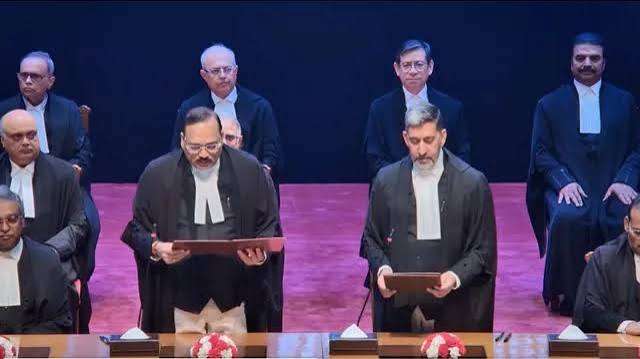
A bench of Chief Justice Surya Kant and Justices Joymalya Bagchi and V Mohana told Solicitor General Tushar Mehta, appearing for the Centre, that the court was concerned with the complete closure of these Metro stations from 9 pm on Friday till further orders, and cancellation of main and express trains.
The top court was hearing a petition challenging the suspension of trains to Delhi and Metro services in the national capital ahead of the protests announced by the Cockroach Janta Party (CJP) and opposition parties demanding the resignation of Chief Election Commissioner (CEC) Gyanesh Kumar.
The senior lawyers also mentioned before the Bench the Delhi Police’s decision not to grant permission for the protest.
But since there was no petitioner or an aggrieved party to challenge the Delhi Police decision, the Supreme Court did not consider the issue.
However, taking cognisance of the hardships and inconvenience that may be caused to citizens, the Bench asked the government to reconsider the prohibition and allow operation of metro train and train services in a regulated manner.
Solicitor General Tushar Mehta, who appeared for both Delhi Police and the Centre, agreed to the Supreme Court’s suggestion.
He, however, told the Bench that he cannot give any assurance about what steps would be taken since he cannot foresee what might unfold Saturday. “Regulation would be as per the situation that will arise. Some leeway has to be given to the security forces,” he told the Bench.
“There is a distinction between complete prohibition and regulation. Solicitor General has fairly agreed to impress (upon) the authorities to reconsider the prohibition and allow metro operations and rail services so that people do not face hardship or inconvenience while traveling inside the city,” the Bench said.
It also said that restrictions must be put in place keeping in mind the principles of proportionality, adding that the authorities must widely publicise preventative measures being implemented so that citizens do not suffer. The Bench also said that free flow of traffic should happen and that the police must issue a traffic advisory to inform the public about possible blockades in sensitive areas.