



Sanjaya addressed Dhritarashtra with a voice heavy with concern. “O King,” he said, “Bhīmasena moves across the battlefield like the blazing midday sun, radiating irresistible power. The arrows released from his mighty bow resemble streams of living fire, consuming everything before them. Unable to withstand his terrible assault, your warriors abandon their positions in fear and flee beyond the reach of his dreadful gaze. The confidence that once filled the Kaurava ranks has withered beneath the storm of Bhīma’s wrath.”
Yet, amid the glory of battle, Bhīma’s heart was troubled. Thoughts of Arjuna filled his mind, and anxiety weakened the intensity of his attack. Turning to his faithful charioteer Visoka, he spoke with deep concern. “Arjuna has gone in search of our elder brother, Yudhishthira. If he has witnessed the King’s sorrowful condition, his own spirit may also have sunk into grief. Should misfortune befall both my brothers, the destruction of the Kaurava army would bring us no satisfaction. Victory itself would become meaningless. This thought consumes my heart without mercy. There remains no remedy for such grief. Only the destruction of Duryodhana, the commander of our enemies, and the principal leaders of his army can offer even the smallest measure of relief.”
Steadying his mind, Bhīma surveyed the enemy ranks and instructed Visoka, “Observe their banners and royal insignia. Tell me how their divisions stand, and also examine the stock of our weapons.” Visoka smiled with unwavering confidence and replied, “My lord, whenever your righteous anger rises, your enemies either perish or flee in terror. Do not trouble yourself over our weapons. Six cartloads of arrows and divine missiles remain untouched. Your strength is itself the greatest weapon. With your mighty arms, no task against the enemy is impossible.”
These reassuring words revived Bhīma’s spirit. Grasping Visoka’s hand with affection, he declared, “Now witness the sport of battle. I shall transform this dreadful war into an arena of heroic achievement and sweep away our enemies.” His thoughts turned to Vidura, whose wise counsel had echoed through the royal court during the infamous game of dice. Vidura had lamented that the gambling match had been arranged with deceitful intentions and predetermined injustice. He had also declared with certainty that the brother of Dharmaraja would never utter falsehood and that every vow spoken by Bhīma would one day be fulfilled. Remembering those prophetic words, Bhīma reflected, “At this critical hour, there is none beside me to advise the best course of action. Yet my divine guide, who is as a revered teacher and protector, will direct my mind toward the wisest path.”
Raising his head with renewed determination, Bhīma carefully examined the distant battlefield. He noticed great confusion among the Kaurava divisions, their formations collapsing as soldiers ran in disorder. Instantly he understood that Arjuna must have pierced their lines. Visoka, whose experienced eyes missed nothing upon the battlefield, cried out joyfully, “Arjuna is there! He has plunged into the mighty Kaurava elephant corps. The banner bearing Hanuman shines brilliantly, flashing like lightning dancing across banks of dark rain clouds. Behold the radiant form of Krishna guiding the celestial chariot, while the sparkling jewels upon Kiriti’s crown illuminate the battlefield.”
Hearing this welcome news, Bhīma’s joy overflowed. Every limb thrilled with renewed energy. Turning to Visoka, he said warmly, “You have gladdened my heart with this blessed news. As a token of my gratitude, I shall reward you with one hundred servants, twenty magnificent horses, and fourteen prosperous villages.”
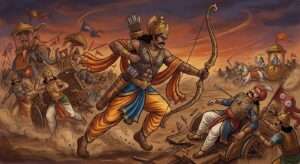
Meanwhile, Arjuna carved a devastating path through the enemy. His irresistible arrows felled the heads of mighty elephants, and he urged Krishna to steer the chariot swiftly toward Bhīma. Sanjaya continued his narration. “As Arjuna pursued the Kaurava cavalry, countless warriors converged upon him with fierce determination. Yet he shattered all four divisions of their army in moments. The tumult created by his advance echoed across the battlefield like the mighty sound produced when Mount Mandara churned the Ocean of Milk. Broken banners, shattered royal umbrellas, torn fans, splintered bows, and countless arrows covered the earth like ornaments strewn upon a sacrificial altar.”
Arjuna was driven by a single purpose—to confront Karna. Sweeping aside every obstacle, he reduced hundreds of chariots and their valiant warriors to ruin. Nearly four hundred chariots fell beneath his irresistible assault. The courage of the Kaurava soldiers melted away, and fear replaced their martial spirit. Many abandoned the field in panic. Yet Karna’s indomitable courage rekindled the confidence of his warriors, inspiring them once again to stand against the sons of Pandu.
Seeing Karna before him, Arjuna advanced with the majesty of Garuda descending upon a vast assembly of serpents. At the same moment, Bhīma rushed forward with the irresistible speed of the wind. His arrows shattered the weapons of countless warriors and spread terror throughout the hostile ranks. Witnessing Bhīma’s devastating advance, Duryodhana cried to his commanders, “If Bhīma survives, the Pandavas cannot be defeated. Surround him from every side and destroy him without delay.”
The Kaurava warriors closed around him like hunters surrounding a mighty beast. Yet Bhīma broke through their encirclement as a fierce shark tears apart the strongest fishing net before plunging into the open sea. His weapons devastated the enemy formations. The battlefield became a dreadful river of blood, where severed heads floated like turtles upon crimson waters, while dismembered arms twisted like serpents carried by the current.
Desperate to halt Bhīma’s advance, Duryodhana urged Shakuni into battle. The crafty prince rushed forward, releasing a relentless shower of arrows upon Bhīma’s broad chest. Unmoved, Bhīma answered with countless shafts, but Shakuni displayed remarkable skill, intercepting them in mid-flight. Smiling fiercely, Bhīma shattered Shakuni’s bow, but the Gandhara king instantly seized another and launched sixteen brilliantly shining arrows with deadly precision. They struck Bhīma with tremendous force, bruising his ribs and causing intense pain. His banner crashed to the ground. His horses neighed in agony, while blood flowed from the wounded body of his faithful charioteer, whose muscles had been torn by the attack. Delighted beyond measure, Duryodhana loudly praised Shakuni’s remarkable feat.
Enraged beyond restraint, Bhīma seized the formidable Shakti weapon, blazing like the very tongue of Yama, and hurled it toward Shakuni. Displaying astonishing dexterity, Shakuni caught the celestial weapon and hurled it back. It struck Bhīma’s arm with tremendous force, wounding him severely. The Kaurava warriors erupted into triumphant shouts.
Unable to endure their arrogant celebration, Bhīmasena rose with terrible fury. Taking up another mighty bow, he shattered Shakuni’s weapon, then pierced him with a succession of razor-edged arrows. The impact was overwhelming. Shakuni collapsed unconscious upon the battlefield. Seeing his maternal uncle fallen, Duryodhana rushed forward, lifted him into his chariot, and carried him away beyond the sight of the Pandava warriors. Fear spread instantly among the Kaurava commanders. Their confidence dissolved; the division leaders fled in every direction, and the common soldiers followed in terrified retreat. Sanjaya paused briefly before continuing his solemn narration, preparing to recount the next dramatic turn in the great war of Kurukshetra.

