



Dhritarashtra’s mind ran wild with anxiety, eager to know the unfolding events and to untie their significant threads so that he might conclude the strength and destiny of his posterity, and when Sanjaya continued his report of the disturbance and altercation between the grandsire and Karna, the king was further troubled.
After rebuking Karna, the grandsire gathered his focus and spoke with authority, “Son of a charioteer, King Duryodhana has placed a heavy burden upon my head and reposes complete faith in me. In such circumstances, dispute is unwise, and therefore I endured your superfluous discourse. That restraint alone preserved you. Utter not a single word further,” and having spoken thus, he remained serious and silent.
Then Duryodhana addressed the grandsire, “You should not grow angry at this stage. Keeping in mind the severity of our task and my own welfare, kindly bear these inconsistencies. You both must work in unison and fulfill my ambition, dissolving all differences,” and this attitude calmed both warriors.
Thereafter Duryodhana requested that the capabilities and strength of the Pandavas be presented, and the grandsire replied, “If I clearly reveal their prowess, Karna’s mind will be perturbed, and I am uncertain of your response after hearing my assessment. Why do you draw me into such a complex situation?” To this Duryodhana answered, “It is only you who can assess their resources better than anyone. I am ready to give weight to every word you utter,” and upon this assurance, Sanjaya said to Dhritarashtra that Bhishma set himself to explain.
“O King,” said Bhishma, “Dharmaraja, blazing like fire, is an Atiratha, irresistible in the field of war. Bhima stands foremost among the Atirathas, endowed with transcendental physical power, his chivalry beyond comparison. Nakula and Sahadeva are Samarathas; their sinew, courage, and fearlessness are unrestrainable, and standing at the front of the forces, they offer fierce resistance to their enemies. By pride of merit and the power of penance, the Pandavas stand superior to common men; they have mastered all six limbs of Dhanurveda and gained full command of archery, and they can steadfastly withstand the onslaught of foes. Their enemies cannot comprehend their warcraft and strategy; each has proved his valor individually, and when united against our forces, they will cause them to fade away.”
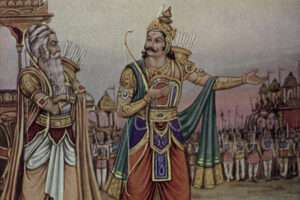
“They have come to confront us, kindled by past humiliation and hardened by hardship, transformed into vengeance; therefore, they will not easily turn back but will fight until victory or embrace death, caring nothing for their own lives, and to withstand such spirit is most difficult.”
“Suyodhana, it is not possible to describe to you the mighty battle qualities of Phalguna. Never have I seen such a warrior, nor shall we behold his equal in times to come. That royal tiger is ever supported by the all-pervading Srihari. What more needs to be said? He alone guards his forces with the blessed Gandiva, and he cannot be subdued by any power.”
At this narration, the assembly was clouded by sorrow, and again Bhishma spoke, “The sons of Panchali—Prativindhya, Shrutasoma, Shrutakirti, Satanika, and Shrutasena—are all Maharathas. Uttara stands equal to them, and Abhimanyu, the son of Arjuna, stands foremost among the Atirathas, equal to Krishna and Arjuna, having learned all techniques of war. Heroism is his pastime, yet he is pious and tolerant, ever mindful of the hardships endured by his parents, and he confronts battle with poised courage.”
“Satyaki stands as a tall and ornamented crest among the Atiratha lineage, heroic in every endeavor and ever concerned for the welfare of the Pandavas; therefore, he fiercely opposes our forces, fighting with incomparable techniques and testing the mettle of warriors. This pair will bring manifold challenges upon our hosts and trouble them beyond measure.”
“King Drupada of Panchala and King Virata of Matsya are famed for their physical strength; both are intelligent strategists and Atirathas, bound closely to the Pandavas and laying all their might to lead them to victory. They leap into battle, staking their lives for the sons of Pandu.”
“Shikhandi is a Maharatha, powerful, driven by single-minded resolve and a single purpose, fighting to the death for the Pandavas. His birth signifies vengeance from a former life, transformation of form, and the fulfillment of destiny, being born from the vow of Princess Amba to defeat him who once rejected her. Reborn as Shikhandi, daughter of Drupada and later a male warrior through the boon of a Yaksha, he stands before Bhishma, who would not fight one born as a woman, and thus becomes the cause of Bhishma’s downfall on the field of Kurukshetra.”
“The son of Dhrishtadyumna, Dhrishtavarma, though wandering, unfocused, and foolish, is strong and persistent, an Ardha-ratha. King Drishtaketu of Chedi, son of Shishupala, is a daring Maharatha, and Bhoja and Aja, both kings, are his allies and Maharathas, strong and courageous. The race of Panchala shines with the birth of Uttamauja, Yudhamanyu, Kshatradeva, Jayanta, Amitauja, Virata, and Satyajit; these seven warrior kings are Maharathas, who leap like wild tuskers upon the battlefield, scattering enemy forces, creating tumult by their swift and mighty action.”
“The five brothers of the Kekaya dynasty are all Maharathas and proven heroes, inundating enemy hosts like a forest fire. The kinsmen of Virata—Kashisha, Neela, Suryadatta, Madhiraksha, and Shankha—are Maharathas and invincible in battle, proficient archers and masters in the use of many weapons and the science of war, whose united combat is fierce and unbearable to enemy camps.”
“Chekitana and Chitrayudha are Maharathas, genuinely devoted to Arjuna, effective in war sport, and learned in the use of shastras and astras, terrible in the field of battle. The same qualities are possessed by Chandradatta and Vyaghradatta, jewels among the Atirathas. Senabindu is an Atiratha, inheriting the efficiency and prowess of all these kings. The Pandya king is an Atiratha, commanding vast and trained forces. King Kashi is a Samaratha. Kuntibhoja is an Atiratha, adept in warcraft, his forces powerful and proven. King Rochamana is a mighty Maharatha, excelling warriors and standing equal to the celestials.”
“Ghatotkacha, born of a demoness, is an Atiratha, equal to his father Bhima in strength, lord of the Rakshasas, endowed with magical powers, conquering enemies as if in sport, and commanding immense demonic hosts. These are those whose prowess remains within my living memory. In both camps stand fierce warriors. Though the warriors of the Pandava forces are strong and formidable and cannot move before me, I cannot move Shikhandi even an inch, nor can I slay him.”
Then Duryodhana asked how Shikhandi escaped the grandsire’s power and strength, and Bhishmacharya replied that there were valid reasons and events of the past for his decision and that these should be heard.
Sanjaya then said to Dhritarashtra that the grandsire had displayed extraordinary might to retain the king’s confidence in him, being concerned about the apprehensive forces of Karna and his allies, and that it was necessary to strengthen Duryodhana’s confidence through a truthful presentation. Dhritarashtra was satisfied with these efforts and eager to know more, and though the genuine strength of the opposing camp had shaken the assembly, by awakening their awareness the chief of the army, Bhishma, sought to present with clarity the historic happenings connected with the Kuru dynasty.

