MS Shanker
The political landscape of Tamil Nadu appears to be entering an entirely new phase. For the first time since 1967, the state has moved beyond the traditional dominance of the two towering Dravidian formations — the Dravida Munnetra Kazhagam and the All India Anna Dravida Munnetra Kazhagam.
The emergence of Joseph Vijay and his party, Tamilaga Vettri Kazhagam, as the single largest political force has undoubtedly altered the political conversation in the state. Whether this becomes a lasting political transformation or merely a temporary electoral disruption remains the larger question.
What cannot be denied, however, is that Vijay’s rise represents a major shift in voter behaviour, especially among younger voters and first-time electors who appear increasingly detached from the emotional loyalties that once firmly tied Tamil Nadu politics to the DMK-AIADMK binary.
For decades, Tamil Nadu voters alternated power between the two Dravidian camps with remarkable clarity. But the passing of two towering personalities — M. Karunanidhi and J. Jayalalithaa — created a political vacuum that neither side has fully managed to fill. The charisma-driven stability that once anchored Dravidian politics gradually weakened, opening the door for another film personality to capture the imagination of the electorate.
Tamil Nadu’s political history has long witnessed cinema and politics walking hand in hand. From M. G. Ramachandran to Jayalalithaa, screen popularity has often translated into political capital. Vijay’s rise therefore is not entirely unprecedented. Yet, the circumstances are different this time. Earlier cinematic icons entered politics through strong ideological or organisational frameworks. Vijay, by contrast, is attempting to build an entirely new political structure amid a fractured mandate.
That fractured verdict is perhaps the most significant takeaway from this election.
While TVK emerged as the single largest party, both the DMK and AIADMK still retained substantial vote share and a respectable legislative presence. The DMK securing 59 seats and the AIADMK 47 clearly indicates that the Dravidian movement is far from politically extinct. Writing its obituary at this stage would be premature.
Rather, what Tamil Nadu may now be witnessing is the beginning of coalition-era instability — something relatively uncommon in the state’s post-1967 political history.
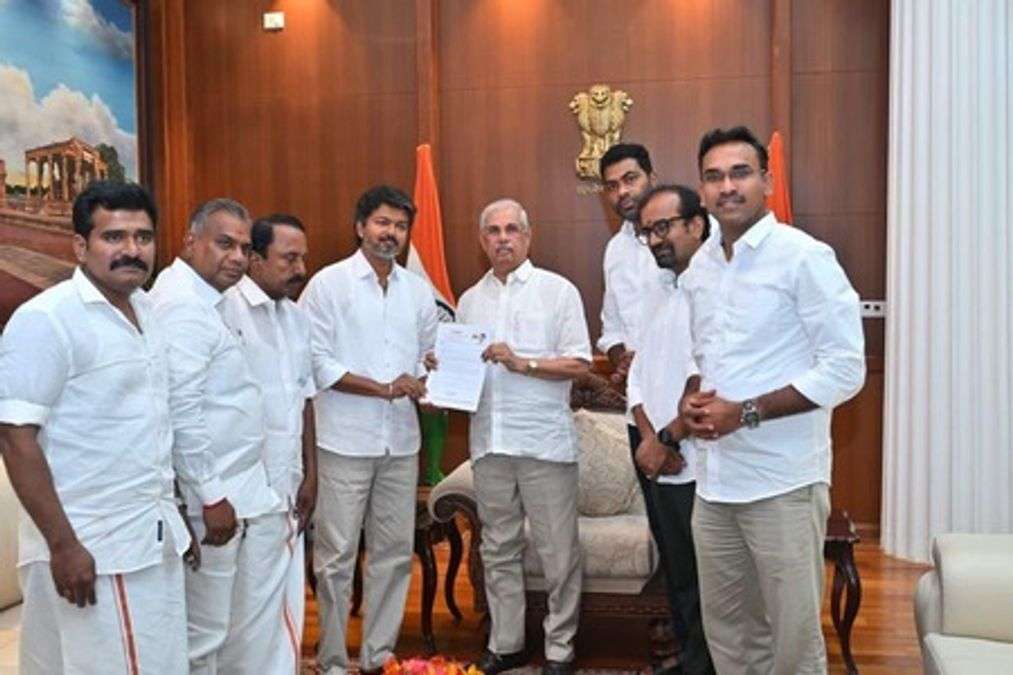
The role of the Governor too has triggered intense debate. Yet constitutionally, the Governor’s responsibility is to determine whether a claimant can demonstrate legislative support required to form government. Once Vijay furnished letters of support from other parties, the invitation to form government became procedurally defensible, regardless of political disagreements surrounding it.
What has surprised many observers is the nature of the coalition arithmetic itself.
The support extended to TVK has come from parties with widely divergent ideological positions — including the Indian National Congress, Communist Party of India, Communist Party of India (Marxist), Viduthalai Chiruthaigal Katchi and the Indian Union Muslim League.
This arrangement raises inevitable questions about long-term sustainability. Outside support in Indian politics has historically proven unpredictable. Coalition partners often extend support not out of ideological alignment but political convenience. The moment contradictions sharpen, governments become vulnerable.
That is why many political observers believe Vijay may have rushed too quickly toward power instead of consolidating his political base from the Opposition benches. In parliamentary democracy, sometimes refusing office can strengthen political legitimacy more than hurriedly occupying it.
Had TVK declined government formation citing lack of absolute majority, the political burden would likely have shifted back onto the Dravidian parties. That scenario could have produced either an uneasy alliance or another unstable arrangement, potentially allowing Vijay to return stronger in a future election with a clearer mandate.
Instead, TVK now inherits the enormous burden of governance at a difficult economic moment.
Like several state governments across the country, Tamil Nadu faces mounting fiscal pressures, welfare commitments, and infrastructure financing challenges. Governance under such circumstances demands not merely popularity, but administrative depth, coalition management skills, and ideological clarity. Apart from these, his own party’s election manifesto promises like six free LPG cylinders and gold to newly marrying couple, besides others.
This is where the real test for Vijay begins.
His critics also argue that despite presenting himself as an alternative to both the DMK and the BJP, TVK’s political positioning on cultural and religious issues appears ambiguous. The charge frequently levelled against Dravidian politics — particularly by its opponents — is that of selective secularism and perceived hostility toward overt Hindu symbolism while accommodating minority identity politics.
In that context, Vijay’s own campaign imagery and alliances have drawn scrutiny from critics who accuse regional parties of practising political double standards on religious symbolism. Supporters, however, would argue that such symbolism reflects personal faith and democratic plurality rather than communal politics. The debate itself reflects the growing ideological churn underway in Tamil Nadu.
What appears increasingly evident is that Tamil Nadu politics is entering a transitional phase where identity politics, generational shifts, coalition compulsions, and national political currents are colliding simultaneously.
The BJP, though still not electorally dominant in the state, may also seek to leverage these changing dynamics by attempting a stronger Hindu consolidation narrative, similar to strategies witnessed in states like West Bengal and Assam. Whether such political realignment succeeds in Tamil Nadu — a state with a deeply entrenched Dravidian socio-political identity — remains uncertain.
But one conclusion is unavoidable: Tamil Nadu has entered unfamiliar political territory.
The era of unquestioned one-party Dravidian dominance appears shaken, though certainly not dismantled. Vijay’s rise has disrupted the established order, but whether he becomes a transformative political force or merely a transitional phenomenon will depend entirely on how he navigates governance, coalition contradictions, economic pressures, and ideological expectations in the months ahead.
Tamil Nadu may not yet be witnessing the end of Dravidian politics. But it is certainly witnessing the beginning of post-certainty politics.