Lakshmanrao Upadhyayula
The hymn associated with Trasadasyu, son of Purukutsa, presents a remarkable meeting point of kingship, spirituality, cosmic order and human aspiration. It occurs in the Fourth Mandala of the Ṛgveda, in the celebrated hymn 4.42, addressed to Indra and Varuṇa. The voice of the hymn is powerful and deliberately expansive: the speaker identifies himself with the authority and attributes of the divine rulers, expressing the ideal of a Kṣatriya whose sovereignty is not merely political but rooted in ṛta—the universal order that sustains existence.
The opening declaration, “I am the ruler of the Kṣatriya realm,” should not be understood merely as an expression of personal pride. In the Vedic imagination, kingship carries a sacred responsibility. The ruler is expected to preserve order, protect people, uphold justice and ensure the prosperity of the land. The hymn therefore places sovereignty within a larger cosmic framework: the ruler belongs to a world in which human society, divine powers, natural forces and moral law are interconnected.
The hymn speaks of two great dimensions of authority represented through Indra and Varuṇa. Indra embodies dynamic power, courage, initiative and the ability to overcome forces that obstruct life. Varuṇa represents sovereignty, moral restraint, cosmic law and the mysterious order through which heaven and earth remain governed. Their conjunction is therefore deeply significant. Power without moral discipline can become destructive, while moral order without the strength to defend it can become ineffective. The hymn imagines ideal sovereignty as the union of strength and righteousness.
The declaration that the people belong to the ruler is equally significant when understood in its Vedic setting. It does not simply imply ownership of human beings. Rather, it conveys the intimate responsibility of the king toward the community. The people, cattle, waters, fertile fields and prosperity of the kingdom constitute an interconnected sphere of protection. The true ruler is therefore measured not merely by military victory but by the flourishing of the society entrusted to him.
The hymn then expands from political sovereignty into cosmic dimensions. Indra and Varuṇa are associated with the vastness of heaven and earth, with the waters and with the maintenance of the ordered universe. The imagery suggests that the ancient Vedic mind did not sharply separate the physical world from the moral and spiritual worlds. The regular movement of waters, the stability of heaven and earth, the fertility of the land and the righteous conduct of human beings were understood as different expressions of an underlying order.
This aspect gives the hymn a distinctive scientific temperament. The Vedic poet observes nature as a system governed by regularity, relationship and transformation. Water is not merely a religious symbol; it is indispensable to agriculture, fertility and survival. The prayer for abundant waters and productive fields reveals an awareness of the dependence of civilization upon ecological cycles. The image of waters being gathered and released evokes the fundamental relationship between rainfall, rivers, cultivation and human prosperity.
The reference to creating and extending the threefold world further reveals the Vedic tendency to perceive reality structurally. Heaven, atmosphere and earth form a connected field rather than isolated domains. The poet repeatedly returns to the idea of boundaries, expansion and stability. Such imagery reflects an intellectual curiosity about the organization of the cosmos and the conditions that make ordered existence possible.
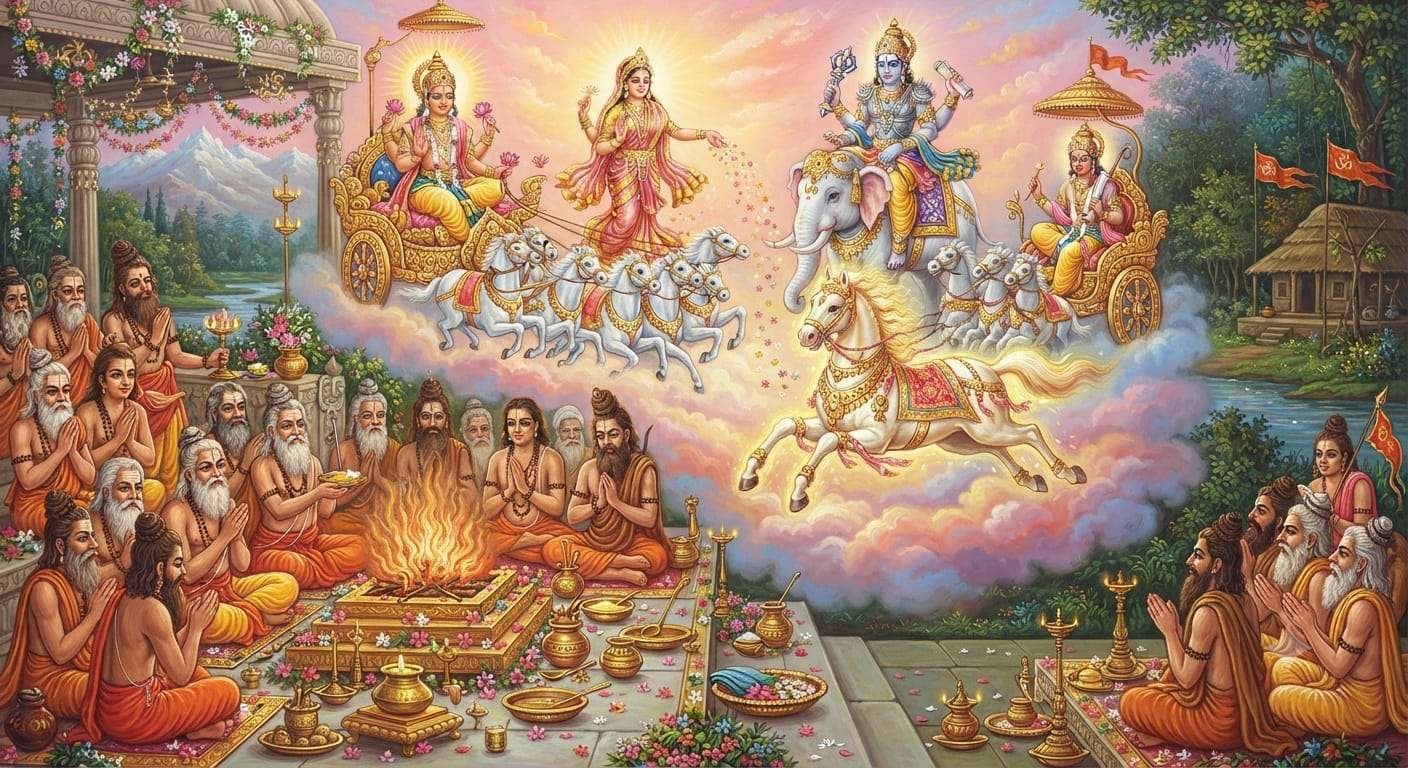
The horses that appear in the hymn are equally meaningful. In Vedic society, the horse represents speed, energy, mobility and martial capability. Warriors who seek battle are portrayed as following the powerful ruler, while the dust raised in combat becomes an image of overwhelming force. Yet the hymn does not glorify violence for its own sake. Victory is associated with strength directed toward the removal of obstruction and the protection of order. The warrior’s ideal is therefore disciplined courage rather than uncontrolled aggression.
The poet declares that no hostile force can easily overcome them because they possess divine strength. Soma, hymns and sacrifice reinforce that strength. Here again, the Vedic worldview reveals an integrated conception of human achievement. Physical courage, intellectual clarity, ritual discipline, communal cooperation and divine inspiration are not treated as competing forces. They are complementary dimensions of a complete life.
The hymn’s treatment of Soma and sacred speech is especially profound. Soma is not simply a ritual substance; within the poetic imagination it represents inspiration, exhilaration and the awakening of higher consciousness. The hymns themselves are living forces. When properly uttered, they establish a relationship between human beings and the cosmic powers. The poet therefore sees disciplined speech as an instrument capable of shaping consciousness and strengthening collective purpose.
Varuṇa’s presence introduces an important ethical dimension. The poet declares that Varuṇa knows the activities of the entire living world. Nothing is outside the sphere of cosmic awareness. This is the foundation of Vedic moral thought: human conduct takes place within a universe governed by ṛta. The individual may conceal an action from other human beings, but cannot ultimately escape the larger order of existence. Varuṇa consequently becomes an image of moral vigilance and universal accountability.
Indra, on the other hand, is celebrated as the destroyer of Vṛtra and the releaser of the rivers. Vṛtra, in the literal-poetic structure of the hymn, represents an obstructing power, while the release of the waters signifies restoration of movement and abundance. The image has both natural and spiritual dimensions. Rain and rivers sustain physical life, while the breaking of obstruction represents the release of energy, knowledge and possibility. The victory of Indra thus becomes a powerful metaphor for overcoming stagnation.
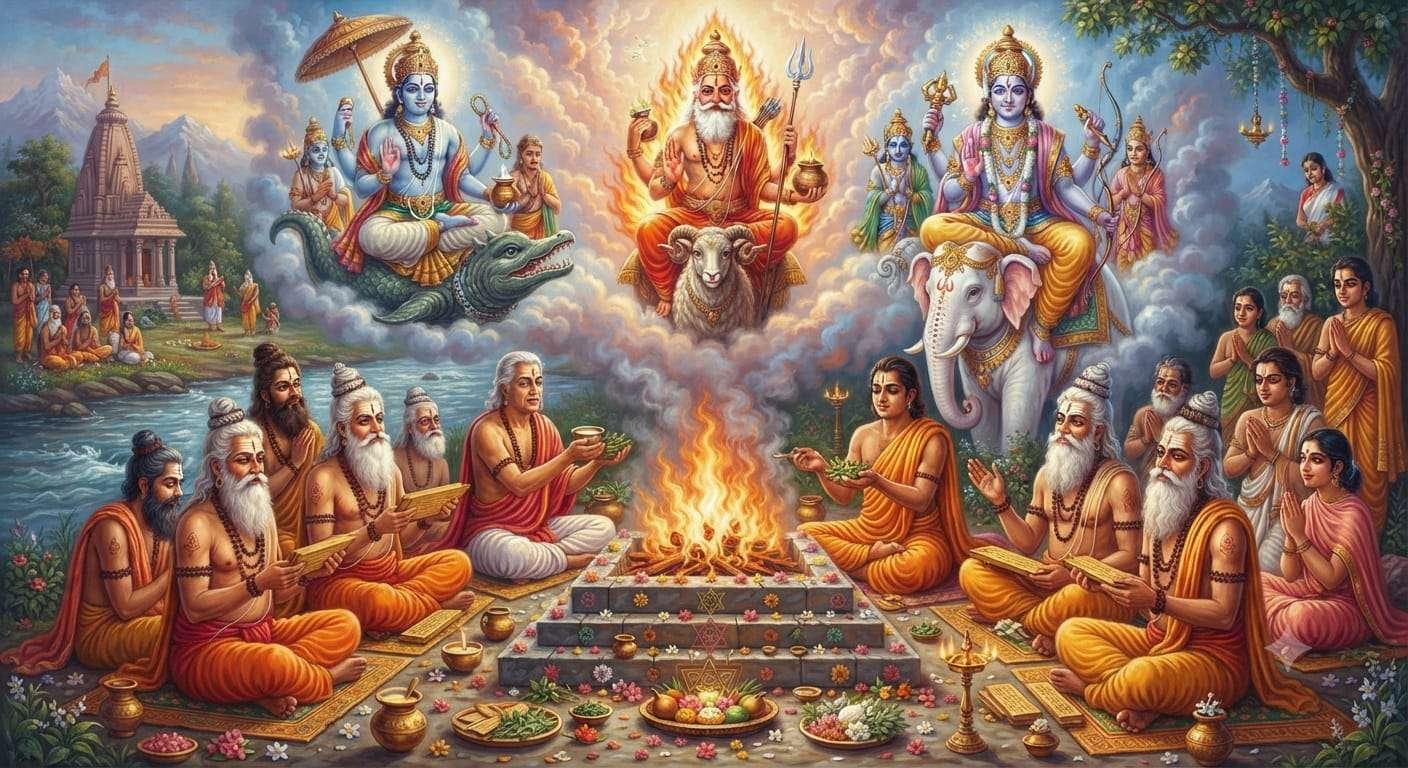
One of the most moving passages recalls the ancestors and the seven sages. The hymn remembers a time when the Purukutsa lineage faced danger and the seven ṛṣis performed the necessary rites. Through their sacrifice and invocation of Indra and Varuṇa, Trasadasyu was brought forth as a powerful protector and enemy-destroyer. The story therefore connects political legitimacy with ancestral memory, spiritual discipline and divine grace.
Purukutsānī, the wife of Purukutsa, occupies an important place in this sacred memory. Through her devotion and offerings to Indra and Varuṇa, the royal lineage receives Trasadasyu. The birth of the heroic son is therefore not presented merely as a biological event but as the culmination of prayer, sacrifice, lineage and divine favour. Trasadasyu becomes a symbol of renewed strength arising when a community remains steadfast during adversity.
The description of Trasadasyu as resembling Indra elevates the king beyond ordinary political authority. Yet this likeness is best understood symbolically. A righteous king should embody the qualities attributed to Indra—courage, decisiveness and the ability to remove destructive obstacles—while also reflecting the qualities of Varuṇa: restraint, justice, vigilance and respect for cosmic law. The ideal ruler is consequently both warrior and guardian.
The hymn also contains an important philosophy of prosperity. Wealth is not sought as an isolated accumulation of possessions. The prayer asks for productive cattle, nourishing pasture, abundant resources, victorious strength and enduring prosperity. The famous Vedic metaphor of the cow as a source of nourishment expresses a larger economic vision in which agriculture, animal husbandry, rainfall, food production and social stability form one system.
This makes the hymn surprisingly relevant to a modern scientific outlook. Its fundamental question is not simply, “How may we become powerful?” but, “What conditions allow life and society to flourish?” Water, food, fertile land, organized society, ethical leadership, disciplined knowledge and protection from destructive forces all appear within the same conceptual field. The Vedic poet observes prosperity as the outcome of interconnected systems rather than as a single isolated achievement.
The prayer to Indra and Varuṇa therefore becomes a prayer for balance. Strength must be guided by wisdom; prosperity must be supported by ecological abundance; authority must be restrained by morality; knowledge must serve life; and human ambition must remain aligned with the larger order of existence. The hymn’s grandeur lies precisely in this integration.
Its concluding prayer is consequently not a narrow demand for victory. The poet asks for enduring wealth, nourishment and protection, comparing human prosperity to cattle sustained by rich pasture. The gods are invited to accept the offerings, while the community seeks a source of abundance that will not diminish. The image suggests continuity rather than temporary success—a prosperity capable of sustaining generations.
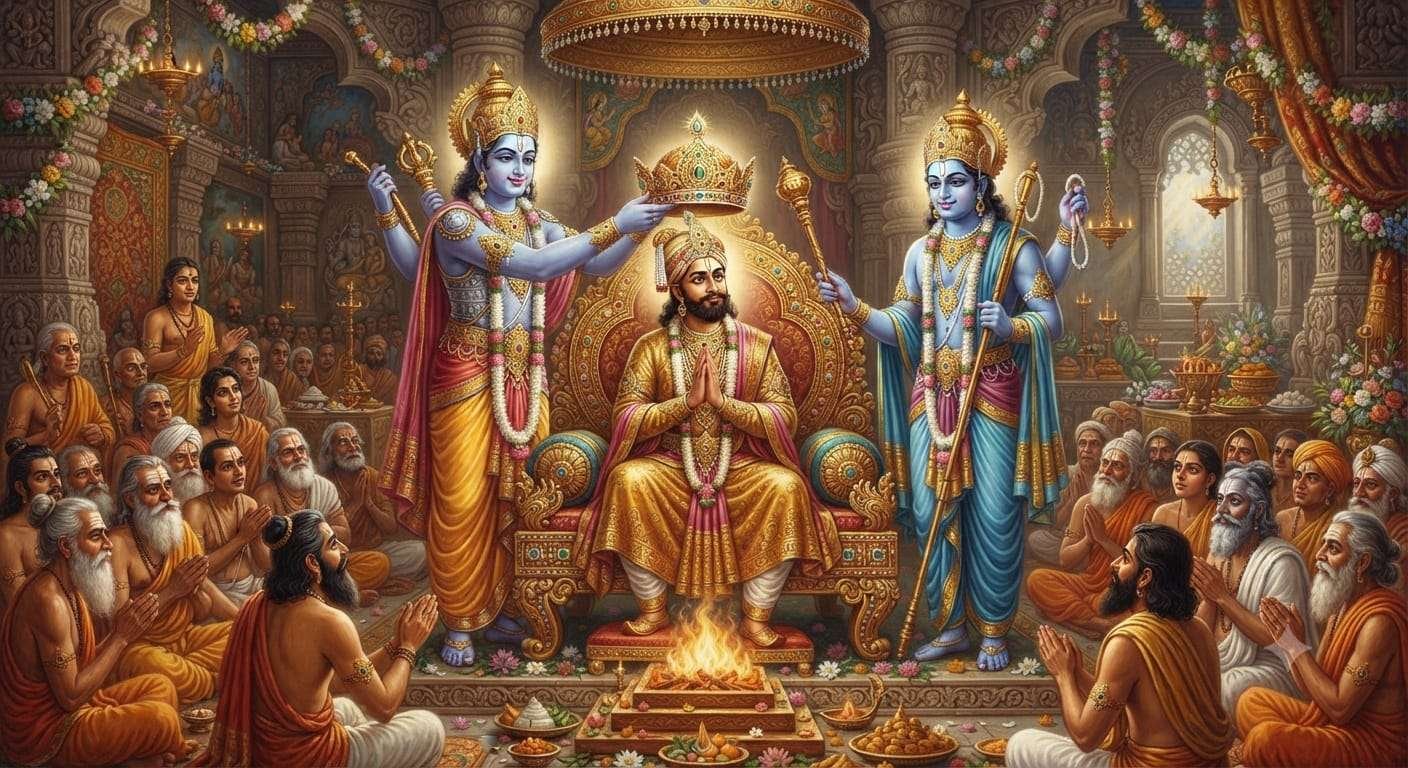
Seen in its full Vedic context, Trasadasyu emerges not merely as a heroic king but as an archetype of responsible sovereignty. His greatness derives from his association with the forces that sustain order: Indra’s strength, Varuṇa’s moral authority, the wisdom of the ṛṣis, the fertility of the waters and the disciplined power of yajña. The hymn transforms kingship into a sacred trust and transforms prosperity into a responsibility toward the whole community.
The deepest message is that civilization survives when power and wisdom walk together. The warrior requires the sage, the ruler requires moral law, agriculture requires water, society requires justice, and human aspiration requires a larger vision of existence. In this sense, the hymn is both spiritual and rational: it looks at the universe with wonder, recognizes patterns in nature, seeks causes behind prosperity and adversity, and places human conduct within an ordered cosmos.
The voice of Trasadasyu finally becomes the voice of humanity itself—confident, courageous and conscious of its immense potential, yet dependent upon forces larger than the individual. To possess strength is not enough; strength must protect. To possess wealth is not enough; wealth must nourish. To possess knowledge is not enough; knowledge must illuminate. And to possess authority is not enough; authority must preserve ṛta.
Thus the ancient hymn presents a timeless Vedic ideal: the truly powerful human being is not the one who merely conquers others, but the one who conquers disorder within himself, protects the community, respects the rhythms of nature and aligns his actions with the universal order. In that synthesis of courage, knowledge, morality, ecology and spiritual awareness lies the enduring magnificence of the Trasadasyu hymn.