



The Aitareya Brahmana presents a profound vision of creation in which the emergence of the universe, the formation of living beings, and the manifestation of consciousness are understood as interconnected dimensions of a single cosmic order. Its account is not merely a sacred narrative describing the actions of the Creator; it invites contemplation of the relationship between the human body, the natural world, the faculties of perception, and the mysterious principle of life. Viewed through a Vedic lens, the narrative reveals that existence is sustained by an intricate harmony between matter, vitality, awareness, and the environment. Read with a scientific temperament, it also encourages us to distinguish the symbolic language of ancient wisdom from empirical explanations while appreciating the enduring philosophical questions that the text raises.
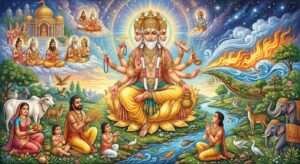
According to the narrative, Lord Brahma, the Creator, brought forth a host of divine beings, including Agni, Vayu, and other cosmic powers. Yet, despite their divine origin, they found themselves confronted by hunger and thirst, struggling to sustain their existence in the vastness of creation. They approached their Creator and requested suitable abodes in which they could dwell and obtain nourishment. Their appeal establishes a fundamental principle: existence requires not only the act of creation but also an appropriate environment, the means of sustenance, and an organised relationship between living beings and their surroundings. The narrative thereby moves beyond the mere appearance of life and directs attention towards the conditions necessary for its continuity.
In response, the Creator fashioned a cow as a possible abode for the divine beings. They examined the form but declared it inadequate for their purpose. He then brought forth a horse, yet they again expressed dissatisfaction. Finally, the human form appeared, and the divine beings recognised its suitability and beauty. The Creator acknowledged that the human form was indeed well fashioned and directed the divine powers to enter their respective abodes. The sequence is philosophically significant. The cow and the horse represent forms of life with their own distinctive capacities, while the human form becomes the symbolic meeting ground of multiple faculties. The narrative does not diminish the importance of other living beings; rather, it highlights the distinctive complexity through which human existence becomes a field for the manifestation of diverse powers.
Agni, the principle of fire, entered the human mouth and became speech. Vayu, the principle of air and movement, entered through the nostrils and became the vital breath. Aditya, the solar power, entered the eyes and became sight. The deities governing the directions entered the ears and became hearing. The powers associated with herbs and trees manifested themselves as hair upon the skin, establishing a symbolic connection between the human organism and the vegetation of the natural world. The Moon entered the heart and became the mind, while the principle associated with death entered the downward-moving vital function. Water became the reproductive essence and entered the generative organs.
These correspondences reveal the characteristic imagination of Vedic thought, in which the human being is not conceived as an isolated entity but as a microcosm reflecting the larger universe. Fire finds expression in speech, air in breathing, solar radiance in vision, and the powers of the natural world in the living body. Such associations are symbolic rather than literal physiological explanations. Their philosophical importance lies in recognising that human life depends upon a coordinated relationship between distinct faculties, each serving a particular function within the whole. The mouth cannot replace the eyes, hearing cannot perform the work of breathing, and thought cannot independently sustain the organism without its material and physiological foundations. The unity of life emerges through the cooperation of differentiated functions.
From a scientific perspective, these ancient correspondences invite an interesting comparison with the integrated functioning of the human body. Modern biology explains respiration through the respiratory system, vision through the eyes and nervous pathways, speech through the coordinated action of the brain, respiratory organs and vocal apparatus, and cognition through complex neural processes. These explanations arise from observation, experimentation and physiological investigation. The Vedic narrative, by contrast, employs divine personification and symbolic correspondences to express the interdependence of life’s faculties. The two approaches should not be confused, but neither need the philosophical value of the ancient account be overlooked. One investigates mechanisms through empirical evidence; the other explores meaning, order and the place of human existence within a larger reality.
Hunger and thirst, however, remained dissatisfied with their condition. They too approached the Creator, asking for a dwelling place within the newly established order. The Creator assured them that they would receive their share among the divine powers. Accordingly, wherever an offering was allotted to a deity, hunger and thirst would also obtain their portion. This episode introduces a penetrating observation about the nature of existence: no living being can remain entirely independent of the demands of the body. Even the most elevated faculties of human life operate within the conditions imposed by material existence. Intellectual brilliance, moral aspiration and spiritual contemplation do not abolish the requirements of nourishment and hydration. The body must be sustained if its faculties are to function.
The symbolism extends beyond physical appetite. Hunger may be understood as the elementary demand that impels life towards nourishment, while thirst represents the continuing need for replenishment. In a wider philosophical interpretation, these forces also suggest the incompleteness inherent in embodied existence. Life must continually receive from its surroundings what it cannot produce in isolation. Food comes from the natural world; water sustains physiological processes; air enables respiration; and sunlight supports the ecological systems upon which countless forms of life depend. Thus, the narrative places human existence within a network of reciprocal relationships rather than presenting it as an independent possession.
The Creator then contemplated the establishment of the worlds and their guardians, arranging the conditions under which nourishment could become available to living beings. Through a process described as sacred contemplation or austerity, he brought forth the waters, from which an unfamiliar form emerged and became food. Yet the food did not remain passively available. It turned away and attempted to escape. The Creator sought to apprehend it through speech, but food could not be secured merely by naming it. He attempted to reach it through the nose, but smelling it was insufficient. He tried through the eyes, yet seeing it did not satisfy hunger. Hearing about food brought no nourishment, and touching it did not remove the need to eat. Nor could the mind, by merely thinking about food, transform the thought into physical sustenance.
This sequence offers one of the most striking philosophical insights of the narrative: perception is not possession, and knowledge is not always equivalent to experience. To speak of food is not to consume it; to see it is not to assimilate it; to smell it is not to derive energy from it. The distinction between representation and reality remains central to human understanding. A description of water cannot quench thirst, and knowledge of the principles of nutrition cannot replace nourishment itself. Intellectual recognition is valuable, but its practical consequences depend upon appropriate action. The narrative therefore presents a timeless lesson about the limitations of the senses when they are separated from the functions required to sustain life.
The Creator finally apprehended the food through the downward-moving vital function, associated in the text with the process of receiving and expelling bodily substances. In this account, food becomes effective not through perception alone but through its incorporation into the living organism. In modern physiological terms, nourishment involves ingestion, digestion, absorption and metabolism, through which the body obtains energy and materials required for maintenance, growth and repair. The ancient narrative does not offer this modern biochemical explanation, yet its central distinction remains illuminating: the presence of food outside the body is different from its assimilation within the body. Only when the organism can make use of nourishment does food fulfil its life-sustaining purpose.
Having established the relationship between the living being and nourishment, the Creator reflected upon the question of how the organism could continue to function without the sustaining principle that animated it. Speech could speak, the nostrils could draw in air, the eyes could see, the skin could feel, and the generative organs could discharge reproductive material. Yet the existence of these individual activities did not, by itself, explain the unity that held them together. The narrative thus turns from the separate faculties towards the principle that enables them to participate in a living whole. It asks, in symbolic language, how the animating presence enters the body and makes its activities expressions of one continuing existence.
The Creator then broke through an opening and entered the human form. This entrance is associated with vidruti, the opening through which the divine presence manifests itself, and with joy. The passage symbolically represents the transition from an arrangement of bodily faculties to the experience of an animated and conscious being. The senses may be present, the organs may possess their structures, and the functions may be organised, but the philosophical question of what constitutes living awareness remains. The text approaches this mystery through the language of divine immanence, suggesting that the deepest significance of the human being cannot be reduced, within its spiritual framework, to the inventory of bodily parts.
Scientific inquiry approaches the question of consciousness through the study of neural activity, perception, memory, attention, self-awareness and the integrated functioning of the brain and body. Although considerable progress has been made, the full nature of subjective experience remains a subject of continuing philosophical and scientific investigation. The Vedic account should not be treated as a substitute for such research or as experimental proof of a particular theory of consciousness. Its contribution lies elsewhere: it preserves the enduring question of how a multiplicity of functions becomes the unified experience of a living individual. By placing this question at the heart of creation, it encourages reflection upon the distinction between the structures of life and the experience of being alive.
The narrative next speaks of three abodes or conditions associated with the human being, including the state of dreaming, in which inner experience becomes a distinctive field of awareness. Dreaming reveals that the mind can construct experiences even when ordinary external perception is diminished. In dreams, remembered impressions, emotions and imagined events may appear with remarkable vividness, sometimes without the orderly constraints of waking consciousness. Modern sleep science investigates dreaming through the study of sleep stages, brain activity and memory processes. The ancient account approaches the subject symbolically, inviting the reader to consider the different conditions through which awareness is experienced. Its emphasis on the dream state establishes that human existence cannot be understood solely by examining outward behaviour; the inner world of experience also demands attention.
The text then returns to the mystery of birth and manifestation. Having entered the human form, the divine principle is associated with the creation of the elements and the establishment of the living world. The Creator contemplates the question of distinction: where, indeed, is the difference between the originating principle and the being that has emerged from it? The question leads towards the recognition that the divine presence is not merely an external craftsman standing apart from creation. Within the narrative’s theological vision, the source of existence is also manifested through the forms and powers that arise from it. Creation therefore becomes a relationship between origin and manifestation, unity and diversity, the universal principle and the individual being.
This idea carries substantial philosophical significance. The world presents itself through innumerable distinctions: living and non-living, body and mind, individual and environment, perception and thought. Yet these distinctions exist within a shared order of nature. Human beings depend upon air, water, soil, plants, animals and the larger ecological systems that make life possible. The apparent independence of the individual is therefore limited by profound relationships of dependence and participation. The Vedic vision invites us to recognise that individuality does not necessarily imply absolute separation. A person possesses a distinct identity while remaining inseparably connected with the conditions that sustain existence.
The narrative associates this recognition with Indra, whose name is connected with divine knowledge and the perception of the supreme principle. The account explains that the divine reality became manifest and was recognised through insight, and it relates this recognition to the designation Indra. The precise theological and linguistic interpretations of the passage belong to the tradition of Vedic exegesis, but its broader philosophical direction is clear: understanding arises when the observer perceives more than outward appearance and seeks the principle underlying manifestation. To see the world is one thing; to inquire into its order, relationships and origin is another. The passage consequently presents knowledge not merely as the accumulation of facts but as a movement towards deeper comprehension.
The guiding lights of society may be understood through this same principle. A truly enlightened person does not merely possess information, authority or eloquence; such a person develops the capacity to distinguish truth from illusion, reason from prejudice, and responsible action from selfish impulse. The Vedic narrative’s movement from creation to perception, from perception to nourishment, and from bodily functions to the question of consciousness provides a useful framework for reflecting upon human responsibility. Knowledge becomes meaningful when it informs conduct, and wisdom becomes socially valuable when it contributes to the welfare of others. The person who understands the interdependence of life is more likely to recognise the importance of compassion, fairness, restraint and responsibility.
This ethical implication is especially relevant to the formation of a balanced society. Material progress without moral discernment may produce comfort without contentment, power without accountability, and knowledge without humane purpose. Conversely, spiritual aspiration without rational examination may become vulnerable to superstition or uncritical belief. The Aitareya Brahmana’s narrative can be approached fruitfully when its symbolic depth is accompanied by intellectual honesty. Respect for inherited wisdom does not require abandoning scientific standards; scientific reasoning does not require dismissing every philosophical insight expressed through sacred literature. A mature outlook allows each form of inquiry to be examined according to its proper purpose and evidentiary foundations.
The account also encourages a more responsible relationship with nature. Its association of the human body with fire, air, sunlight, vegetation and water underscores, symbolically, the fact that human life participates in a larger natural order. Contemporary ecology provides extensive evidence that the health of human populations is connected with clean air, safe water, fertile soil, biodiversity and stable environmental systems. The degradation of these foundations ultimately affects human well-being. From this perspective, the ancient narrative acquires renewed relevance: the world is not simply a storehouse of resources to be exploited without limit, but the sustaining environment within which life unfolds. Gratitude for nourishment should therefore be accompanied by conservation, moderation and respect for the processes that replenish the earth.
The discussion of hunger and thirst likewise offers a broader lesson about desire and responsibility. Biological needs are essential, but human societies must also confront the consequences of excess, unequal access and the misuse of resources. The recognition that every living being depends upon sustenance should awaken concern for those who lack adequate food, water or the basic conditions of dignity. Spiritual understanding cannot remain confined to personal contemplation if it fails to influence the treatment of fellow beings. The deepest value of philosophical reflection lies in its ability to transform perception into conduct and knowledge into compassionate action.
Ultimately, the Aitareya Brahmana presents the human being as a meeting point of cosmic symbolism, bodily function, perception and consciousness. Its account of the divine powers entering their respective abodes portrays life as an organised harmony of differentiated faculties. Its exploration of hunger and the pursuit of food distinguishes sensory awareness from actual sustenance. Its account of the Creator entering the human form directs attention towards the mystery of animation and awareness, while its concluding association with divine recognition raises the question of how true knowledge emerges from experience. These themes form a continuous philosophical movement from the external world towards the living body, from the body towards consciousness, and from consciousness towards an inquiry into the ground of existence.
The enduring message is that human greatness does not consist merely in the possession of intelligence, physical ability or social influence. It arises from the harmonious development of the body, mind, understanding and moral character. Scientific temperament enables us to examine claims through evidence and reason; philosophical inquiry encourages us to reflect upon meaning and responsibility; spiritual contemplation invites us to recognise the depth and interconnectedness of existence. When these approaches are pursued with humility and discernment, they can contribute to a more thoughtful and humane civilisation. The guiding lights of society are therefore those who unite knowledge with wisdom, conviction with openness, and personal achievement with concern for the common good. In this sense, the Vedic vision becomes not merely an account of primordial creation, but an enduring invitation to understand life more deeply and to live it more responsibly.

