



Orangenews9 is pleased to introduce a new series of articles devoted to the Bhagavad Gita, one of the most profound spiritual and philosophical texts of Sanatana Dharma. This initiative follows the overwhelming response from readers to our earlier articles exploring the spiritual traditions of Sanatana Dharma, presented by learned Vedic scholars and writers such as U. Lakshman Rao, Vinay ji and Shashikant Bhargava. Many readers expressed a desire for a deeper, more systematic understanding of the Bhagavad Gita, particularly from a perspective that enables the younger generation to recognise its relevance to the challenges and choices of everyday life. The Gita is not merely a religious text confined to a particular tradition. Its central teachings address questions that are universal to human existence—duty, responsibility, action, discipline, inner conflict, decision-making, self-knowledge and the search for a meaningful life. Its wisdom can therefore be studied and contemplated by people irrespective of their faith, culture or background. What makes the Bhagavad Gita especially enduring is that it does not merely glorify an individual or impose a way of life through fear or compulsion. Through the profound dialogue between Sri Krishna and Arjuna, it examines the nature of righteous action, the discipline of the mind, the responsibilities of human life and the importance of acting with integrity. The battlefield becomes not only the setting of a historical or spiritual episode, but also a powerful metaphor for the inner conflicts that every human being encounters while facing difficult choices. Orangenews9 hopes that this series will inspire readers, particularly the younger generation, to approach the Bhagavad Gita not simply as an ancient scripture, but as a living source of wisdom whose insights continue to illuminate questions of character, responsibility, purpose and conduct. It is also significant that Prime Minister Narendra Modi has, on several occasions, presented the Bhagavad Gita to world leaders, bringing attention to its universal philosophical message and its spirit of Vasudhaiva Kutumbakam—the profound ideal that the world is one family. — EDITOR
M Radha Madhavi
The Bhagavad Gita stands as one of the most profound spiritual and philosophical revelations of the Indian Itihasa tradition. It is not merely a dialogue between Sri Krishna and Arjuna on a battlefield; it is a profound exploration of faith, devotion, truth, righteous conduct, knowledge, action and liberation. Its extraordinary strength lies in the fact that it addresses a particular historical crisis while simultaneously speaking to the timeless dilemmas of human existence. The battlefield of Kurukshetra becomes, therefore, not merely a geographical place of war, but a symbolic field in which every human being encounters conflict between duty and attachment, knowledge and confusion, courage and fear, and righteousness and personal inclination.
The teaching begins at a moment when Arjuna, despite possessing immense strength, knowledge and martial accomplishment, becomes overwhelmed by emotional conflict. His crisis is not simply that of a warrior who is reluctant to fight. It is the deeper crisis of a human being who cannot determine how duty should be understood when competing obligations appear equally compelling. Sri Krishna does not resolve Arjuna’s dilemma merely by giving him an instruction. Instead, He gradually expands Arjuna’s understanding of life, the Self, nature, action, knowledge, devotion and Dharma. Thus the Gita transforms an immediate personal crisis into a universal philosophy of human responsibility.
The Gita presents the Divine as both transcendent and immanent. Sri Krishna explains that His manifested nature operates through eight fundamental principles: earth, water, fire, air, space, mind, intellect and ego. These constitute the lower or material nature through which experience and activity become possible. The inclusion of mind, intellect and ego is especially significant because it demonstrates that human psychological activity is also connected with Prakriti. What the intellect perceives, analyses and directs within the material realm remains subject to change and transformation. Nature is dynamic; whatever belongs to the realm of manifestation participates in the processes of emergence, development, decay and renewal.
This distinction between the eternal and the changing is one of the intellectual foundations of the Gita. Human beings often mistake temporary conditions for permanent reality. Body, possessions, social position, emotional circumstances and even particular modes of thought continually change. The Gita therefore directs attention beyond the changing field toward the deeper principle of consciousness that witnesses change. Its teaching does not reject the world; rather, it seeks to establish the proper relationship between the eternal Self and the changing field of Nature.
The discussion of the fourfold social order must also be understood within this philosophical framework. The Gita describes the four divisions of human social responsibility in relation to guna and karma—the qualities and tendencies of nature and the corresponding functions or actions. In this sense, the original philosophical formulation is concerned with disposition, capability, conduct and responsibility rather than with a simplistic hereditary interpretation. The teaching associates different forms of social duty with different combinations of qualities and capacities. It is therefore important to distinguish the philosophical principle expressed in the Gita from later social practices and historical institutions that may have developed around it.
The underlying reasoning is practical. Human beings possess different dispositions, abilities, inclinations and responsibilities. A society cannot function merely by assigning identical duties to everyone. Its stability depends upon individuals performing responsibilities appropriate to their nature and competence. The Gita therefore repeatedly emphasizes svadharma—one’s own appropriate duty. The deeper principle is not social privilege but responsible action in accordance with one’s nature, capacity and ethical obligation.
This principle can also be understood psychologically. A person’s nature influences what he or she finds natural to learn, practise and accomplish. Food preferences, habits, modes of thought, emotional tendencies, forms of discipline and patterns of action are all influenced by the qualities of nature. Yet the Gita does not present human nature as an excuse for moral irresponsibility. On the contrary, it teaches that disciplined action can refine one’s nature. One begins where one’s present condition places him, but one need not remain imprisoned by that condition.
The wisdom of Dharma in the Indian tradition similarly reflects an awareness that social circumstances change with time. Dharma is not merely a fixed collection of external rules. It contains principles that must be understood and applied according to circumstances, place, time and the needs of society. The remembered traditions of different periods—associated with sages such as Manu, Gautama, Sankha and Likhita, and later Parasara—illustrate the Indian attempt to interpret ethical and social conduct in relation to changing conditions. These traditions should therefore be approached historically and philosophically rather than treated as though every rule belonging to one period must mechanically govern every subsequent age.
The Manusmriti occupies an important place within the historical development of the Dharmashastra tradition, while later Smritis and commentarial traditions continued to interpret Dharma. The larger intellectual pattern is significant: sages contemplated the relationship between eternal principles and changing circumstances. The purpose was not simply to preserve an ancient rule unchanged, but to discover how righteous conduct could remain meaningful when society itself was changing.
The Bhagavad Gita brings many such dimensions of Dharma into a single integrated vision. It speaks about knowledge, action, devotion, meditation, renunciation, discipline, the qualities of nature, the Self, the Supreme Reality and liberation. Its seven hundred verses compress an astonishing range of philosophical inquiry into a relatively brief text. Each teaching can be approached as a method of understanding life, a source of inner strength or a guide for confronting a particular human difficulty.
That is why the Gita continues to speak to different generations. A young person may encounter in it guidance concerning education, discipline and purpose. A householder may discover reflections on responsibility, relationships and work. A leader may find principles concerning duty and self-control. A person facing grief may find its teaching on the imperishable Self. One struggling with anxiety may find its discipline of action without attachment to results. A seeker may discover a path of knowledge, meditation or devotion. The circumstances differ, but the fundamental human questions remain remarkably similar.
The Gita’s teaching of action is particularly relevant to this universality. It does not advise withdrawal from responsibility merely because the outcome is uncertain. Instead, it teaches disciplined action while loosening the psychological bondage created by excessive attachment to results. This is a profound distinction. Human beings control neither every circumstance nor every consequence. What they can cultivate is clarity of intention, sincerity of effort, ethical conduct, and steadiness of mind. In this sense, Karma Yoga transforms work from a source of anxiety into a form of spiritual discipline.
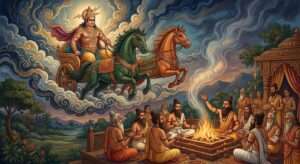
The Gita can therefore be compared to the ever-flowing Ganga. The river remains recognisable while its waters are continually renewed. Likewise, the text remains ancient while its interpretation continually acquires new relevance. It may also be compared to the ever-rising Sun, because its essential function is illumination: it brings clarity where confusion prevails. In the Vaishnava understanding, it is inseparable from Sri Krishna, the Supreme Divine, who enters the human crisis not as a distant observer but as guide, friend, teacher and charioteer.
The greatness of the Gita lies particularly in this intimate dimension. Sri Krishna does not address an abstract humanity detached from human experience. He addresses Arjuna by understanding his fear, confusion, affection, moral hesitation and sense of responsibility. The Divine teaching consequently becomes intensely personal. The universal truth is communicated through a relationship between teacher and disciple, making philosophy accessible through dialogue rather than imposing it as an inaccessible doctrine.
The tradition has therefore celebrated the Gita through many sacred names and associations. It is called Gita, the divine song; Ganga, recalling the purifying and ever-flowing current of sacred wisdom; and Gayatri, evoking spiritual illumination. It is also associated in traditional enumerations with names such as Sita, Satya, Sarasvati, Brahma Vidya, Brahma Valli, Trisandhya, Mukta Gehini, Ardha Matra, Chidananda, Bhavaghni, Bhaya Nashini, Veda Trayi, Para, Ananta, Tatvartha and Jnana Manjari. These names should not be understood merely as decorative titles. Each expresses a particular way in which generations of devotees and philosophers have experienced the text—as knowledge, truth, liberation, wisdom, protection, transcendence and spiritual bliss.
The profound message attributed to Sri Krishna—that those who teach, learn or listen to the Gita draw near to the Divine—reveals another essential dimension of the text. Knowledge becomes sacred when it is transmitted with sincerity and received with humility. The Gita is not presented as information to be accumulated but as wisdom to be lived. Reading alone does not complete its purpose. Reflection must become understanding; understanding must become conduct; and conduct must gradually become character.
Ultimately, the Bhagavad Gita may be understood as a bridge between the eternal and the immediate. It begins with Arjuna’s personal anguish on a particular battlefield and expands into a philosophy of existence. It explains the changing nature of Prakriti while directing the seeker toward the unchanging Self; it explains action while teaching freedom from attachment; it discusses social responsibility while emphasizing one’s own Dharma; it honours knowledge while affirming devotion; and it addresses the individual while speaking to humanity as a whole.
The enduring power of the Gita is therefore not that it provides one mechanical answer for every historical situation. Its strength lies in teaching human beings how to think, discern, act and surrender with wisdom. Every age brings new circumstances, technologies, institutions and social arrangements, yet the fundamental questions remain: What is my duty? What is truly permanent? How should I act when values conflict? How can I remain truthful without becoming rigid? How can action be performed without bondage? How can knowledge become wisdom?
The Gita continues to answer these questions by returning the seeker to the central relationship between Dharma, consciousness and action. Like the Ganga, its flow does not cease; like the Sun, its light remains available to those who seek illumination. Its verses belong to an ancient Itihasic moment, yet their inquiry belongs to every human being who has stood before a difficult choice and asked, with sincerity, what the right path should be.

