



Mere Kanha – Janmashtami Special
Janmashtami is a festival deeply rooted in India’s cultural and religious consciousness. It’s not just a date, but a celebration of our emotions, memories, and life values. On the night of the Ashtami (eighth day) of the Krishna Paksha (dark fortnight) of Bhadrapada month, when the sound of conch shells resonates in temples and the chant of “Nand ke ghar Anand Bhayo” fills the atmosphere with devotion, time seems to stand still for a few moments. Amidst the tableaux adorning homes, temples, and streets, little Krishna, seated in a swing, becomes the center of devotion, love, and joy.
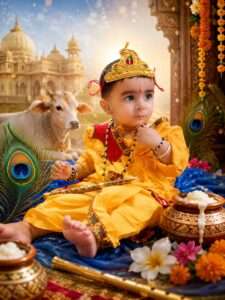
The tradition of dressing young children as Krishna on Janmashtami is a special attraction. When children appear adorned with peacock feathers, yellow robes, crowns, flutes, and mischievous smiles, the atmosphere is instantly filled with joy. But the question is, is dressing up as Krishna all we need to know? Does placing a crown and handing him a flute fulfill our responsibility?
In fact, dressing a child as Krishna is not merely an external adornment, but an opportunity to sow the seeds of life values within him. This occasion teaches us that Krishna is not only a religious symbol, but also a symbol of love, friendship, compassion, courage, wisdom, and hard work. When a child takes on the role of Krishna, it becomes equally important to explain Krishna’s character and his life message.
The child form of Krishna has been a special favorite in the Indian psyche for centuries. His mischievousness exudes the joy of life, his flute exudes the sweetness of love and conversation, his friendships embody intimacy, and his struggle against Kansa embodies the courage to stand up to injustice. This is why Krishna’s stories naturally appeal to children. These tales offer both entertainment and profound life lessons.
The need for this learning has only increased in today’s times. Childhood has changed. Courtyards, community halls, and open fields have been replaced by mobile phones, computers, video games, and social media. Technology has opened new doors of knowledge and possibilities for children, but it has also brought a challenge: children are increasingly disconnected from their cultural roots and authentic social connections.
At such a time, festivals like Janmashtami can be an important way to connect children with their culture. But we must be careful that the festival doesn’t become limited to taking photos, dressing up in attractive costumes, and sharing images on social media. If a child wears the costume of Lord Krishna but doesn’t practice love, truth, compassion, and courage, the true purpose of the festival remains unfulfilled.
Krishna’s stories hold many life lessons for children. His childhood pranks of stealing butter convey the message of simplicity and joy in life. The story of Mount Govardhan teaches collectivism, leadership, sensitivity to nature, and responsibility. The friendship between Sudama and Krishna demonstrates that true relationships are not based on wealth or social status, but on love and intimacy. Krishna’s message in Kurukshetra teaches that one should not shirk duty even in difficult circumstances.
These same values need to be integrated into children’s lives in today’s context. A modern Kanha isn’t just someone who knows how to operate a smartphone, but one who understands how to use technology judiciously and responsibly. He or she should gain knowledge from the internet, but also learn to protect themselves from misinformation and negative content. He or she should be active on social media, but should not ridicule or insult anyone. He or she should stand up to cyberbullying rather than participate in it.
A modern Kanha is also one who doesn’t remain silent in the face of injustice. He opposes gender discrimination, supports the weak, and helps those in need. He has the courage to ask questions, but also the humility to respect the opinions of others. He competes, but never loses his sensitivity.
Teaching children the qualities of Krishna can begin at home. Along with dressing them in costumes on Janmashtami, parents should tell them a short Krishna story and explain its meaning. The flute can be seen as a symbol of love, music, and communication, not just decoration. The crown can be seen as a symbol of responsibility, not just royal splendor. A peacock feather can connect us with nature and beauty, while a yellow robe can remind us of simplicity and purity.
Janmashtami is also an opportunity to promote sensitivity to nature. Krishna’s life is intertwined with the natural world of Govardhan, the cow herds, the Yamuna, and Vrindavan. Children can be taught that nature is not merely a commodity, but the foundation of our lives. Instead of plastic and unnecessary artificial decorations, clay, cloth, paper, and other environmentally friendly materials should be used during festivals. Even small initiatives can foster greater environmental awareness in children.
We also need to understand that values are developed less through teachings and more through behavior. If we tell children the story of Krishna’s friendship, but then act selfishly and bitterly in our own relationships, the message will be weakened. If we preach the importance of truth but compromise on it in our own conduct, children will learn from actions rather than words. Therefore, the primary responsibility of creating “My Krishna” lies with the family and society.
For me, “My Krishna” isn’t just a child adorned with a peacock feather and a crown. My Krishna is a child with innocence in his mind, compassion in his heart, humility in his behavior, and the courage to stand up against injustice. He works hard to fulfill his dreams, not being disheartened by failure or arrogant in success. He is rooted in his own culture, but also respects the culture and ideas of others.
Krishna means both loving life and facing its hardships. His flute brings us sweetness, but his message also gives us the courage to act. Therefore, it is not enough to introduce children only to the charming child form of Krishna; they must also be introduced to his thoughts and vision of life.
This Janmashtami, let’s not just adorn our children with peacock feathers, crowns, and flutes. Let us also give them the ornament of love, a heart of compassion, a foundation of truth, and a crown of courage. Let them learn to hold technology in their hands, but wisdom in their minds; to hold success before them, but compassion within them; and to hold authority, but an equally deep sense of responsibility.
Because a true Krishna is one who strives to make the world around him a little more beautiful, sensitive, and just. Only when our children’s smiles are filled with innocence, their behavior with compassion, their thoughts with wisdom, and their actions with courage will the celebration of Janmashtami attain its true meaning.
This Janmashtami, let’s give our children not just the form of Lord Krishna, but also his qualities. Perhaps these values will become the foundation of tomorrow’s society, where there is love, harmony, respect for nature, and the courage to stand up against injustice. Only then will our society truly become a beautiful Vrindavan.

