



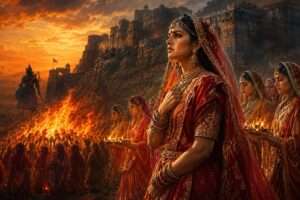
Jauhar is one of those events in Indian history whose memory still lives deeply in the soil, folklore, and heroic traditions of Rajasthan. To consider Jauhar merely an act of self-immolation in fire would be to limit its historical and social context. Behind it lay war, power struggles, women’s insecurities, fears of defeat, and the complexities of contemporary social conditions. Therefore, Jauhar should be discussed with not only with emotions but also a sense of history and human sensitivity.
In Rajput history, bravery wasn’t limited to simply raising the sword on the battlefield. Along with the valor of men, stories of women’s sacrifice, courage, and self-respect have also been passed down from generation to generation. Whether it’s the folk memory of the Jauhar of Queen Padmavati of Chittor or the tales of other brave women of Mewar and Rajasthan—these stories have created an image of Rajput identity in which self-respect is considered the highest value.
Powerful lines like “The flames of Jauhar have awakened, to dry up the entire Sindhu”—are expressions of this collective memory. They reflect the pain, anger, and self-respect of that period of history. However, while understanding these sentiments today, it is also important to remember that historical events should not be used as a means to incite hatred or animosity against any community in current society.
The most important aspect of jauhar is linked to women’s identity. In medieval wars, women of defeated states faced threats of abduction, violence, enslavement, and forced control. The social structure of that era lacked the legal protections, institutional safeguards, and modern options for independent decision-making that women enjoy today. It was in this environment that incidents like jauhar emerged. To understand them, it is necessary to examine the circumstances of that time in contrast to current social and legal norms.
But understanding the tragedy of history and blindly glorifying it are two different things. Jauhar cannot be a path for us to emulate today. In a modern democratic society, a woman’s dignity should be protected not through death, but through law, education, social awareness, and just institutions. Our goal should be to create a system in which no woman is forced to end her life to protect her identity.
Honoring the memory of Rajput women warriors would be more meaningful in this context. Associating their courage solely with death would be limiting their struggle and individuality. It is more important to understand their inherent self-respect, courage to make decisions in times of crisis, and mental fortitude in the face of adversity. The sacrifices recorded in history can inspire us to ask what we are doing today to ensure the safety and respect of women.
Similarly, the tales of swordplay and sacrifice of Rajput heroes are not merely tales of war and adventure. They were part of the political circumstances of their time, the struggles to protect regional autonomy and honor. Lines like “The lions who watered the earth, shedding blood from their chests” commemorate the heroic tradition that profoundly influenced the history and folk culture of Rajasthan.
Historical memory is healthy only when it combines pride with conscience. We should remember the sacrifices of our ancestors, but we must avoid turning history into present-day hatred. Blaming entire communities today based on the actions of individuals or groups involved in a historical conflict is neither historically accurate nor socially just.
The role of literature and poetry, in particular, becomes crucial here. Heroic poetry can instill a sense of self-confidence, courage, and patriotism in society. However, if the same poetry begins to promote hatred towards a community, its creative purpose is weakened. Therefore, slogans like “Jai Bhavani” and “Jai Mata Padmavati” should be viewed as cultural memory and reverence, not as political slogans of hostility towards anyone.
The memory of Jauhar teaches us another important lesson—self-respect is a crucial value in human life, but in modern society, self-respect and life should not be made contradictory. Today, it is our responsibility to ensure that every woman has access to education, economic independence, legal rights, a safe environment, and the freedom to choose her own life. This may be the most humane message that can emerge from that historical suffering.
The fragrance of bravery that permeates the soil of Rajasthan must live on, not just in the ashes of the past, but also in the responsibilities of the present. The need is not to rekindle the flames of Jauhar today, but to understand its history. Saluting those brave women will only be meaningful when we create a society where a woman’s dignity is not compromised, where her wishes are paramount, and where she need not sacrifice her life to protect them.
History gives us pride, but it also gives us responsibility. The story of Jauhar must be read with the same balance—neither blind glorification nor disrespectful oblivion. It is a painful memory of our past, embodying courage, self-respect, and tragedy.
Salute to the courage of the brave women, tribute to the sacrifice of the heroes and by learning from that history, resolve to create such a present – where the protection of honour is along with life, not against life.

