

For centuries, Bharat was a torchbearer of science, mathematics, and astronomy. Long before much of the world understood the movement of planets or complex calculations, ancient Bharatiya scholars had already laid foundations in mathematics, medicine, metallurgy and space observation. From Aryabhata to Sushruta, Bharat’s intellectual heritage was once admired globally.
But history was not kind.
First came invasions. Then came colonial rule. And after Independence, despite possessing immense talent, Bharat spent decades struggling under political systems that failed to create a truly world-class scientific ecosystem. Many brilliant Indian scientists, engineers, and technocrats quietly left the country in search of opportunities abroad because they felt ignored, restricted or undervalued at home.
In my view, precisely that’s what painful brain drain weakened Bharat for decades.
But something has begun changing over the last decade.
Today, Bharat is no longer seen merely as a market for global technology. It has emerged as a nation capable of advancing breakthrough science of its own. From digital infrastructure and space missions to defense manufacturing and semiconductor ambitions, the country is steadily strengthening its scientific confidence.
And now comes a discovery that has stunned the global scientific community.
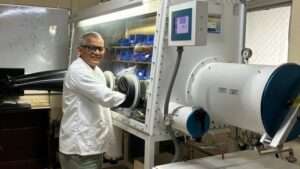
Researchers from IIT Madras and IISc Bengaluru have achieved something many experts believed was impossible for nearly 75 years.
In simple terms, scientists across the world had long believed that a highly stable molecular structure with a “ferrocene” molecule could only exist with carbon at its core. This structure is extremely important because of its strength and stability. It already finds use in rocket fuels, batteries, fuel additives, and even cancer research.
For decades, scientists assumed this structure could never be recreated without carbon.
But Bharat’s scientists have now proved the world wrong.
The research team successfully built a completely new version of this structure by replacing carbon with boron and iron with osmium. The result is what many are calling the world’s first “carbon-free ferrocene” — a breakthrough that could open the doors to an entirely new branch of chemistry.
What makes this extraordinary is not merely the discovery itself, but what it represents.
It signals that Bharat is no longer just following global science. It is beginning to lead it.
And the implications could be enormous.
In defense and space technology, materials that can survive extreme heat and pressure are vital. Bharat’s missile systems, hypersonic programmes, and rocket engines require highly stable compounds capable of functioning under punishing conditions. This breakthrough could eventually contribute to stronger and more reliable propulsion systems for organisations like DRDO and ISRO.
In energy storage, Bharat is aggressively pushing electric vehicles and large-scale battery manufacturing. One of the biggest challenges in battery technology is durability and long life. Since this newly developed structure appears more stable than traditional versions, it may one day help create batteries that last longer and perform better.
In medicine, too, the possibilities are exciting. Existing ferrocene-based compounds are already being explored in anti-cancer treatments globally. A whole new family of such structures could give Indian pharmaceutical researchers fresh opportunities to develop advanced medicines, with the intellectual property remaining in Bharat instead of being imported from foreign laboratories.
The chemical industry could also benefit enormously. Bharat still imports many specialised industrial compounds and catalysts used in manufacturing. This discovery could help create new generations of stronger and more efficient industrial materials domestically, reducing foreign dependence.
Even Bharat’s semiconductor ambitions may eventually gain from this work. As the nation pushes to build its own semiconductor ecosystem, advanced materials capable of withstanding high temperatures will become increasingly important.
But beyond all industrial applications lies something even bigger.
That’s Scientific sovereignty.
For decades, Bharat largely consumed scientific inventions created elsewhere. The West developed foundational technologies while countries like Bharat often entered later as manufacturers, service providers, or buyers.
In my view, this discovery is bound to make changes to that narrative.
The foundational intellectual property behind this new scientific platform belongs to Bharat. Future research, industrial applications and commercial products developed from this discovery may trace their roots back to IIT Madras and IISc Bengaluru.
That is how scientific superpowers are built.
Not merely through factories or imports, but through original breakthroughs that reshape entire fields of knowledge.
Equally inspiring is the story behind this achievement. This was not an overnight success or social media-driven science. It emerged from nearly 15 years of patient collaboration between scientists, driven by curiosity and deep research rather than instant commercial rewards.
That is an important lesson for Bharat.
True scientific greatness demands long-term investment, institutional freedom, and sustained research support. Governments, universities, and industries must now work together to ensure such pioneering work multiplies across the country.
The world may still underestimate Bharat in many areas. But increasingly, Bharat is proving that it can compete with the best — not only in software or services, but in original science itself.
This achievement by IIT Madras and IISc Bengaluru is more than a chemistry breakthrough.
It is a declaration.
Bharat is returning to the global scientific stage — not as a spectator, but as a creator.