



More than Revanth’s voter card
The controversy over Telangana Chief Minister A. Revanth Reddy’s alleged dual voter registration has once again exposed a much larger and more uncomfortable truth: Bharat’s electoral database management remains a bureaucratic maze where government agencies work in silos and accountability is often the first casualty.
The issue is no longer merely whether the Chief Minister’s name appears in two electoral rolls. That will eventually be established or disproved through official records. The larger question is why government institutions continue to rely on reactive firefighting instead of building robust mechanisms that prevent such anomalies in the first place.
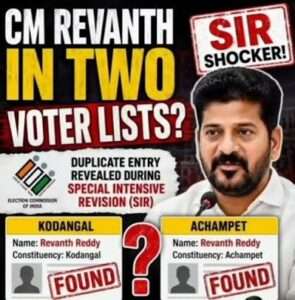
The controversy erupted after a social media video claimed that Revanth Reddy was registered as a voter in two different Assembly constituencies and could face penal consequences under electoral laws if found guilty of holding dual voter registrations. The video quickly went viral, prompting political opponents, including the BJP and BRS, to seize upon the allegation to target the Chief Minister.
Ironically, before the Election Commission could officially speak, the Telangana government chose to issue a clarification. That, in itself, raised eyebrows. Electoral rolls are the exclusive domain of the Election Commission. It is neither the responsibility nor the mandate of the State government to defend or explain anomalies in electoral records, particularly when they concern the Chief Minister himself.
If there was indeed an electoral roll anomaly, it should have been the Election Commission that came forward immediately with documentary evidence and a detailed clarification. Silence from the constitutional authority and intervention by the government only ended up creating more suspicion and unnecessary political controversy.
According to the electoral rolls presently available in the public domain, Revanth Reddy’s name appears in Kodangal Assembly constituency under Mahabubnagar Parliamentary constituency and also in Achampet Assembly constituency under Nagarkurnool Parliamentary constituency, both carrying the same EPIC number. It is also a matter of record that Revanth Reddy had contested Assembly elections from both Kodangal and Kamareddy constituencies in the recent elections.
The Telangana government’s official “FactCheck_Telangana” handle subsequently issued a clarification attributing it to the Office of the Chief Electoral Officer. Curiously, the CEO’s office itself did not issue any public statement on its official platforms. Even more strangely, the post was deleted within hours.
If the duplicate entry is merely an electoral roll anomaly, as claimed, then the Election Commission must place all facts before the public. Electoral transparency cannot operate through anonymous explanations, deleted tweets or unofficial clarifications.
In my view, this controversy has very little to do with the political identity of the individual involved. Today it happens to be the Chief Minister. Tomorrow, it could be an ordinary citizen. The principles of electoral integrity remain identical for everyone.
The Election Commission’s ongoing Special Intensive Revision (SIR) exercise is supposed to identify duplicate, outdated and erroneous entries. If that process is functioning efficiently, such anomalies should automatically get corrected without requiring political intervention or media controversies.
Yet, the problem runs much deeper.
My own experience during the Special Intensive Revision exercise exposed the shocking state of coordination between government departments. When the Booth Level Officer handed over our verification forms, I discovered that the name of my elder brother, who had passed away several years ago, was still present in the electoral records. I immediately submitted the necessary details, including the date of death, requesting deletion of his name.
There is more. My house number was recently changed by the Alwal Municipality, resulting in confusion over polling booth allocations. While my daughters, residing in the same house, have been assigned polling stations barely a few hundred metres away, my wife and I have been allotted a polling booth at Safilguda’s Vivekananda School several kilometres away.
How does such an absurd situation arise in the age of digitisation and integrated governance?
When a person dies in a hospital, the details are routinely communicated to municipal authorities for issuing death certificates. Similarly, deaths occurring at home are documented through the prescribed municipal procedures. Municipal databases are regularly updated. Property tax records are digitised. Aadhaar databases are linked to multiple public services. Yet, voter rolls somehow continue to function as if they belong to an entirely different administrative universe.
This is where the real failure lies.
The Election Commission, Municipal Administration, Revenue Department and local civic bodies continue to operate as isolated islands despite possessing interconnected citizen data. There appears to be no institutional mechanism for periodic synchronisation of records relating to deaths, migration, change of addresses and other essential details.
One wonders what prevents the Election Commission from establishing a monthly or quarterly data-sharing mechanism with municipal authorities across the country. If municipalities can update birth and death records in real time, why can’t electoral rolls be simultaneously updated? Why should voters be forced to repeatedly prove that their deceased relatives are no longer alive or that they continue to reside at the same address?
Good governance is not about issuing clarifications after controversies erupt. It is about preventing controversies through efficient systems and institutional coordination.
The Revanth Reddy voter card controversy will eventually be resolved one way or another. But if it compels the Election Commission and various government departments to finally shed their lethargic approach and build a transparent, integrated and constantly updated electoral database, the controversy may well serve a larger public purpose.
After all, electoral integrity begins not at the polling booth, but in the accuracy of the voters’ list itself.



Very well analysed. One wishes that this is read by the ECI at Delhi and Hyderabad without fail.