I have absolutely no hesitation in saying this. Yogendra Yadav’s statement that “the future of democracy in Bharat will be settled on the streets and not in Parliament or through elections” is perhaps one of the most dangerous political propositions made in recent times. If this is not an invitation to constitutional anarchy, I do not know what is.
And I am compelled to ask Prime Minister Narendra Modi and his government one uncomfortable question. What is preventing them from examining whether such inflammatory statements violate the spirit or provisions of existing law?
For years, I have watched Bharat’s self-appointed guardians of constitutional morality lecture this country about democracy, constitutional values and institutional propriety. Rahul Gandhi carries copies of the Constitution wherever he goes. The Congress party speaks endlessly about saving democracy. Its ecosystem lectures Bharatiyas on constitutional values almost every single day.
Yet, one of their newest political companions has now virtually declared Parliament and elections irrelevant.
Which Constitution are we speaking about?
The one framed by Dr Babasaheb Ambedkar or the one being rewritten on the streets by professional agitators?
If Bharat’s future is not going to be decided through elections and Parliament, why should Bharatiyas vote at all? Why should taxpayers spend thousands of crores conducting elections? Why should political parties contest elections? Why should Parliament function? Why should MPs draw salaries from public money if eventually every political dispute is going to be settled on the streets?
The logical conclusion of Yogendra Yadav’s argument is frightening. It effectively means governments shall not be determined by ballots but by the ability to assemble larger crowds on public roads.
That is not democracy. That is mobocracy.
Dr B.R. Ambedkar had warned independent Bharat against abandoning constitutional methods and embracing what he famously described as the “Grammar of Anarchy.” Unfortunately, seventy-five years later, some of our intellectuals seem determined to convert Ambedkar’s warning into their political manifesto.
Ironically, those who invoke Ambedkar the most appear least interested in remembering his most important warning.
I have absolutely no objection to dissent. Let me make that abundantly clear. The Constitution permits me to criticize Narendra Modi just as much as it permits Yogendra Yadav to criticize him. It protects our freedom of speech and our right to protest peacefully. But the Constitution nowhere says that governments can be overthrown politically through perpetual street mobilization because electoral verdicts are inconvenient.
There is a world of difference between constitutional protest and constitutional subversion.
When Yogendra Yadav says Bharat’s democratic future will be decided on the streets, one is entitled to ask him a simple question. Which streets? The streets occupied by ten thousand people? One lakh people? Ten lakh people? And if tomorrow another political party mobilizes twenty lakh people against him, should that become the new democratic verdict?
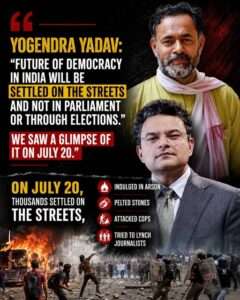
Where does this dangerous proposition eventually take Bharat?
To Bangladesh? To Sri Lanka? To Nepal? Or somewhere much worse?
Some may accuse me of exaggeration. I disagree.
Political destabilization across the world rarely begins with tanks rolling on the streets. It invariably begins with intellectual justifications delegitimizing democratic institutions. Parliament is first described as irrelevant. Elections are described as compromised. Constitutional institutions are portrayed as untrustworthy. Eventually, the streets are projected as the only remaining instrument of political legitimacy.
History has repeatedly demonstrated how dangerous such political experiments can become.
I also find it extremely ironic that Parliament suddenly becomes dispensable only when electoral outcomes become politically inconvenient. Had Rahul Gandhi become Prime Minister, would Yogendra Yadav still be arguing that Bharat’s democratic future must be decided on the streets instead of Parliament? I seriously doubt it.
The selective commitment to constitutional morality is becoming increasingly difficult to ignore.
Let me state another uncomfortable truth. I have consistently maintained that protesting governments is not merely a constitutional right but also a democratic necessity. However, there exists a constitutional Lakshman Rekha. Once political mobilization graduates from peaceful protest to advocating that democratic legitimacy itself must flow from street power, it ceases to remain merely political speech and begins raising far more serious constitutional questions.
No civilized democracy can permit elected institutions to be held hostage by permanent agitations.
Those who lose elections have constitutional remedies available before them. They can return to the people. They can challenge governmental actions before courts. They can expose corruption. They can persuade voters to elect them the next time around.
What they cannot do is declare that elections themselves are secondary to street mobilization.
That proposition is unacceptable.
I am equally disturbed by the growing normalization of anarchic politics being romanticized as democratic resistance. Arson is not dissent. Stone pelting is not constitutional morality. Attacking journalists is not democratic protest. Violence against policemen is not revolutionary politics. Destroying public property cannot become an acceptable instrument of political negotiation.
The Constitution guarantees rights. It simultaneously imposes responsibilities.
Therefore, I believe the Modi government must not dismiss such statements as mere political rhetoric. It should examine them seriously and objectively. If any provisions of existing law are attracted, the government should proceed strictly in accordance with law and due constitutional process. Nobody, irrespective of ideological affiliations or intellectual reputation, enjoys immunity from constitutional scrutiny.
The question before Bharat today is not whether one likes Narendra Modi or dislikes Rahul Gandhi. Governments will come and governments will go.
The real question is much bigger.
Will Bharat’s future be decided in Parliament or on the streets?
My answer is unequivocal. It must always be Parliament.
Because in a constitutional democracy, governments are elected in polling booths, laws are enacted inside Parliament and political legitimacy flows from the people—not from whoever can gather the loudest crowd on the streets.
The day we accept anything to the contrary would perhaps be the day we begin surrendering the very Constitution so many claims to defend.