K S Nagarajan
The increasing demand for energy and the continuous depletion of conventional energy resources have encouraged researchers and engineers to explore alternative methods of energy generation and utilization. Modern engineering focuses not only on producing energy efficiently but also on recovering and utilizing energy that would otherwise remain unexploited. Consequently, human-powered machines, energy-harvesting devices, regenerative mechanisms, and motion-conversion systems have gained considerable attention for their ability to convert mechanical motion into useful work.
Mechanical systems comprising gears, shafts, pulleys, springs, freewheels, and reciprocating mechanisms are widely employed in industrial machinery to transmit power from one component to another. These mechanisms improve mechanical efficiency, provide controlled motion, and reduce manual effort. Similarly, electromagnetic devices such as solenoids are commonly used to convert electrical energy into linear mechanical motion for automation and control applications.
The proposed system combines several mechanical and electromechanical elements into a single integrated mechanism. Its design consists of a pedal-operated drive mechanism, a freewheel assembly, a gear train, a rotating shaft, solenoid-operated pull-and-push plungers, a ball-chain arrangement, a pulley system, and a crank mechanism.
The system is initially activated through manual pedalling, after which the rotational motion is transmitted through gears and shafts to operate the remaining mechanisms. The project primarily focuses on studying the interaction among these components, understanding the transmission and conversion of motion, and evaluating the overall performance of the integrated mechanism.
Particular emphasis is placed on analysing energy flow through the system and understanding the contribution of each component towards its overall operation.
Background
Engineers have long sought to improve the efficiency of mechanical systems by reducing friction, optimising transmission mechanisms, and recovering useful energy from moving components. Human-powered machines such as bicycles, treadle pumps, pedal-powered generators, and flywheel-driven equipment demonstrate how mechanical energy supplied by a user can perform useful work.
The freewheel mechanism is widely used for transmitting power in one direction while permitting independent rotation in the opposite direction. It prevents reverse torque transmission and enables smoother operation in several industrial and mechanical applications.
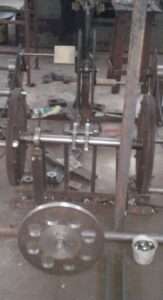
Gear mechanisms are fundamental machine elements used for transmitting torque and altering rotational speed. Spur gears provide positive engagement with minimal slippage and are extensively employed in power transmission systems. Likewise, crank mechanisms convert rotary motion into reciprocating motion, or vice versa, and are commonly used in engines, compressors and pumps.
Solenoids are electromagnetic actuators capable of producing rapid linear motion when energised. They are widely employed in valves, locking systems, automation equipment, relays and industrial control systems. By integrating solenoid actuation with mechanical linkages, controlled reciprocating motion can be achieved without resorting to complex hydraulic or pneumatic systems.
The ball-chain arrangement used in the proposed system offers an innovative means of transmitting motion while maintaining the continuous movement of rolling elements. The pulley mechanism further converts transmitted motion into rotational output, while crank arms transform rotary motion into reciprocating displacement.
The proposed project integrates these well-established mechanical principles into a single experimental platform for theoretical and practical evaluation.
Objectives of the Project
The primary objective of the project is to design, fabricate and study an integrated mechanical system comprising a pedal mechanism, freewheel, gear train, solenoid-operated plungers, ball-chain arrangement, pulley mechanism and crank assembly.
The specific objectives are:
- To design a mechanically stable supporting frame using C-channel sections.
- To develop a pedal-operated drive mechanism for efficient rotary motion transmission.
- To study the operation of the freewheel and gear transmission systems.
- To integrate solenoid-operated plungers with the rotating gear assembly.
- To investigate the movement and behaviour of the ball-chain mechanism.
- To convert rotary motion into reciprocating motion using crank arms.
- To evaluate the overall performance of the assembled mechanism.
- To analyse energy transfer through various stages of the system.
- To identify mechanical losses and operational limitations.
- To document the design, fabrication, testing and performance analysis of the prototype.
Scope of Work
The scope of this project includes the conceptual design, fabrication, assembly and performance evaluation of the proposed mechanical system. The work focuses on integrating mechanical and electromechanical components into a single operating prototype.
The project includes:
- Design of the supporting frame.
- Selection of gears, shafts, bearings and freewheel components.
- Design of the pedal transmission mechanism.
- Integration of solenoid-operated plungers.
- Fabrication of the ball-chain assembly.
- Design of the pulley and crank mechanism.
- Assembly of all mechanical components.
- Basic electrical wiring for solenoid operation.
- Theoretical calculations relating to force, torque and rotational speed.
- Experimental testing of the completed prototype.
- Performance evaluation and documentation.
The project does not include advanced electronic control systems, battery management systems, programmable controllers or large-scale power generation. The study is confined to evaluating the mechanical and functional characteristics of the prototype under laboratory conditions.
Need for the System
Mechanical systems that efficiently utilise human effort and transmit motion have significant applications in educational demonstrations, laboratory experiments and prototype development.
Studying integrated mechanical systems helps students and engineers understand the relationships among different machine elements and the principles governing motion transmission and energy transfer.
The proposed system serves as a demonstration model that combines multiple engineering concepts into a single machine. Rather than studying gears, freewheels, pulleys, crank mechanisms and solenoids independently, it integrates them into one coordinated working assembly.
Potential applications include:
- Demonstration of power transmission mechanisms.
- Understanding motion conversion principles.
- Studying gear synchronisation.
- Investigating reciprocating motion generation.
- Learning electromechanical actuation using solenoids.
- Educational laboratory experiments.
- Mechanical design and fabrication training.
- Prototype development and engineering research.
The project also provides practical exposure to machine design, fabrication techniques, assembly procedures and testing methodologies.
Proposed Working Principle
The proposed system operates by converting manual pedal input into coordinated mechanical motion through a sequence of interconnected mechanisms.
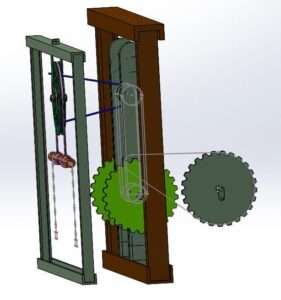
Initially, the operator actuates the pedal mechanism located at the base of the frame. The pedal transmits rotational motion through a freewheel assembly, which ensures one-directional power transmission while preventing reverse motion. The freewheel drives a small pinion gear mounted on the main shaft.
The rotation of the pinion gear simultaneously drives two larger gears mounted at the ends of the main shaft. These gears incorporate specially designed circular tracks that accommodate freely moving steel balls.
Each main gear incorporates a crank mechanism fitted with a solenoid, referred to as the “pull solenoid,” which applies a controlled driving force to the ball-chain assembly. The pull crank and the plunger crank are positioned 180 degrees apart to ensure coordinated motion.
A second solenoid-operated plunger mechanism is mounted within a cup-shaped housing at the opposite end of a seesaw-type linkage. When electrically energised, the plunger exerts force on the terminal plate of the ball-chain arrangement to maintain equilibrium and facilitate reciprocating motion. Upon interruption of electrical supply, an internal spring returns the plunger to its original position.
The reciprocating motion of the plungers interacts with the rotating gear assembly, producing periodic mechanical impulses that contribute to the coordinated operation of the system.
Above the gear mechanism, a horizontal pipe contains a series of steel balls arranged in a chain-like configuration and connected to a pulley mechanism through a wire rope. The reciprocating movement of the ball-chain assembly influences the motion of the freely moving steel balls, thereby contributing to momentum transfer within the mechanical system and sustaining smooth rotational movement during operation.
The prototype has been conceived as an experimental model to study motion transmission, energy transfer, electromechanical integration and the interaction of multiple machine elements operating within a single system.
(The author is Chennai-based scientist and innovator who, at the age of 78, continues to pursue research and development projects across multiple branches of science and engineering. His work includes applied electronics, mechanical innovations and interdisciplinary research initiatives. He is actively associated with projects involving some of India’s premier academic institutions, including IIT Madras.)