

Leadership is often measured by how a person treats his supporters. True statesmanship, however, is revealed by how one treats his fiercest critics.
That is precisely why Prime Minister Narendra Modi’s response to the young protesters who hurled the most abusive, vulgar and deeply personal insults at him during the recent protests deserves thoughtful appreciation, irrespective of one’s political preferences.
Perhaps never before in independent Bharat has any Prime Minister faced such relentless, organised and deeply personalised political hostility. Criticism is natural in a democracy. Dissent is healthy. Opposition is indispensable. But what the country has increasingly witnessed over the past decade is not merely criticism of Narendra Modi’s policies but sustained attempts to demonise him as an individual, ridicule his family, question his motives and poison the minds of impressionable youth through manufactured narratives and political propaganda.
Unfortunately, a section of young people appears to have become easy prey to this ecosystem.
Many among them may genuinely believe they were fighting for justice over the examination paper leak issue. Others may simply have joined because social media has transformed political protests into fashionable public performances. Still others, lured by momentary fame, ideological influencers or political handlers, crossed every line of civility by using language that no Bharatiyas family would ever tolerate within the four walls of their own home.
Yet, Narendra Modi chose not to respond with anger.
He did not demand exemplary punishment.
He did not ask the police to make examples of them.
He did not call them enemies of the nation.
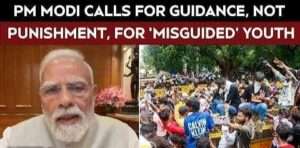
Instead, he referred to them as “misguided youth.”
Even more remarkably, he appealed to media organisations not to repeatedly telecast their faces and identities, arguing that exposing them endlessly could permanently damage their future.
That single statement perhaps revealed more about Modi’s character than a thousand political speeches ever could.
It reminded me of an old Bharatiyan saying—that when our teeth accidentally bite our tongue, we do not break the teeth. We understand that both belong to the same body.
That was exactly the analogy employed by the Prime Minister.
Whether one supports him politically or opposes him electorally, it would be difficult to deny the emotional depth behind that comparison.
In today’s hyper-polarised politics, where every disagreement quickly escalates into hatred, the easier path would have been to invoke every available legal provision against those who abused him. After all, no constitutional office can function if vulgar abuse is normalised under the guise of free speech.
Many legal experts would argue that obscene personal abuse directed against a constitutional functionary falls well outside the protection of legitimate democratic dissent.
There is merit in that argument.
Freedom of speech has never meant freedom from responsibility.
Civilised democracies survive because citizens understand the distinction between disagreement and degradation.
One may question government policies.
One may challenge administrative decisions.
One may even seek the resignation of ministers.
But reducing political discourse to vulgar abuse ultimately degrades democracy itself.
Nevertheless, Narendra Modi consciously chose reconciliation over retaliation.
That decision deserves appreciation.
Some critics have argued that the Prime Minister’s remarks diverted attention from the examination controversy or the allegations surrounding police action.
That criticism is understandable in a political context.
However, the gesture itself should be evaluated independently.
Forgiveness does not erase accountability.
Nor does compassion invalidate ongoing investigations.
The Prime Minister’s appeal was not an endorsement of abusive conduct. Rather, it was an appeal to society not to permanently stigmatise young individuals for one reckless episode that could have lifelong consequences.
That distinction is extremely important.
If television channels had not aired their own footage and if investigators had not disclosed the involvement of thousands of individuals, including those allegedly engaged in violent attacks on police personnel, the public might have been left with a completely different impression of the events. Competing political narratives would undoubtedly have continued to dominate public discourse.
Reports indicated that hundreds of police personnel sustained injuries during the violence, including officers decorated for gallantry in anti-terror operations. If those reports are accurate, violence against law enforcement can never be justified, regardless of the cause being protested.
At the same time, if any individual security personnel exceeded lawful limits in responding to the violence, those actions too must be investigated under the rule of law. Democracies cannot operate on selective accountability.
Violence by protesters cannot justify excesses by authorities.
Equally, isolated allegations against authorities cannot justify organised violence against public institutions.
Both propositions can simultaneously be true.
This episode also raises uncomfortable questions about the role of political mobilisation.
Why are young Indians increasingly encouraged to view every disagreement through the prism of anger?
Why has abuse become a substitute for argument?
Why is outrage rewarded more than reason?
Why are social media algorithms creating heroes out of those who shout the loudest instead of those who think the deepest?
India possesses one of the youngest populations in the world.
That demographic dividend can become the nation’s greatest strength or its gravest vulnerability.
Young people deserve guidance, not manipulation.
They deserve opportunities, not exploitation.
They deserve mentors, not political contractors.
Parents, teachers, universities, media organisations and political parties all share a collective responsibility in nurturing informed citizenship rather than encouraging performative outrage.
Narendra Modi’s response, in that sense, carried a larger message.
He was speaking not merely to those who abused him but to an entire generation.
He was telling them that mistakes need not define an entire life.
He was asking society to correct rather than cancel.
He was urging parents and elders to guide rather than merely condemn.
Such appeals are increasingly rare in modern politics.
Around the world, leaders often respond to personal attacks with litigation, censorship or political retaliation. Others weaponise victimhood for electoral gain. Modi chose a different course. He neither celebrated his victimhood nor sought public sympathy. Instead, he requested restraint from the media and introspection from the youth themselves.
That reflects confidence.
It reflects emotional maturity.
More importantly, it reflects a civilisational value deeply rooted in Bharatiya philosophy—that forgiveness, when accompanied by wisdom, is not weakness but strength.
Of course, forgiveness cannot become a licence for lawlessness.
Those responsible for violence, destruction of public property or attacks on security personnel must face the legal consequences of their actions. The rule of law must prevail without fear or favour.
But those who merely succumbed to youthful recklessness deserve an opportunity to learn, reform and contribute positively to society.
As a citizen, I found the Prime Minister’s words deeply moving.
Politics today rewards confrontation.
Television debates reward shouting.
Social media rewards hatred.
History, however, remembers something entirely different.
It remembers those rare leaders who possessed the moral confidence to forgive when they had every constitutional authority to punish.
Whether one agrees with Narendra Modi politically is entirely a matter of personal choice.
But his appeal to spare the misguided youth, protect their future and allow them an opportunity for introspection was not merely a political statement.
It was a profoundly human one.
In an age overflowing with outrage, perhaps compassion remains the most extraordinary expression of leadership.