
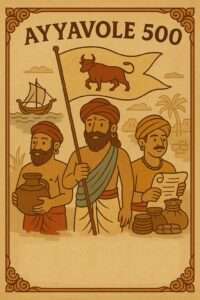
The Ayyavole 500, also known as the Five Hundred Lords of Ayyavole, Ainnurruvar (Tamil), or Nanadesi, was a confederation of merchant guilds active in South India and across the Indian Ocean and Bay of Bengal trade arc from roughly the 8th/9th century CE through the 15th century, a run of over 600 years. It was not a single firm or a capital market. It was a corporate, feudally structured trading body that combined pooled merchant capital, state-granted commercial privilege, and private armed protection to run long distance overland and maritime trade.
The guild originated in Aihole (also spelled Ayyavole), a temple town in the Bijapur district of present-day Karnataka, which had been a major city under the Chalukyas of Badami. Historians differ on how it began:
- Meera Abraham argues the guild formed when a group of Mahajanas or Brahmanas, the “Five Hundred Swamis of the Mahaagrahara of Aihole,” institutionalized control over existing regional commerce. This ties the guild’s origin to elite, temple-linked landowning groups rather than itinerant traders.
- Kenneth Hall traces the origin instead to small bands of itinerant, lower-capital merchants serving isolated hinterland communities, who banded together for mutual protection and gradually grew into a powerful commercial association.
- R. Champakalakshmi has pushed back on Hall’s account, favoring a more elite-institutional origin closer to Abraham’s.
The earliest epigraphic references date to the 8th and 9th centuries CE, with the volume of inscriptions peaking in the 11th and 12th centuries.
What They Actually Did
- Financed and coordinated long-distance trade in pepper, spices, textiles (notably fine cotton and silk), gems, and horses, across both overland routes and maritime convoys.
- Negotiated toll exemptions and trading rights from regional kings, most significantly the Chola dynasty from the 10th century onward, in exchange for funding public works: temples, water tanks, and local infrastructure.
- Absorbed, patronized, or operated alongside other guilds rather than displacing them, including the Manigramam, Anjuvannam (a guild of West Asian, i.e. Jewish, Christian and Muslim traders operating out of Malabar and Coromandel ports), and Valanjiyar.
- Functioned under a title structure: guild leaders who became especially wealthy or powerful took the title samayachakravarti, “emperor of the trading assembly.”
There is no evidence in the epigraphic record of tradable financial instruments, public price discovery, or anything resembling equity or debt markets. The comparison to “Wall Street” is evocative but structurally inaccurate; this was closer to a hybrid of a chamber of commerce, a logistics and security consortium, and a sovereign-privilege negotiator.
The Military Dimension
The guild maintained a genuine military capacity, not just reputation. It financed private guards and militia, referred to in inscriptions as Vira Balanjas (“valiant merchants,” also rendered Vira Balanju, Vira Banajigaru, Vira Balija), whose job was to protect caravans from banditry on land and convoys from piracy at sea.
Notably, an 1177 CE inscription from Kurugodu (Bellary district) records that the Mummuridandas, a body of warriors who were “warriors first and merchants next,” were an explicit offshoot of the Ayyavole 500, tracing their lineage directly back to the Five Hundred of Aihole (Aryapura). This is direct epigraphic evidence that the guild’s military function was formalized enough to spin off its own armed order.
Religious and Social Dimension
The guild had a patron deity, identified in the Barus (Sumatra) inscription as Durga, and its members were closely associated with agraharas (Brahmin settlements) and temple institutions. Trading rights and disputes were often recorded as temple grants or endowments, meaning commerce, religion, and local governance were institutionally intertwined rather than separated.
Geographic Reach
This is where the guild’s scale is least ambiguous. Inscriptions bearing the Ayyavole 500 name or its Ainnurruvar/Ainuttava variants have been found in:
- South India broadly: Karnataka, Tamil Nadu, Andhra Pradesh (inscriptions at Visakhapatnam, Nellore, Cuddapah), Kerala (Pandalayini-Kollam, near Kozhikode, c. 1000 CE)
- Sri Lanka (Viharehinna inscription)
- Southeast Asia: Sumatra (Barus), Java, the Malay Peninsula
- Burma (Myanmar)
- Possibly southern China, per some secondary sources, though this is less rigorously documented than the Southeast Asian evidence
The commercial network is generally described as running from the Red Sea in the west to China in the east, covering the full Indian Ocean and Bay of Bengal rim. Their expansion tracked closely with Chola naval and political expansion, particularly the overseas campaigns of Raja Raja Chola I (r. 985–1014 CE) and Rajendra I (r. 1014–1044 CE) into Sri Lanka and the Srivijaya sphere in Sumatra, which opened Southeast Asian markets to Tamil and Karnataka merchant capital.
Peak and Decline
Inscriptional activity, the best available proxy for guild vitality, peaks in the 11th and 12th centuries. By the end of the 12th century, the guild was already losing its preeminent position, though isolated inscriptions (e.g., a 1531 CE grant from Cuddapah) show some form of the guild or its associated Vira-Balanja dharma persisting in name into the 16th century. The consensus reading is a long structural decline from the 13th century onward, coinciding with the weakening of Chola state patronage and the rise of alternative trading powers and, later, direct European entry into Indian Ocean trade from the 16th century.
Key Historiography
- Meera Abraham, Two Medieval Merchant Guilds of South India (Manohar, New Delhi, 1988), the standard academic study of the Ayyavole and Manigramam guilds.
- Kenneth R. Hall, work on itinerant merchant organizations and the “medieval maritime trading arc.”
- R. Champakalakshmi, critical responses to Hall’s origin thesis.
- Noboru Karashima, epigraphic studies including the Viharehinna inscription (Sri Lanka).
- K.A.N. Sastri and Ranabir Chakrabarti, on the Chola-era institutional context for guild expansion.
The Ayyavole 500 is a good analogy for organized, state-sanctioned, privately-armed trade infrastructure, not for capital markets. There is no evidence of:
- Tradable shares or bonds
- Centralized price discovery
- Anything resembling a secondary market for risk
What it does resemble, structurally, is pooled venture capital for specific trade expeditions, backed by political privilege and enforced by private security, closer to a medieval version of a vertically integrated trading conglomerate with its own paramilitary wing than to an exchange.