



“Doctor, my feet swell by evening. It comes down after I sleep, so I don’t think there is anything serious.” This is a very common question in clinical practice. Many people notice that their footwear becomes tight by evening, socks leave deep marks around the ankles, or the feet and lower legs look puffier after a long day. Some blame age. Others blame standing for too long, hot weather, excess salt or “water retention”.
Many simply ignore it. Sometimes, there is indeed a simple explanation. But sometimes, swollen legs are the body’s way of signalling that something is wrong. The medical term for swelling caused by excess fluid collecting in the tissues is oedema. It is not a disease by itself. It is a symptom, and the reason behind it can range from something harmless and temporary to a condition requiring medical attention.
Why do the legs swell?
A review on lower-limb oedema published in the British Journal of Nursing in 2024 explained that prolonged standing or sitting can cause relatively harmless swelling, but persistent oedema may also occur with heart, kidney or liver disease. The legs are particularly prone to swelling because gravity encourages fluid to collect in the lowest parts of the body. Normally, blood travels down to the legs through arteries and returns towards the heart through veins. The muscles of the legs, particularly during walking, help push blood upwards. Valves inside the veins prevent blood from flowing backwards.
When this system does not work efficiently, fluid can accumulate in the tissues. This is commonly seen in chronic venous insufficiency, a condition in which the veins of the legs have difficulty returning blood efficiently to the heart. Varicose veins, prolonged standing, obesity and increasing age can contribute to it. The swelling is often worse towards the end of the day and may improve after lying down with the legs elevated. But the veins are not the only possible explanation. 1Heart failure, kidney disease, liver disease, low levels of blood proteins, thyroid disorders and certain medications can also cause swelling.
Medicines such as some blood-pressure drugs, anti-inflammatory medicines, steroids and hormones can contribute to oedema in some people. There is also lymphedema, where the lymphatic system—the network responsible for draining excess fluid from tissues—does not work properly. It may develop after surgery, cancer treatment, infection, and trauma or because of abnormalities present from birth. Therefore, the same-looking swollen ankle can have completely different causes in different people. One important cause of persistent leg swelling in tropical countries like India is filariasis.
Microscopic parasitic worms damage the lymphatic system, preventing normal drainage of body fluids and leading to chronic swelling, known as lymphedema. Daily skin care, limb elevation, prescribed compression therapy, regular exercise and early treatment of infections are the cornerstones of management.
One leg or both legs?
This simple observation can provide an important clue. Swelling in both legs, particularly when it develops gradually, is more often associated with conditions affecting the whole body, although chronic venous disease is also very common. Swelling in one leg, especially when it appears suddenly, deserves greater attention.
According to a 2026 review in FP Essentials, a monthly peer-reviewed clinical monograph series published by the American Academy of Family Physicians (AAFP), bilateral lower-extremity oedema is commonly associated with systemic conditions such as heart failure, cirrhosis or kidney dysfunction, whereas unilateral swelling is more often associated with local problems such as deep vein thrombosis, infection or injury.
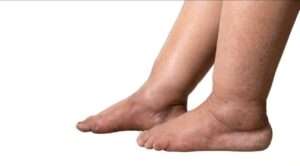
One important condition that should never be casually dismissed is deep-vein thrombosis, or DVT. This means a blood clot forming in a deep vein, usually in the leg. It can cause swelling, pain, warmth or redness. If the clot travels to the lungs, it can cause a potentially life-threatening pulmonary embolism, meaning blockage of a blood vessel in the lungs. A suddenly swollen, painful leg is therefore not something to simply massage at home.
When should swelling worry us?
Not every swollen foot requires an emergency visit. But certain warning signs should never be ignored. 2Sudden swelling of one leg, particularly when associated with pain, warmth or redness, requires prompt medical assessment for conditions such as DVT.
Expert guidance recommends clinical assessment and use of validated diagnostic pathways when DVT is suspected. Swelling accompanied by breathlessness, chest pain, coughing up blood, fainting or sudden worsening of breathing requires urgent medical attention because a blood clot may have travelled to the lungs. Similarly, progressively increasing swelling in both legs accompanied by breathlessness, difficulty lying flat, unusual tiredness or rapid weight gain may indicate worsening heart failure.
Persistent swelling associated with reduced urine output, facial swelling, jaundice, abdominal swelling or significant changes in general health also deserves medical evaluation. The important message is simple: Do not judge the seriousness of leg swelling only by how much it hurts. Some serious conditions may cause surprisingly little pain.
How does a doctor find the cause?
There is no single test for swollen legs. The diagnosis begins with a careful history.
A doctor wants to know when the swelling started, whether it affects one or both legs, whether it is worse in the evening, whether it improves overnight, whether there is pain or redness, what medicines are being taken and whether there are symptoms involving the heart, lungs, kidneys or liver. The legs are then examined for skin changes, varicose veins, tenderness, temperature, symmetry and whether pressing the swollen area leaves a temporary depression. This is called pitting oedema. Depending on the findings, blood and urine tests may be required. A kidney and liver assessment, thyroid testing, urine testing for protein and, where appropriate, tests related to heart function can help identify systemic causes.
The 2022 American Family Physician review recommends a structured evaluation rather than simply treating the swelling itself. When a blood clot is suspected, a Doppler or compression ultrasound can examine blood flow in the veins. For chronic bilateral swelling, venous ultrasound can also help identify chronic venous insufficiency. When heart failure is suspected, an echocardiogram—an ultrasound examination of the heart—may be needed. The treatment should therefore be directed at the cause, not merely at making the swelling disappear. 3
Management
For people whose swelling is related to prolonged standing or sitting, simple measures can help. Regular walking activates the calf muscles and helps blood return from the legs towards the heart. Avoiding long periods of sitting or standing in the same position is useful. When resting, elevating the legs can help reduce dependent swelling. Maintaining a healthy weight, controlling blood pressure and diabetes, avoiding excessive salt intake and keeping the skin of swollen legs clean and moisturised are also important. Compression stockings can be extremely useful for selected patients, particularly those with venous disease.
They work by applying pressure to the leg and helping fluid and blood move upwards. However, compression should not be treated as a universal remedy for every swollen leg. The underlying cause should first be assessed, particularly when there is suspected arterial disease, significant heart failure or an acute unexplained swelling. One practice that should be avoided is taking diuretics, commonly called “water tablets”, without medical advice. These medicines increase urine production and are useful when swelling is caused by certain systemic conditions, but they are not the correct treatment for every type of leg oedema.
Do not ignore the warning
Swollen feet and ankles are common. But common does not mean unimportant. A person who develops swelling after spending an entire day standing may simply need rest, movement and leg elevation. Another person with the same-looking swelling may have an underlying heart, kidney, liver, venous or lymphatic problem. The difference cannot always be identified by looking at the ankle alone. The body often gives small warnings before a major problem becomes obvious. Persistent swelling is one such warning that is too easily dismissed. The next time a pair of shoes suddenly feels tight, or deep sock marks appear around the ankles at the end of the day, it is worth asking a simple question: Is this merely tiredness—or is the body trying to tell us something? A swollen leg is not a diagnosis. It is a message. And sometimes, listening to that message early can make a very big difference.

