



Modi’s strategic defiance could reshape Bharat’s geopolitical standing
The perceived cold war between US President Donald Trump and Prime Minister Narendra Modi may be entering a new phase. The underlying contest is not merely about tariffs, oil or a ceasefire between Bharat and Pakistan. It is about a larger question: can Washington still expect New Delhi to fall in line whenever American strategic interests demand it?
Modi’s answer, so far, appears to be a firm no.
Trump’s penchant for projecting himself as the ultimate dealmaker has repeatedly collided with Modi’s insistence on strategic autonomy. The American President’s claims about his role in securing a ceasefire between Bharat and Pakistan, which New Delhi has consistently maintained was a bilateral matter, exposed the limits of Washington’s ability to dictate terms to a country that increasingly sees itself as a major global power.
This is where the geopolitical chessboard becomes interesting. And oil, as always, remains central to the game.
Venezuela’s vast petroleum reserves, American energy interests, the search for dependable refining capacity and the strategic importance of Bharat’s energy infrastructure form part of a complicated international equation. Yet, any suggestion that Washington engineered political developments in Venezuela or Bharat specifically to control Bharatiya refining capacity requires credible evidence. Geopolitical analysis must distinguish between strategic possibilities and established facts.
The larger reality, however, is unmistakable. Energy security has become an instrument of power, and Bharat is no longer a peripheral player in that contest.
Bharat’s refining capacity, its expanding energy market and its ability to source crude from different suppliers give New Delhi options that many countries do not possess. Its purchases of Russian oil, despite Western pressure following the Russia-Ukraine conflict, demonstrated that national interests would not automatically be sacrificed to accommodate Washington. The message was clear: Bharat would make its own calculations.
That independence has consequences.
For decades, American foreign policy operated on the assumption that economic pressure, diplomatic persuasion and strategic partnerships could bring other countries around to Washington’s preferred position. Trump’s tariff diplomacy has carried that approach to an aggressive new level. But coercion has its limits, particularly when directed at a country with a vast domestic market, growing economic weight and an increasingly diversified network of international partnerships.
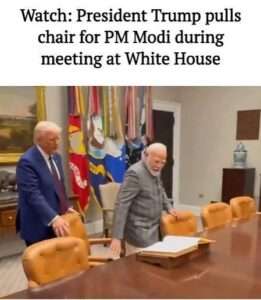
Modi’s refusal to publicly surrender strategic ground has therefore become more than a bilateral disagreement. It has turned into a test of whether the United States can accommodate the rise of another power without demanding political obedience.
Meanwhile, domestic political developments in Bharat have added another dimension. Opposition parties, including the Congress, the Aam Aadmi Party and the Left, have found common ground on several issues against the Modi government. Political mobilisation and social media campaigns have intensified the contest for public opinion. Allegations of coordinated messaging or algorithmic manipulation, however, need evidence before they can be treated as established fact.
The decisive point is that Bharat’s foreign policy cannot be reduced to the fortunes of any one political campaign. Nor can its international standing be determined by the volume of domestic political noise.
What matters is whether New Delhi can convert its growing economic and strategic weight into durable diplomatic advantages.
Recent diplomatic engagement, discussions over trade and tariffs, and continuing negotiations on energy demonstrate that confrontation does not necessarily end in capitulation. Washington and New Delhi have too many shared interests, from the Indo-Pacific to technology and supply chains, to allow differences to become permanently irreconcilable. Equally, neither side can assume that the other will accept an unequal bargain indefinitely.
This is where Modi’s approach will face its real test. Defiance makes a compelling political headline; delivering tangible gains makes a successful foreign policy. Better trade terms, secure energy supplies, stronger manufacturing, technological partnerships and greater freedom of diplomatic action would constitute meaningful victories. Rhetorical exchanges alone would not.
Bharat must also recognise that a wounded superpower does not necessarily abandon its ambitions. Pressure can return through tariffs, regulatory restrictions, diplomatic manoeuvres or competing strategic partnerships. Washington will continue to pursue American interests, just as New Delhi must pursue India’s.
The answer is neither reflexive hostility towards the United States nor unquestioning alignment with it. It is calculated engagement, backed by economic strength and the confidence to say no when necessary.
The emerging lesson is that Bharat cannot be treated as a subordinate whose choices can be settled in another capital. Modi’s most consequential geopolitical legacy would be to make that principle irreversible, irrespective of who occupies the White House.
The scorecard, therefore, should not be declared based on political theatre. The contest is much bigger than Trump versus Modi. It is about the transition from a world in which one superpower sets the terms to a multipolar order in which Bharat insists on having a decisive say.
The hunter may yet discover that the target has become a formidable rival. But the elephant’s true victory will come not from making the hunter retreat, but from ensuring that nobody can dictate where it walks next.


