



The spiritual history of India is not a history of isolated doctrines competing with one another; it is a continuous civilisational conversation in which the deepest questions of existence were repeatedly asked, challenged, refined and experienced. The Vedic seers contemplated the relationship between man, nature, the elements and the cosmic order. The Upanishadic sages turned the inquiry inward and asked what the ultimate Self is. The Buddha entered this long stream of Indian spiritual questioning and subjected inherited assumptions, ritual practices and extreme forms of asceticism to the test of direct experience. Buddhism therefore may be read not merely as a rejection of something that came before it, but as one of the great transformations within the larger intellectual and spiritual atmosphere of ancient India.
Scholars still debate the chronological relationship between the early Upanishads and Buddhism. Dharmananda Kosambi, the distinguished Buddhist scholar and Pāli specialist, belonged to a tradition of scholarship that explored the possibility that some Upanishadic formulations were later than the Buddha and were influenced by Buddhist thought. Such a thesis should be understood as a scholarly argument rather than as an uncontested historical fact. Other historians of Indian thought have reached different chronological conclusions, particularly concerning the older Upanishads. What is nevertheless profoundly significant is the intellectual proximity between the two traditions: both placed the problem of suffering, desire, knowledge, self-discipline and liberation at the centre of human existence.
The Vedic imagination itself contains a powerful reverence for the natural world. Earth, water, fire, air and space were not regarded merely as inert substances but as dimensions of a sacred order in which human life participated. The worship of the elements was therefore more than an act of supplication; it represented an acknowledgement that human existence depends upon a larger ecological and cosmic harmony. When that harmony is violated, the consequences ultimately return to living beings. In this sense, the ancient vision contains an insight that modern humanity is rediscovering through ecological science: nature is not merely a resource placed outside us. We are woven into it.
The ethical interpretation of the Vedic sacrifice also deserves careful attention. The word अध्वर has traditionally been interpreted through the idea of freedom from dhvara, injury or violence, and Yāska’s Nirukta connects the term with the negation of violence. Traditional interpretations consequently understand adhvara as a sacrifice that is unobstructed and, in an important interpretive strand, non-injurious. At the same time, the Vedic and later ritual literature contains complex and sometimes conflicting traditions concerning sacrifice, so it would be historically too broad to reduce the entire Vedic ritual tradition to a single uniform practice. The deeper philosophical point is that ritual acquires its highest meaning when the outward act expresses an inward discipline rather than becoming an excuse for cruelty.
The spirit of such an interpretation can be beautifully expressed through the ancient prayer of universal friendship:
“मित्रस्याहं चक्षुषा सर्वाणि भूतानि समीक्षे।
मित्रस्य चक्षुषा समीक्षामहे॥”
The aspiration is simple and immense: may I look upon all beings with the eyes of friendship, and may all beings look upon one another in the same spirit. The ethical universe implied by such a prayer does not stop at human society. It extends towards animals, birds, vegetation, rivers, mountains and the elemental foundations upon which life depends.
The ancient Indian understanding of nature therefore carried with it a discipline of restraint. The earth was not to be treated as an object without limit. Digging the soil, gathering medicinal herbs and taking what was necessary from nature were surrounded by ritual consciousness and gratitude. Whether interpreted literally as ritual practice or symbolically as ecological ethics, the underlying principle is striking: take from nature with humility, not arrogance; use what is necessary, not everything that is available.
This is where the encounter between Vedic spirituality and Buddhism becomes particularly illuminating. The Buddha did not condemn the Vedic search for truth merely because it was Vedic. His criticism was directed especially towards practices in which ritual or austerity became separated from compassion and wisdom. In Buddhist tradition, the fundamental question was not whether a person could endure pain, but whether suffering itself had been understood and overcome.
Siddhartha Gautama had already experienced the privileges of palace life. Yet luxury could not answer the fundamental questions of ageing, sickness, death and liberation. He therefore left the palace and entered the life of a seeker. The traditions surrounding his journey describe his encounters with teachers, philosophers and ascetics, followed by years of increasingly severe austerity. He finally discovered that the deliberate destruction of the body could not itself produce liberation.
The significance of this discovery becomes clearer when one imagines the ascetic world into which Siddhartha had entered. One practitioner stood upon a single leg, believing that physical endurance would bring spiritual merit. Another subjected his body to painful practices. Another sat surrounded by fires under the burning sun. Their conviction was sincere: greater physical suffering, they believed, would bring them closer to God or liberation.
Siddhartha’s question was therefore revolutionary precisely because it was compassionate: if the purpose of spiritual life is liberation from suffering, why should suffering deliberately be multiplied?
The question contained a new measure of spirituality. The body was not an enemy to be conquered. Nor was pleasure itself the final answer. The body was an instrument through which consciousness could awaken. To destroy that instrument in the name of liberation was to misunderstand the relationship between body and spirit.
The ascetics, according to the traditional narrative, could not accept his questioning. Their anger itself revealed the difficulty of the path: when an idea becomes an absolute, even a compassionate question can appear threatening.
Siddhartha then went still further. He abandoned extreme austerity and resolved to discover the truth through balanced discipline. His body had become exceedingly weak; his physical strength had almost disappeared. At this decisive moment, Buddhist tradition places before him the simple but profound lesson of the musical instrument.
A string that is stretched too tightly will break. A string that is left too loose cannot produce music.
Between the two extremes lies harmony.
The image is deceptively simple. It became one of the great symbols of Buddhist thought. Life cannot be understood through indulgence alone, nor through self-destruction. Excessive attachment binds the mind; excessive repression weakens the very instrument through which wisdom must operate. The Middle Way is therefore not mediocrity. It is disciplined balance.
In philosophical language, it means that truth is not necessarily found at either extreme. In psychological language, it means that the mind must neither be enslaved by desire nor tortured by hatred of desire. In physical language, it means that the body must be sustained sufficiently for the mind to remain clear. In ethical language, it means that compassion must govern discipline.
It was at this critical juncture that Sujātā entered the story.
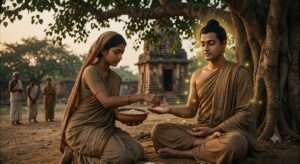
Buddhist traditions narrate that Sujātā, associated with the village of Senānigama near Uruvelā, offered milk-rice to the weakened Siddhartha. Some traditions describe her as the daughter of a prosperous householder; later narratives elaborate the preparation of the milk-rice in extraordinary detail. The ancient Buddhist account preserved through different textual traditions makes the offering a decisive turning point: the Bodhisattva accepted nourishment, regained strength and prepared himself for the final search.
The symbolism of the offering is more important than the culinary detail. Sujātā did not bring Siddhartha a philosophical treatise. She brought food. Yet that food became part of the story of enlightenment.
There is a profound lesson here. Spirituality does not float above ordinary life. It enters life through nourishment, kindness, hospitality and human compassion. The hand that offers food can participate in a spiritual revolution as surely as the mind that formulates a philosophy.
The traditional stories describe Sujātā’s milk as exceptionally rich and carefully prepared. In one widely transmitted version, milk from progressively selected groups of cows was used to produce an especially nourishing preparation. Your account of the milk being successively drawn from smaller groups of cows beautifully captures this traditional symbolism: nourishment itself becomes a process of concentration, refinement and transformation.
Sujātā’s offering may therefore be read at several levels. At the simplest level, a hungry ascetic received food. At a deeper level, life restored the body that had been weakened by an erroneous understanding of spiritual discipline. At the highest symbolic level, nature, woman, food, compassion and human awakening converged at one decisive moment.
Siddhartha’s acceptance of food was not a surrender of spirituality. It was the recovery of the conditions necessary for spiritual clarity.
The story consequently reverses a common misunderstanding of renunciation. Renunciation does not necessarily mean rejecting life. It means releasing bondage to life. Food may be accepted without greed. Wealth may be possessed without attachment. The body may be cared for without making the body the centre of existence. Desire may be understood without becoming its servant.
This is where the teaching of the Buddha moves towards one of its deepest insights: suffering is intimately related to craving, and liberation requires a transformation of the mind rather than merely an alteration of external circumstances.
“तृष्णा मूलं हि दुःखस्य,
तृष्णा मूलं पुनर्भवः।
तृष्णाक्षये सुखं नित्यं,
निर्वाणं परमं पदम्॥”
The verse above expresses the philosophical idea in a traditionalised form: craving becomes the root through which suffering perpetuates itself; when craving is understood and extinguished, the mind discovers another order of freedom. The precise wording should be regarded as a poetic formulation of the Buddhist doctrine rather than as a verbatim canonical quotation.
Sujātā’s own words, in the narrative you have presented, deepen the lesson. She has no desire to possess the ascetic whom she believes to be divine. She has fulfilled a vow and offered what she prepared. The act is complete because there is no demand attached to it.
This is an extraordinary ethical distinction. Giving becomes pure when the giver does not turn the gift into a claim upon the recipient. Compassion becomes freedom when it does not create obligation. Love becomes sacred when it does not become possession.
The Buddha’s insight can therefore be expressed through a chain of reasoning: desire produces expectation; expectation produces attachment; attachment produces fear of loss; fear of loss produces suffering. When desire is understood rather than blindly obeyed, the mind becomes lighter. When the mind becomes lighter, perception becomes clearer. When perception becomes clearer, wisdom becomes possible.
The Upanishadic and Buddhist traditions meet here in a remarkable manner, even though their metaphysical conclusions are not identical. The Upanishads frequently turn the seeker inward towards the deepest Self and ultimate reality, while Buddhism famously develops a different analysis through impermanence, dependent origination and anattā, the absence of a permanent independent self. Yet both traditions refuse to accept superficial existence as the final answer. Both demand inward examination. Both ask the human being to move from appearance towards truth.
This is why the Buddha’s criticism of ritual violence should not be confused with a rejection of the entire Vedic spiritual inheritance. His challenge was directed towards the assumption that external performance alone could produce liberation. The Buddha transferred the centre of gravity from ritual efficacy to ethical conduct, disciplined awareness, compassion and direct insight.
The transformation was therefore not simply from one religion to another. It was from external performance towards inward verification.
The ancient Indian world had already produced the question; the Buddha intensified the demand for an answer that could be lived.
His enlightenment was thus not merely an intellectual conclusion. It was presented as a transformation of consciousness. The weakened ascetic became the awakened Buddha. The search that had begun in the palace had passed through luxury, renunciation, teachers, austerity, failure, nourishment and meditation. Every stage became part of the final understanding.
The symbolic universe surrounding the enlightenment is correspondingly magnificent. Buddhist literary traditions describe the earth responding, the directions becoming radiant and celestial beings rejoicing. The imagery should not be read merely as physical reportage. It is religious poetry expressing a metaphysical intuition: when ignorance is dispelled within one human consciousness, the entire universe appears illuminated.
The darkness was not necessarily outside him. The decisive darkness was ignorance.
The light was not merely sunlight. It was awakened knowledge.
The earth did not need to change its nature. The perceiver had changed.
Thus the traditional vision can be rendered poetically:
“बुद्धे तस्मिन् जुहुर् नासौ,
धरणी धृतविकम्पना।
सिद्धाः सर्वे दिशो दीप्ता,
दिवि दुन्दुभयोऽभवन्॥”
The meaning intended here is that when the Buddha awakened, the earth trembled with sacred wonder, the directions became radiant, the Siddhas rejoiced and celestial drums resounded in the heavens. This follows the literary symbolism associated with Buddhist accounts of the Buddha’s awakening rather than functioning as a modern historical description.
The image is extraordinarily beautiful because it places enlightenment within the whole cosmos. The individual does not become enlightened against creation. Rather, creation itself becomes meaningful through awakened consciousness.
That idea also brings us back to the Vedic reverence for the elements. Earth, water, fire, air and space are not merely external constituents of the world. They become metaphors for balance within the human being. Earth represents stability; water, adaptability; fire, transformation; air, movement; space, openness. Disturb one excessively and life suffers. Balance them and life flourishes.
The same principle operates psychologically. An excessively rigid mind breaks like an over-tightened string. An excessively passive mind produces no music. A disciplined mind holds tension without becoming imprisoned by it.
This is the spiritual genius of the Middle Way.
It does not ask humanity to abandon aspiration. It asks humanity to purify aspiration.
It does not condemn discipline. It asks discipline to become intelligent.
It does not glorify pleasure. It asks pleasure not to become bondage.
It does not glorify pain. It asks suffering to become a teacher rather than an object of worship.
The encounter between the Vedic imagination and Buddhist awakening can therefore be understood as a civilisational dialogue about the same fundamental human problem: how can consciousness live without destroying either itself or the world around it?
The Vedic vision speaks of ṛta, the cosmic order in which life participates. The Upanishadic inquiry searches for the deepest reality behind appearances. Buddhism examines impermanence, craving, suffering and the possibility of liberation. These are different intellectual pathways, but they share an unmistakable seriousness: human beings must learn to live in accordance with truth rather than impulse.
And perhaps this is why the story of Sujātā remains so enduring.
The Buddha did not become enlightened by starving himself.
He did not become enlightened by conquering another human being.
He did not become enlightened by accumulating possessions.
He did not become enlightened by multiplying rituals.
He became Buddha after discovering that wisdom required a mind free from confusion, a body sufficiently sustained to support contemplation, and a path that avoided destructive extremes.
The maiden who brought a bowl of milk-rice therefore stands beside the philosopher, the ascetic and the meditator in the architecture of the Buddha’s story. Her contribution was not an abstract doctrine. It was an act of nourishment. And in that act, the ordinary became sacred.
The deepest message may therefore be stated in a single movement: from violence to compassion, from excess to balance, from ritual to meaning, from desire to understanding, from suffering to insight, and from darkness to awakening.
The guiding lights of society are not merely those who construct institutions or accumulate knowledge. They are those who teach humanity how to restrain power, how to respect nature, how to question inherited assumptions without hatred, how to discipline the mind without torturing the body, and how to transform knowledge into compassion.
In that larger civilisational journey, the Vedic seer, the Upanishadic sage, the wandering ascetic, the compassionate Buddha and the humble Sujātā can be seen as participants in one vast human conversation.
Its final question remains as urgent today as it was in the forests of ancient India:
How can human beings attain inner freedom without causing suffering to the world that sustains them?
The answer suggested by this entire spiritual journey is neither indulgence nor self-destruction. It is awakened balance.
And when balance becomes wisdom, wisdom becomes compassion; when compassion becomes action, action becomes dharma; and when dharma is lived without attachment, the individual life itself becomes a light for society.

