
M Jaishree
The Upanishads represent one of the most profound transitions in the intellectual and spiritual history of India: a movement from the outward performance of ritual toward the inward exploration of consciousness. They do not reject the Vedic vision; rather, they distil it, internalise it, and carry it into a subtler dimension. The Vedic imagination perceives human beings as participants in a vast cosmic order in which nature, society, ritual and the universe are interconnected. The Upanishads deepen this insight by asking a more intimate question: if the universe operates according to an order, what is the corresponding order within the human being? They answer that the individual must discover that order through knowledge, contemplation, discipline, and self-awareness.
The Vedic conception of nature is fundamentally one of convergence rather than confrontation. Human life is not imagined as something separate from the natural world. The rhythm of dawn and dusk, the movement of seasons, the fire that transforms offerings, the rains that sustain agriculture, and the celestial order all form parts of one interconnected system. This is remarkably close to what modern systems thinking describes as an interconnected network in which no component functions entirely in isolation. The Vedic sages did not possess modern scientific instruments, but they possessed an extraordinary observational temperament. They recognised patterns, relationships, cycles and consequences. Their spirituality was therefore not merely an escape from nature; it was an attempt to understand the human place within the larger order of existence.
Agni occupies a particularly important position in this Vedic vision. Fire is the mediator between the earthly and the celestial domains. What is offered through Agni is transformed and carried symbolically toward the higher realm. Agni therefore represents communication between different levels of existence. He is not simply physical fire but an image of transformation itself. Matter is changed by fire; an offering becomes something else; the visible becomes connected with the invisible. In this sense, Agni can be understood psychologically as well: intention becomes action, action becomes consequence, and consequence enters the larger order of life. The Vedic prayer to Agni is consequently not merely a request for supernatural intervention but an invocation of the principle that human activity should be aligned with cosmic order.
The Vedas required an elaborate social structure for their ritual performance. A yajna was a collective undertaking involving priests, patrons, assistants, reciters, offerings, procedures, metres, pronunciation and carefully regulated sequences. Knowledge was distributed among specialists, and the correctness of performance was considered essential. This collective character itself had social significance. Yajna brought people together, established cooperation and created a shared symbolic world. It taught that significant human objectives cannot always be achieved individually. Society itself is a form of yajna in which different people perform different functions and contribute to a larger purpose.
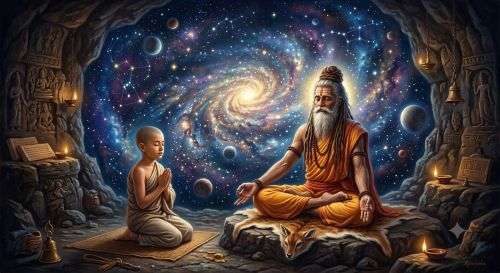
The Upanishadic movement introduces a strikingly different mode of inquiry. The centre of attention shifts from the collective ritual to the teacher and the student, from external performance to inner investigation, and from offering substances into fire to offering ignorance into the fire of knowledge. Meditation requires no assembly of priests, no elaborate apparatus and no external spectacle. The essential instruments are attention, discrimination, discipline and consciousness. In this respect, the Upanishads democratise the spiritual experience at the level of method: the decisive field of investigation is the human mind itself.
Yet Upanishadic teaching is described as private and esoteric not because truth belongs to a privileged few, but because profound knowledge cannot simply be transferred as information. It must be assimilated through preparation and reflection. A scientific principle can be written in a book and examined intellectually; the transformation of consciousness requires a different kind of participation. Hence the extraordinary importance given to the teacher. The celebrated injunction, “Acharya Devo Bhava”—regard the teacher as worthy of reverence—expresses the recognition that knowledge is not merely accumulated but transmitted through a living relationship between one who has understood and one who seeks to understand.
The movement from priestly mediation to philosophical inquiry may therefore be seen as a major victory of wisdom, but not necessarily as a rejection of the priest or of the Vedas. The Upanishads do not destroy the Vedic foundation; they reinterpret its deepest significance. The external fire becomes an inward fire of awareness. The sacrificial offering becomes the surrender of ignorance. The journey toward heaven becomes a journey into the nature of the Self. What was previously represented through ritual symbolism is progressively explored through philosophical questioning.
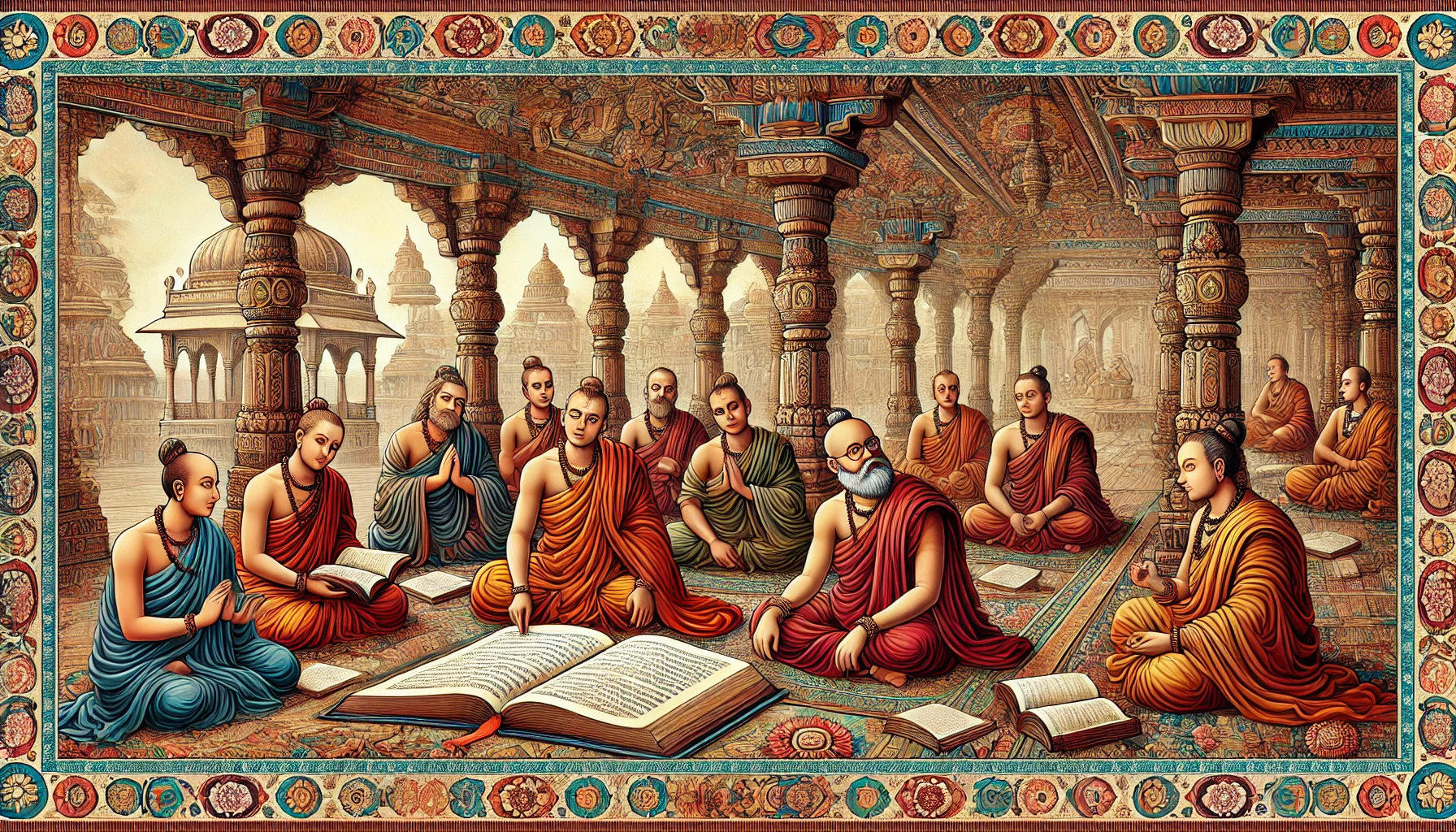
The Vedic tradition also placed extraordinary importance on sound. The Veda was not merely a written text to be read silently. Its preservation depended upon precise pronunciation, intonation, metre and grammatical discipline. The science of recitation developed sophisticated methods to protect the verbal form of the sacred texts from corruption. The relationship between sound and meaning was taken seriously because an alteration of sound could alter meaning and, within the ritual framework, could disturb the intended effect of the recitation. This reflects a remarkable linguistic consciousness. Long before modern phonetics and computational theories of information preservation, the oral tradition developed highly systematic mechanisms for maintaining textual accuracy across generations.
The Upanishads, by contrast, generally place greater emphasis upon meaning than upon ritual recitation. Their language, though capable of great philosophical depth, often has a remarkable economy. A simple question can open an immense field of inquiry. A conversation between teacher and student can move from an ordinary incident to the nature of death, consciousness, reality and immortality. This simplicity is one of their greatest literary strengths. The Upanishads do not always overwhelm the reader with elaborate description; they frequently allow an idea to expand within the mind of the listener.
Their apparent simplicity, however, should not be confused with superficiality. A short Upanishadic statement may contain layers of metaphysical, psychological and ethical meaning. Later philosophical commentaries sometimes make these teachings appear more complicated because commentators attempt to establish precise doctrines, distinctions and systems. Such interpretations are intellectually valuable, but the original beauty often lies in the directness of the question and the profundity of the answer. The distilled nature of Upanishadic wisdom gives it an unusual psychological power: the reader is not merely presented with a conclusion but invited to contemplate it.
The narrative technique of the Upanishads contributes greatly to this power. Like the Vedic literature, they occasionally use stories, dialogues, and carefully constructed encounters. These are not stories designed primarily for entertainment. Their characters function as instruments of philosophical revelation. A small narrative becomes a doorway into a much larger question.
The story of Nachiketa in the Katha Upanishad is an outstanding example. A father, angered by his son’s persistent questioning, declares that he will give him to Yama, the Lord of Death. The statement is made in anger, yet the boy takes it seriously. He goes to the abode of Death and waits. From this apparently simple event begins one of the most profound philosophical conversations in world literature. The story moves immediately from family tension to the fundamental human question: what happens after death? Nachiketa does not seek wealth, pleasure or worldly achievement; he wants to know what lies beyond mortality. His intellectual courage makes him an archetype of the genuine seeker.
The brilliance of the Upanishadic method is that the story does not depend upon fantasy. It does not require spectacular miracles to produce wonder. Its wonder arises from the question itself. Death becomes the teacher, but the teaching is philosophical rather than theatrical. Yama does not simply grant a magical boon that resolves all human problems. Instead, the dialogue distinguishes between the pleasant and the good, between temporary gratification and enduring wisdom. Psychologically, this is profound: human maturity begins when a person learns to distinguish immediate desire from long-term value.
The Brihadaranyaka Upanishad similarly presents philosophical inquiry through powerful dialogues. Yajnavalkya is questioned, challenged, and examined. Knowledge is not portrayed as an unquestionable possession of an authority. It is tested through dialogue. This is an important intellectual characteristic of the tradition. Genuine knowledge should withstand questioning. The willingness to question the teacher, challenge an argument and pursue a difficult idea reveals a temperament that is closer to philosophical investigation than to blind acceptance.
The absence of excessive fantasy in much of the Upanishadic philosophical narrative is itself significant. There are no continuous spectacles of gods descending from heaven to solve human problems. Divine beings may appear, but the decisive transformation generally occurs through knowledge. The emphasis moves from external intervention to internal discovery. The fundamental mystery is not located somewhere in a distant supernatural landscape; it is located within consciousness itself.
This represents a major psychological shift. When a person believes that every problem must be solved by an external power, personal responsibility can become secondary. The Upanishadic approach increasingly turns the seeker inward. The mind becomes the laboratory. Attention becomes the instrument. Meditation becomes the method. Self-knowledge becomes the objective. The central question is not merely, “What exists outside me?” but “Who am I, and what is the nature of the consciousness through which I experience the world?”
The Upanishadic conception of the other world is therefore also different in emphasis from the ordinary idea of heaven as a distant geographical destination. The highest reality is not simply another place to which one travels after death. The boundary between the external world and the inner world becomes increasingly subtle. What a person concentrates upon shapes the quality of his or her experience. The ancient insight that contemplation of a particular object, sound or idea can transform the practitioner anticipates, in a broad psychological sense, the modern understanding of attention and neuroplasticity: repeated attention influences habits of perception, thought and behaviour.

A person absorbed in sound develops sensitivity to sound; one devoted to learning becomes shaped by learning; one who constantly contemplates wealth may organise life around acquisition; one who cultivates compassion may increasingly perceive the world through the lens of compassion. The Upanishads repeatedly return to this relationship between attention and transformation. What we repeatedly contemplate does not remain merely an object outside us; it becomes part of the structure of our personality.
This also explains the Upanishadic interest in sound, speech, breath, mind and consciousness. These are not treated as unrelated phenomena. They are interconnected dimensions of human existence. The Sama tradition, for example, gives extraordinary importance to musical intonation. The Upanishadic mind is fascinated by the possibility that sound can become a vehicle for concentration and transformation. The point is not simply to produce a correct sound but to understand what sound reveals about the relationship between the physical, psychological and spiritual dimensions of existence.
The progression from Veda to Upanishad does not mean that one replaced the other. One of the most remarkable characteristics of Indian civilisation is its capacity to preserve successive layers of thought without necessarily destroying the earlier ones. The Vedas continued; the Brahmanas continued; the Aranyakas continued; the Upanishads emerged; later came the Puranas and the great Kavyas. Each contributed something different. They formed a civilisational ecology of knowledge rather than a single linear system in which the old had to disappear for the new to survive.
This principle of coexistence is deeply consistent with the Upanishadic temperament. A forest does not require only lions. Tigers, deer, birds, insects, trees and countless other forms of life occupy different ecological niches. Their differences do not necessarily constitute a contradiction. The forest survives through interdependence. Modern ecology describes this through biodiversity, food webs, ecological niches and systemic balance. The Upanishadic vision reaches a comparable insight through a spiritual vocabulary: existence is relational, and diversity does not automatically mean disorder.
The same principle can be applied to human society. Every person does not have to perform the same function, possess the same temperament or pursue the same form of excellence. Social harmony does not mean uniformity. It means allowing different capacities to contribute without destroying one another. A healthy society resembles an ecosystem more than a battlefield. Its strength lies in cooperation, differentiation and mutual dependence.
This is why the broader spiritual literature of India can be seen as complementary rather than competitive. The Ramayana, for instance, operates substantially within a world inhabited by human beings, monkeys and demons, while the Mahabharata brings human, divine and extraordinary beings into a more complex interaction. The Bhagavata and later Puranic traditions develop yet another dimension, in which divine play, devotion and mythology become central. These different modes of expression serve different psychological and cultural purposes. Philosophy, ritual, epic, mythology and poetry need not compete for the same function.
The contrast between these traditions is especially illuminating from a psychological perspective. Myth can communicate through imagination; ritual can create collective participation; poetry can evoke emotion; philosophy can sharpen discrimination; meditation can cultivate attention. A mature civilisation may require all these modes because human beings do not learn through one channel alone. Intellectual understanding without emotional depth can become sterile; emotion without discrimination can become unstable; ritual without understanding can become mechanical; imagination without ethical grounding can become escapism.
The Vedic and Upanishadic texts are also striking for their aspiration toward an ordered and peaceful existence. Their ideal is not the glorification of violence, vengeance or domination. The recurring prayers for peace, welfare, prosperity and freedom from suffering reveal an ethical imagination in which individual fulfilment is inseparable from collective wellbeing. “Loka Samasta Sukhino Bhavantu”—may all beings in the world be happy—expresses this expansive moral horizon.
Similarly, “Sarve Jana Sukhino Bhavantu” expresses the aspiration that all people should experience wellbeing, while “Na Kashchit Dukha-Bhag Bhavet” expresses the wish that no one should become a participant in sorrow. These are not merely ornamental religious phrases. They represent a social philosophy: human flourishing cannot be complete if it depends upon the suffering of others.
The repeated invocation of “Om Shanti” reinforces the same aspiration. Peace is invoked not merely as the absence of war but as a condition of balance. In the traditional Shanti Mantras, peace extends outward—from the individual to the environment, from nature to society, from the visible world to the invisible dimensions of existence. In modern terms, this can be understood as an integrated conception of wellbeing in which psychological stability, social harmony and ecological balance are interconnected.
There is also a striking absence of the conventional psychology of enemies in this vision. Where social consciousness becomes organised around permanent opposition—us against them, territory against territory, victory against defeat—conflict becomes self-perpetuating. The Upanishadic approach seeks to discover a deeper unity beneath apparent divisions. If the same fundamental reality pervades existence, then hostility toward another ultimately becomes a form of ignorance about oneself.
This does not mean that the ancient texts deny the existence of conflict in human life. The epics certainly contain war, rivalry, moral ambiguity and suffering. What is distinctive about the Upanishadic perspective is that it searches for the principle beyond conflict. It asks whether human beings can transcend the psychological mechanisms of fear, attachment, ego and vengeance that perpetuate conflict.
Seen scientifically, this is also an investigation into causality. Anger produces certain behaviours; repeated behaviours create habits; habits shape character; character influences relationships; relationships shape society. The sages may not have expressed this in the terminology of contemporary psychology, but their attention to desire, attachment, fear, self-control and discrimination demonstrates a sophisticated interest in the mechanisms of human behaviour.
The Upanishads therefore occupy a unique position between spirituality and rational inquiry. They do not operate as modern science does, because their primary instruments are introspection, dialogue, contemplation and philosophical reasoning rather than controlled laboratory experimentation. Yet they display a scientific temperament in a broader sense: observe, question, discriminate, examine experience and seek underlying principles rather than remaining satisfied with appearances.
Their greatest laboratory is consciousness itself. Their greatest experiment is the disciplined human life. Their central hypothesis is that ignorance creates bondage and knowledge creates freedom. Their method is inquiry. Their teacher is the one who has travelled farther in understanding. Their student is the person willing to question. Their evidence is lived insight. Their ultimate objective is not accumulation of information but transformation of the knower.
That may be the enduring greatness of the Upanishads. They begin with the universe but eventually bring the seeker back to the self. They begin with nature but discover consciousness. They begin with ritual but arrive at knowledge. They begin with the question of what lies beyond the visible and ultimately ask what makes the visible world intelligible to us at all.
The Vedic fire rises upward, carrying the offering from earth toward heaven. The Upanishadic inquiry moves inward, carrying the human mind from appearance toward understanding. One establishes relationship with the cosmos through yajna; the other seeks the foundation of that cosmos through knowledge. Neither needs to destroy the other. Together they represent two dimensions of the same civilisational quest: to live in harmony with the order of existence and to understand the consciousness that seeks that harmony.
The ultimate message is therefore neither withdrawal from life nor domination of nature. It is alignment. The human being must learn to live without violating the larger rhythms of existence. Society must learn coexistence rather than perpetual competition. Knowledge must replace superstition, reflection must refine belief, and compassion must accompany intelligence. The forest does not become beautiful because one species conquers all others; it becomes beautiful because many forms of life coexist within an underlying order.
The sages’ final aspiration is beautifully simple: may there be wellbeing for all, peace for all, and freedom from sorrow. In that aspiration, the Vedic vision of cosmic order, the Upanishadic search for inner knowledge, the ethical responsibility of society and the psychological quest for peace converge into one profound idea: the highest wisdom is not merely knowing the universe, but learning to live in harmony with it.