



The wisdom of the Upanishads begins not with an attempt to measure the universe, but with a profound recognition of the immeasurable. Human knowledge may advance through observation, reason, mathematics and scientific inquiry, yet the greater the field of knowledge becomes, the more clearly the limitations of the individual intellect are revealed. The sages did not regard this limitation as a defeat. On the contrary, they considered the awareness of one’s limitations to be the beginning of true wisdom. The human being is small in the physical vastness of creation, but that smallness does not make him insignificant. Within the limited span of human consciousness lies the extraordinary capacity to contemplate the limitless.
The Īśāvāsya Upanishad expresses this vision in a celebrated declaration:
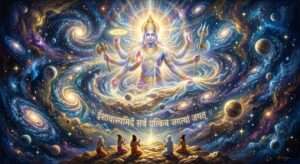
ईशावास्यमिदं सर्वं यत्किञ्च जगत्यां जगत्।
तेन त्यक्तेन भुञ्जीथा मा गृधः कस्यस्विद्धनम्॥
The meaning is profound: everything that exists in this moving and unmoving universe is pervaded by Īśvara. Therefore, one should live with restraint, gratitude and detachment, without coveting what belongs to another.
This is not merely a theological statement. It is a philosophical proposition about existence. The sage observes the universe and arrives at a conclusion that transcends the boundaries of race, nationality, language and religious identity. If the whole of creation is pervaded by the same underlying reality, then no living being can be regarded as completely separate from the rest of existence. The distinction between “mine” and “another’s” becomes a matter of social convention, while the deeper reality remains one.
The Upanishadic seer therefore begins with the universe and ultimately arrives at the human heart. The stars, planets, oceans, mountains, forests, animals, birds, insects, trees, creepers and the smallest forms of life are all parts of one interconnected order. Modern science, through different methods and concepts, has revealed an astonishingly interconnected universe. The ancient sage approached the same mystery through contemplation, disciplined observation and inner inquiry. The languages are different, the methods are different, yet both encourage humility before the magnitude and complexity of existence.
How many forms of life exist in the universe? How many worlds may exist beyond our immediate perception? How many dimensions of nature remain unknown? Humanity does not possess complete answers. Even on Earth, where human beings have lived for thousands of generations, enormous areas of biological, geological, astronomical and psychological knowledge remain unexplored. Every scientific discovery frequently opens another field of questions.
A human lifetime is therefore extraordinarily brief when compared with the age and expanse of the cosmos. Even if knowledge is systematically divided into sciences, arts, philosophies and specialised disciplines, no single individual can master the complete structure of even one branch of creation. Before the seeker has reached the end of one inquiry, life itself may have reached its end. Desires remain, questions remain, and the search for understanding continues beyond the individual.
The sages of India recognised this truth with remarkable intellectual honesty. Their greatness did not arise from claiming omniscience. It arose from recognising the limits of human knowledge and directing the mind toward the deeper source of existence. The wise person does not say, “I know everything.” He says, in effect, “What I know is little; what remains unknown is immeasurable.” Such humility is not weakness. It is the intellectual foundation of genuine inquiry.
The Upanishadic tradition consequently places knowledge and surrender side by side. Knowledge without humility can become arrogance; surrender without discrimination can become superstition. The sages sought a balance in which reason investigates, experience tests, contemplation deepens, and humility protects the seeker from mistaking partial knowledge for absolute truth.
The famous opening mantra of the Īśāvāsya Upanishad gives this philosophy a universal dimension. The expression “ईशावास्यमिदं सर्वम्” does not confine the presence of Īśvara to a temple, scripture, community or geographical boundary. It presents existence itself as sacred. The divine is not merely somewhere beyond the universe; the universe itself is understood as pervaded by the divine principle.
This perception transforms the relationship between human beings and nature. If the river is merely an object, it may be exploited without restraint. If the river is regarded as part of a sacred order, human conduct toward it changes. If a forest is merely a commercial resource, its value can be reduced to timber and land. If it is understood as part of the living fabric of creation, preservation becomes an ethical responsibility.
The same principle extends to animals and the smallest creatures. A person who has internalised the wisdom of Īśāvāsya does not need to search for divinity only in extraordinary places. He begins to recognise the dignity of life itself. The ant crawling across the ground, the bird searching for food, the tree standing silently in the wind and the human being contemplating the meaning of existence are all participating in the same vast order of nature.
There is a beautiful ethical consequence in such awareness. Compassion ceases to be an artificial virtue imposed from outside; it becomes the natural expression of understanding. If the same existence flows through all beings, unnecessary cruelty becomes a contradiction of one’s own spiritual knowledge.
The Indian tradition repeatedly expresses this principle through stories in which compassion is not confined to the learned or powerful. The great narratives of the Rāmāyaṇa, Mahābhārata, Purāṇas and various dharmic traditions demonstrate that wisdom can emerge from unexpected places. Social status and formal scholarship do not automatically determine the depth of a person’s understanding.
The Vālmīki Rāmāyaṇa is particularly significant in this regard. Its world is not populated merely by kings and sages. It includes forest-dwellers, hunters, tribal communities, vānaras, bears, birds and innumerable forms of life. The epic repeatedly demonstrates that moral insight may appear in a person whose social position or formal education does not correspond to conventional measures of scholarship.
Guha, for example, represents loyalty, affection and hospitality without being presented as a conventional intellectual. The vānaras who assist Rāma are not defined by the institutions of formal learning, yet their courage, loyalty, intelligence and practical understanding become indispensable to the larger mission. Hanuman himself represents an extraordinary synthesis of knowledge, strength, humility, diplomacy and devotion.
The lesson is significant: education is not merely the accumulation of information. Learning becomes wisdom only when it develops discrimination, responsibility and the capacity to act rightly.
The same idea appears elsewhere in the dharmic tradition through the story of Dharmavyādha, who teaches the learned Kauśika about the subtle dimensions of dharma. The narrative deliberately overturns the assumption that formal scholarship alone guarantees wisdom. A person may possess extensive knowledge of texts and yet remain immature in conduct, while another may acquire profound understanding through disciplined work, observation, responsibility and service.
This is one of the most remarkable features of the Indian conception of knowledge. Knowledge is not confined to books. It arises through śravaṇa—listening; manana—reflection; and nididhyāsana—deep contemplation. It also arises through experience, observation, ethical conduct and self-correction. The individual is expected not merely to receive knowledge but to transform it into wisdom.
The Upanishadic sage therefore appears almost like a scientist of consciousness. He observes the external world, but he also turns the instrument of observation upon the observer himself. What is the self? What is consciousness? What is the relationship between the individual and the universe? What remains when desires, possessions, social identities and temporary emotions are removed? These are not superficial questions. They represent an early and profound investigation into the nature of human existence.
The famous Upanishadic declaration may therefore be read as both spiritual insight and ethical philosophy:
ईशावास्यमिदं सर्वं यत्किञ्च जगत्यां जगत्।
Everything that moves and everything that does not move is pervaded by the divine.
The phrase “यत्किञ्च”—whatever there is, however small—has particular significance. It leaves no convenient exception. The sacred is not restricted to what human beings consider beautiful, powerful or important. The smallest existence also belongs to the totality of creation.
This vision produces a different kind of human personality. Such a person does not consider strength a license for domination. Knowledge does not become an instrument of humiliation. Wealth does not become an excuse for exploitation. Social position does not become a justification for arrogance. Instead, strength becomes protection, knowledge becomes service, wealth becomes responsibility and position becomes an opportunity to preserve justice.
The ethical culmination is compassion.
अद्वेष्टा सर्वभूतानां मैत्रः करुण एव च।
निर्ममो निरहङ्कारः समदुःखसुखः क्षमी॥
The Bhagavad Gītā describes the person dear to the Divine as one who bears no hatred toward any living being, who is friendly and compassionate, free from possessiveness and ego, balanced in pleasure and pain, and forgiving.
This philosophical continuity between the Upanishads and the Gītā illustrates a fundamental feature of Indian spiritual thought: the highest truth is expected to produce a transformation in conduct. Spiritual knowledge that does not generate compassion remains incomplete.
The great civilisational tradition of Bhārata Varṣa was nourished by this relationship between knowledge and conduct. Its intellectual heritage is vast: the Vedas, Upanishads, Itihāsas, Purāṇas, Buddhist and Jain scriptures, philosophical systems, classical literature, regional traditions, folk narratives and countless streams of oral knowledge. These traditions developed across different periods and communities, yet many of them participated in a larger civilisational conversation about dharma, truth, conduct, liberation and the relationship between human beings and the cosmos.
The civilisation was not sustained by a single institution or a single generation. Sages, ṛṣis, teachers, householders, ascetics, monks, poets, philosophers, artisans and ordinary people carried different portions of the tradition forward. Its continuity was therefore not merely the continuity of texts; it was the continuity of values.
The great civilisational structure stood upon principles such as satya, dharma, ahiṃsā, justice, self-restraint, compassion, hospitality and responsibility. These principles did not require a physical fortress to protect them. Their real protection was the human conscience.
The Vedic vision itself contains a remarkable movement from ritual consciousness toward universal consciousness. Fire, water, air, earth and space were approached not merely as physical substances but as fundamental dimensions of the cosmic order. The ancient reverence for the elements encouraged a relationship with nature that was based upon gratitude rather than unlimited consumption.
This does not mean that ancient society possessed modern scientific knowledge in the contemporary sense. It means that the sages cultivated a disciplined habit of observation, classification, reasoning and contemplation. Their scientific temperament emerged within the conceptual language available to them. They investigated astronomy, mathematics, medicine, grammar, logic, linguistics, psychology, philosophy and natural phenomena, while simultaneously asking questions about consciousness and existence.
The greatness of that approach lies not in pretending that ancient knowledge and modern science are identical. They are not. Their methods, instruments and standards of verification differ. Yet there is a meaningful common spirit: curiosity, observation, disciplined inquiry, recognition of patterns and willingness to examine assumptions.
The true legacy of the sages is therefore not merely a collection of ancient conclusions. It is the cultivation of an enquiring mind.
The ideal human being in this tradition is neither blindly traditional nor blindly modern. He observes, questions, learns, reflects and evolves. He respects inherited wisdom while examining it through reason and experience. He understands that tradition survives not by refusing to change, but by preserving its essential values while allowing knowledge to grow.
The stories of Rantideva, Śibi, Bali, Alarka and Dadhīci express another dimension of this ethical inheritance. Their narratives celebrate generosity, sacrifice, protection of others and dedication to a principle greater than personal comfort. Whether read literally, symbolically or ethically, these stories ask the same fundamental question: what is the value of human life if it is lived entirely for oneself?
The answer offered by the civilisational tradition is that life acquires depth through relationship—with other human beings, with society, with nature and ultimately with the universal reality that sustains existence.
The person who sees the divine in all beings cannot remain indifferent to suffering. His knowledge naturally moves toward compassion. His compassion becomes service. His service becomes social responsibility. Social responsibility becomes civilisation.
Thus, the journey from Īśāvāsya to society is not a movement away from spirituality. It is the practical fulfilment of spirituality.
When the mind understands that existence is interconnected, hatred begins to lose its intellectual foundation. When the heart understands that life is shared, cruelty becomes difficult to justify. When knowledge is joined with humility, arrogance declines. When wealth is joined with responsibility, generosity becomes possible. When power is joined with dharma, protection replaces domination.
This is why the guiding lights of a society are not merely its rulers, wealthy people or celebrated scholars. They are those who preserve the moral imagination of the community. Sages, teachers, philosophers, poets, reformers and ordinary individuals who live by truth can influence generations long after their physical lives have ended.
The ultimate message of the Upanishadic vision is therefore neither that man is the master of the universe nor that man is insignificant before it. Man is a participant in a reality vastly greater than himself. His physical existence may be tiny in cosmic terms, yet his capacity for awareness gives him a unique responsibility. He may not be able to understand the entire universe, but he can understand how he ought to live within it.
That may be the most practical wisdom of all.
A human being cannot count every star, examine every atom, understand every species or comprehend every mystery of consciousness within one lifetime. But he can learn compassion. He can restrain greed. He can protect the weak. He can respect nature. He can seek truth. He can forgive. He can serve. He can live without deliberately causing unnecessary suffering.
And in doing so, the small human life becomes connected with something immeasurably larger.
The fragrance of such humanity does not remain confined to one person. It moves through families, communities and generations. A society that teaches its children to see dignity in every form of life creates a culture of compassion. A society that combines knowledge with humility creates intellectual freedom. A society that joins freedom with responsibility creates stability. A society that places dharma above selfish interest creates the conditions for enduring civilisation.
The ancient Indian sages understood that the greatest revolution begins within consciousness. The transformation of society is ultimately a transformation of the individual mind—from possession to participation, from arrogance to humility, from indifference to compassion, and from fragmentation to the awareness of unity.
The Īśāvāsya vision therefore remains a guiding light not because it asks humanity to abandon reason, but because it asks reason to recognise its own limits; not because it rejects the material world, but because it asks humanity to use material resources without greed; and not because it separates spirituality from life, but because it seeks to make every dimension of life conscious of its sacred interconnectedness.
The universe remains immeasurably vast. Human knowledge remains incomplete. The mystery of existence remains open. Yet within that vastness, the human being possesses one extraordinary possibility: to live wisely.
ईशावास्यमिदं सर्वं यत्किञ्च जगत्यां जगत्।
To recognise this truth is knowledge.
To live by it is dharma.
To extend its spirit to every living being is compassion.
And to preserve that compassion across generations is the true work of civilisation.

