Lakshmanrao Upadhyayula
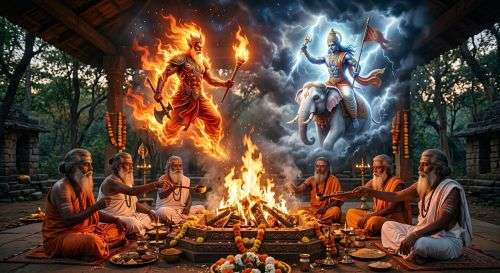
The great sage Vishwamitra, endowed with profound spiritual insight, invoked the divine presence of Agni through the majestic metres of Bruhathi and Tristubh found in the sacred hymns of the Rigveda. In these exalted invocations, Agni is not merely the visible flame kindled upon the sacrificial altar, but the eternal cosmic principle hidden within creation itself. The sage praises Agni as the grandson of the celestial waters, born from the mysterious union of heaven and earth, luminous in splendour, wealthy in divine abundance, harmless to the righteous, and easily appeased by sincere devotion. Agni stands as the most worthy receiver of offerings from all the worlds, the sacred mediator through whom the aspirations of humanity ascend towards the gods. Human beings approach him not with fear, but as companions seeking refuge, guidance, and protection amidst the uncertainties of earthly existence.
The hymns portray Agni as the protector of forests, the hidden energy residing within trees, herbs, waters, and all forms of life. The ancient seers perceived fire not merely as a physical phenomenon, but as the latent force concealed in nature, emerging through friction, lightning, or sacrificial invocation. In a remarkable expression of spiritual symbolism blended with observational wisdom, Agni is invited to unite with the motherly waters and assume a peaceful form. Yet the sage also recognises that absolute stillness does not belong to Agni’s nature, for fire exists through movement, transformation, and dynamic energy. Even when distant, Agni is requested to remain within a benevolent reach of humanity, granting warmth, illumination, and prosperity without bringing destruction. Such reflections reveal the subtle balance understood by the Vedic mind between the constructive and destructive potentials hidden within the forces of nature.
Agni is described as the intimate knower of the desires of priests and sacrificers. He understands the silent intentions behind ritual acts and fulfils the aspirations of those who approach with sincerity and discipline. The Ritvija priests, custodians of sacred rites, move in various directions to conduct rituals according to cosmic order, while others remain seated around the altar, preserving the sanctity of the sacrifice through chants and contemplation. The sacrificial arena thus becomes a symbolic model of the universe itself, where every movement, direction, sound, and offering reflects the harmony of cosmic law. Agni, dwelling at the centre of this sacred arrangement, unites earthly activity with celestial purpose.
The imagery of Agni resting like a lion hidden within mountain caves or concealed in the waters reveals the profound poetic vision of the Vedic seers. Fire lies dormant within wood, within clouds, within the unseen energies of existence, awaiting manifestation. When awakened through churning, Agni rises with irresistible force and defeats hostile powers just as divine wisdom destroys ignorance and chaos. The immortal and betrayal-free Viswedevas recognise this cosmic Agni as the sustaining principle behind sacrifice, order, and life itself. The comparison of Agni being drawn forth like a wandering son brought back by his father symbolises humanity’s rediscovery of divine knowledge concealed within nature. Carried upward by the moving winds, the sacrificial flame becomes the messenger transporting offerings from the mortal realm to the immortal worlds.
The Vedic vision presents Agni as the perpetual well-wisher of humanity, eternally youthful despite his ancient origin. He presides over the yajna with sovereign majesty, regulating the sacred exchange between gods and men. Because he carries oblations to the celestial realms, humanity reveres him as the divine messenger, bridging visible and invisible existence. The evening sacrifice, enriched by the blazing sacred grass and clarified butter, transforms the altar into a radiant field of spiritual energy. Agni’s actions are compared to the skilful works of a master craftsman, for he shapes, purifies, transforms, and elevates all that enters his domain. Like a beloved child recognised by every household, Agni is universally known, dwelling silently within logs and wood until invoked into luminous manifestation.
The hymns further celebrate Agni as omnipresent, swift-moving, ancient, and eternally worthy of worship. His presence extends beyond the sacrificial fire into every aspect of cosmic existence. The Vedic sages envisioned the universe itself as sustained by hidden currents of radiant energy, symbolised through Agni’s all-pervading form. The sacred tradition speaks of three thousand three hundred and thirty-nine celestial hosts worshipping Agni, nourishing him with clarified butter and preparing expansive holy seats for his presence. Thereafter the gods themselves established Agni as the Hota priest upon the sacred altar, affirming his supreme role in maintaining the divine order of sacrifice. Such imagery reflects the Vedic understanding that cosmic harmony depends upon reciprocity, offering, discipline, and the constant circulation of energy between all realms of existence.
The reflections then ascend from the external fire of sacrifice to the inner fire of consciousness. The thoughts of the seers transcend ordinary human understanding, penetrating into the mysteries of mind, life, and truth. The mind is recognised as the sovereign ruler of the human body and its organs. Without the command of mind, no sense organ can function meaningfully. The eyes may see forms, yet without the participation of mind there can be no understanding. Though invisible like the sky, the mind possesses movement, vitality, and immeasurable subtlety. It cannot be regarded as lifeless merely because it escapes physical perception. Rather, it remains the essential instrument through which life becomes purposeful, organised, and conscious.
The Vedic seers recognised that the true distinction of human beings lies not merely in physical form or ancestral lineage descending from Manu, but in the possession of reflective and self-aware intelligence. Mind becomes both the key and the gateway to bondage as well as liberation. Thoughts emerge from the vast inner expanse of mind just as clouds arise within the infinite sky. Even modern scientific inquiry, despite measuring extraordinary velocities and discovering subtle forces within nature, finds itself unable to surpass or fully comprehend the speed and depth of the human mind. Yet the sages caution that the entire proclamation of mind does not constitute ultimate truth. Mental activity alone cannot reveal the eternal reality hidden beyond appearances. Therefore humanity must continue to inquire deeply, transcending superficial knowledge in search of the highest truth.
Thus the contemplations of the Vedic seers unite spiritual insight with disciplined observation, devotion with inquiry, and metaphysical vision with an early scientific temperament. Their exploration of Agni symbolises not only the sacred fire upon the altar but also the radiant energy permeating the cosmos and the inner illumination dwelling within consciousness itself. Their analysis of truth, prayer, sacrifice, and mind extends beyond the visible universe, inviting humanity into an endless journey toward wisdom, harmony, and transcendental understanding.