
There are some infrastructure projects whose importance goes far beyond the concrete, steel and wires that go into building them. They change the destiny of an entire region. The Srinagar–Alusteng–Drass–Kargil–Khaltsi–Leh 220 kV Transmission Line is one such project.
On February 3, 2019, Prime Minister Narendra Modi formally dedicated this remarkable piece of high-altitude infrastructure to the nation. Built by Power Grid Corporation of India Limited (POWERGRID) over approximately 335 km at a cost of around ₹2,266 crore, the transmission line connected Leh and Kargil to the National Electricity Grid for the first time.
For a region as strategically important and geographically inhospitable as Ladakh, this was much more than an electricity project. It was an assertion of connectivity, resilience and national integration.
Before this link was commissioned, Ladakh largely depended on an isolated power system. The challenge became particularly severe during the long and brutal Himalayan winter. River flows would fall sharply, affecting run-of-the-river hydropower projects such as NHPC’s 45-MW Nimoo-Bazgo and 44-MW Chutak projects. Smaller streams could freeze, while access to the region became extremely difficult as mountain passes were buried under snow.
Consequently, huge quantities of diesel had to be transported and stockpiled before winter to keep homes, hospitals, military establishments and essential services functioning.
The construction of the transmission line itself was an extraordinary engineering feat.
The line traverses some of the most difficult terrain on the planet, crossing formidable mountain passes including Zoji La, at around 11,580 feet, and Fotu La, at approximately 13,480 feet. Some tower locations reach elevations of nearly 13,500 feet.
At such heights, conventional engineering solutions were simply not enough. POWERGRID worked with the Defence Research and Development Organisation’s Snow and Avalanche Study Establishment (SASE) to identify safer tower locations and account for avalanche and snow-related risks. Special foundation designs were required to withstand the harsh conditions and the movement of snow in vulnerable corridors.
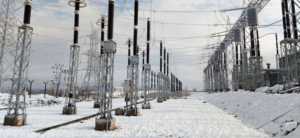
Altitude created another challenge. At extreme elevations, reduced air density affects the electrical insulation characteristics of overhead transmission systems and increases the possibility of arcing. Engineers therefore had to provide appropriate clearances and optimise insulation arrangements. Compact Gas-Insulated Substations were deployed at locations including Drass, Kargil, Khaltsi and Leh, helping overcome the severe constraints imposed by terrain and weather.
Then came the most unforgiving constraint of all—time.
Construction activity in these high-altitude areas could effectively be undertaken only during a short summer window of roughly four to five months. Machinery, material and manpower had to be moved across difficult terrain, with some stretches requiring manual handling and specialised logistics.
When the project was commissioned in 2019, it marked a decisive turning point. Leh and Kargil gained access to a more reliable, year-round supply of electricity from the national grid, reducing their dependence on diesel-based generation, particularly during the harsh winter months.
But the significance of the project goes beyond the towns it initially connected.
Remote areas such as Zanskar, Nubra and parts of the Changthang plateau required subsequent extension and distribution projects. The primary transmission corridor, however, provided the backbone upon which this wider network could progressively develop.
That is why this project deserves to be remembered not merely as a power transmission line but as a symbol of a changing Bharat.
For decades, some of the country’s most remote and strategically sensitive regions lived with the disadvantages of geographical isolation. Roads, telecommunications, electricity and other basic infrastructure often arrived slowly, constrained by terrain and weather.
Today, the story is changing.
From tunnels and all-weather roads to bridges, railways, optical fibre and power transmission, infrastructure is steadily pushing deeper into India’s most difficult frontiers. In Ladakh, every kilometre of such infrastructure carries a significance that is economic, social and strategic.
The 220-kV transmission line is therefore a powerful reminder that nation-building is not always dramatic. Sometimes it happens quietly—tower by tower, kilometre by kilometre—until an entire region is transformed.
The lights that now remain on through the Himalayan winter tell that story better than any slogan ever could.
Bharat is rising—not merely in its cities and economic centres, but in its mountains, its borders and its remotest frontiers.