



Sanjaya continued his solemn narration to King Dhritarashtra. After the mighty hosts of Magadha had been subdued, Karna advanced with unshaken determination and encountered the formidable Trigarta warriors. Across the vast battlefield, where the destiny of kingdoms was being forged in blood and steel, the invincible Arjuna, guided by the unfailing wisdom of Krishna, moved like a blazing celestial force. Under Krishna’s masterful direction, the chariot glided effortlessly through the turmoil while Arjuna released a ceaseless stream of divine weapons upon the advancing enemy. United by unwavering resolve, the Kaurava warriors hurled the full measure of their strength, their finest weapons, and the combined might of their fourfold army. Yet every missile that rushed toward Arjuna was shattered into countless fragments by his flawless skill, falling harmlessly upon the earth. Many of those broken weapons rebounded upon the Kaurava ranks themselves, bringing injury and confusion to their own warriors.
Krishna steered the chariot across different sectors of the battlefield, revealing to Arjuna the dreadful harvest of war. Everywhere lay mountains of shattered weapons, broken chariots, severed standards, royal umbrellas, ceremonial fans, and the lifeless bodies of renowned warriors. Horses writhed in agony, elephants collapsed with severed trunks and shattered limbs, while countless foot soldiers lay motionless beneath the dust of Kurukshetra. Search parties wandered anxiously among the dead, unable to recognize their own companions until familiar faces emerged from beneath blood and dust. The cries of grief that followed echoed through the plain as brothers, fathers, and sons mourned those whom destiny had claimed. Witnessing such immeasurable destruction, Krishna and Arjuna were filled with profound compassion, even amid the relentless demands of battle.
Perceiving fresh unrest in another quarter of the field, Krishna directed the chariot toward the rising commotion. There Duryodhana and Karna had united after engaging different divisions of the Pandava army. At Duryodhana’s command, the valiant forces of the Bahlikas, Pulindas, Tenkanas, Andhras, and Bhojas gathered around Karna, swelling his strength into a formidable tide that pressed heavily upon the Pandava ranks. For a time the advancing multitude disturbed the Pandava formations, threatening to overwhelm them by sheer numbers.
At that critical moment the illustrious Pandya king, Malayadhwaja, surged forward like an untamed tempest. Endowed with extraordinary strength and indomitable courage, he crashed through the Kaurava divisions, leaving behind heaps of fallen warriors, shattered chariots, slain elephants, and riderless horses. His heroic spirit blazed with confidence as he proclaimed that his valor rivaled even that of Bhishma and Drona, and that he would crush the Kaurava army beneath the weight of his mighty arms. His fearless challenge resounded across the battlefield, inspiring the Pandavas while unsettling the hearts of their enemies.
Observing this magnificent display, Ashwatthama smiled with fierce resolve and addressed the Pandya monarch. He declared that Malayadhwaja was scattering the Kaurava hosts like a lion charging through helpless deer, and boldly invited him to face a warrior worthy of his strength. The Pandya king, his heart overflowing with martial enthusiasm, answered with a relentless shower of arrows. Ashwatthama responded instantly with nine keen shafts that struck their mark, and the two heroes became locked in a terrible duel. Bows splintered, weapons shattered, and celestial missiles flashed through the heavens as each sought mastery over the other.
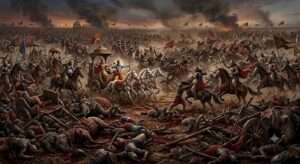
Ashwatthama invoked one sanctified astra after another with flawless precision, but Malayadhwaja neutralized those divine weapons through the power of the Vayavyastra. Displaying astonishing prowess, the Pandya king slew Ashwatthama’s chariot guards, scattered his supporting warriors, broke his standard, killed his horses and charioteer, shattered his bow, and continued to rain arrows with irresistible vigor. Yet Ashwatthama answered every assault with equal balance and unwavering composure, matching every stroke with another of equal force, never allowing his determination to falter.
Then Malayadhwaja advanced at the head of a mighty elephant corps, unleashing another devastating torrent of arrows. One powerful shaft struck Ashwatthama’s gem-studded crown, sending it crashing to the ground. The son of Drona, stung by this humiliation, blazed forth like an enraged serpent pursuing its prey. With terrifying swiftness he slew the foremost guards surrounding the Pandya king, severed the trunk and limbs of the royal elephant, and finally, with irresistible precision, cut off Malayadhwaja’s head before reducing his body to pieces. Bereft of their sovereign, the Pandya forces dissolved in terror and fled from the battlefield. Witnessing this astonishing feat, Duryodhana openly applauded the unmatched valor of Ashwatthama.
The fall of the Pandya king stirred Bhimasena to righteous fury. Charging into the Kaurava ranks with irresistible force, he was supported by Dhrishtadyumna and Satyaki, whose combined valor revived the courage of the Pandava army. Together they struck the Kaurava divisions with such coordinated power that many warriors found themselves unable to withstand the assault and gradually withdrew before their advancing fury. Karna, however, filled with unyielding pride, continued to hurl himself against the foremost Pandava warriors, while Ashwatthama stood steadfast beside him, cutting down numerous Panchala heroes with deadly precision.
Krishna informed Arjuna of the glorious yet tragic death of King Malayadhwaja and carefully described the extraordinary strength displayed by the champions on both sides. Understanding that the decisive hour was drawing near, Krishna guided the celestial chariot into the very heart of the battlefield, where the armies instinctively formed around their greatest warriors. The Pandavas gathered behind Arjuna, while the Kauravas rallied around Karna, preparing for another colossal confrontation that would determine the course of the war.
Karna and Dhrishtadyumna then met in a fierce contest. Clouds of arrows darkened the sky as standards, royal umbrellas, banners, and shining armor were shattered beneath their deadly exchanges. Each warrior inflicted grievous wounds upon the other, neither yielding an inch of ground. Amid this raging conflict, Ashwatthama turned toward Dhrishtadyumna and cried aloud that the slayer of his father should cease fleeing and prepare to receive the punishment he deserved. He vowed that only the death of Dhrishtadyumna could avenge the fall of Drona.
Dhrishtadyumna answered without fear or hesitation. He declared that the very sword which had severed Drona’s head awaited another sacred purpose—the beheading of Ashwatthama himself. He questioned the righteousness of one who claimed the dignity of a Brahmin while choosing the path of relentless warfare, and denounced the hypocrisy of accusing others of sin while wielding weapons with merciless intent. Mocking his adversary’s arrogance, Dhrishtadyumna challenged him to join his father without delay if he possessed the courage he professed. Their words burned with ancient hatred, and their accusations were as sharp as the arrows that flew unceasingly between them.
While this bitter exchange unfolded, Karna pressed fiercely against Uttamauja, the Upapandavas, the Saini princes, and the brave warriors of Panchala and the Pandava host. Simultaneously, Dhrishtadyumna shattered Ashwatthama’s bow, but the son of Drona immediately seized another weapon. With remarkable speed he slew Dhrishtadyumna’s charioteer, destroyed his chariot, killed his horses, broke his bow and standard, and tore down his banner. When Dhrishtadyumna grasped a mace and later a spear to continue the struggle, Ashwatthama destroyed both before they could be brought into action, displaying astonishing mastery in every movement.
Thus Sanjaya faithfully unfolded the dreadful sequence of events before the sorrow-laden King Dhritarashtra. His narration neither favored victory nor concealed defeat, but reflected the battlefield with calm and measured truth. As the web of war grew ever more intricate, every triumph carried the seed of fresh tragedy, every act of heroism demanded another sacrifice, and the fate of the Kuru dynasty drew steadily toward its inevitable and irreversible end.

