



The aged king Dhritarashtra, restless with anxiety, urged Sanjaya to narrate the course of events unfolding in the camp of the Pandavas. Sanjaya began, saying that after the fierce exchange between the sons of Pandu, Lord Krishna continued His discourse with serene wisdom, seeking to restore harmony among minds inflamed by grief, anger, and wounded pride. He desired not merely to settle a dispute but to reveal the subtle principles by which righteousness must be understood and practiced.
Krishna addressed Arjuna with profound compassion. “Listen carefully,” He said. “Every righteous course of action possesses two subtle dimensions. One is the outward observance of duty, and the other is the hidden spirit that gives life to that duty. One who clings only to the letter of a vow while ignoring its deeper purpose walks into error. The noble son of Dharma, who has ever desired the welfare of others and who embodies truth, justice, and compassion, is not one whom you should even contemplate harming. The path upon which your anger now leads you is not the path of righteousness.”
He continued, “In the fervor of youth, without fully understanding the intricate ways of the world, you made a solemn vow. Yet every vow must remain subject to the higher law of Dharma. There are occasions when truth and falsehood cannot be judged merely by their spoken form. Wise men never approve rigid adherence to words when such adherence destroys the very purpose for which righteousness exists.”
Krishna then unfolded one of the profoundest principles of moral philosophy. “A falsehood spoken to preserve innocent life bears no stain upon the soul. On the other hand, a truth that causes needless destruction, leads the righteous astray, or brings ruin upon the innocent cannot claim the sanctity of Dharma. This has been the testimony of the sages and the enduring wisdom handed down by our ancestors. Anyone can proclaim facts exactly as they are, for that demands little discernment. But to speak words that protect life, preserve justice, and uphold the greater good often requires extraordinary wisdom, foresight, and mastery over one’s own mind.”
To illuminate this truth, Krishna narrated an ancient episode from Bharata Varsha. “There once lived a Brahmin named Kaushika. Though sincere in his austerities, he had not deeply understood the teachings of enlightened elders. Dwelling near sacred rivers and holy places, he undertook severe penance and vowed never to utter anything except the literal truth. His steadfastness won him the reputation of being a great lover of truth.”
“One day,” Krishna continued, “a group of innocent travelers, pursued by ruthless thieves, fled into the forest and concealed themselves among thick bushes surrounding the hermitage. Soon the robbers arrived and questioned the hermit about their whereabouts. Kaushika, believing that speaking anything other than the literal truth would condemn him to sin, pointed toward the hidden travelers. The thieves immediately found them, murdered them mercilessly, and carried away their possessions. Though Kaushika had spoken the truth, his truth became the instrument of violence. Because he failed to exercise discrimination between literal truth and righteous truth, he incurred the consequences of that grave error and fell into suffering after death.”
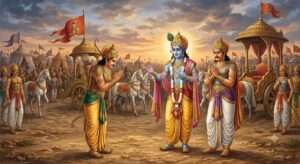
Krishna paused before drawing the lesson. “This ancient Itihasa has been treasured by the wise through countless generations. Truth that becomes the cause of violence ceases to be righteous. One who stubbornly follows his own understanding without seeking the guidance of enlightened elders may unknowingly descend into misery. Therefore, reflect carefully before judging whether your elder brother deserves punishment or death merely because of words spoken in anguish.”
Arjuna’s heart, clouded by anger only moments earlier, now became calm beneath Krishna’s wisdom. Bowing inwardly before his divine guide, he said, “O Krishna, as loving parents rescue their child from danger, so have You delivered me from an act of immeasurable sin. Who else in this world possesses such perfect understanding of righteousness? Show me a path by which I may preserve my honour without harming my noble brother. Guide me so that I neither violate my vow nor incur the blame of abandoning my sacred duty.”
Krishna replied gently, “The son of Dharma was grievously wounded by Karna’s relentless arrows. Enduring unbearable pain, he spoke harshly only because of his suffering. His heart is naturally free from hatred. Bhima, you, Nakula, and Sahadeva have always obeyed him with reverence. Such a righteous soul should never become the object of your anger. There is a simple means to fulfil your vow without causing harm. Address your elder brother merely by his personal name instead of with the reverence due to him. In our tradition, this is considered a symbolic act of dishonour. Immediately thereafter, bow before him with folded hands, emptying your heart of every trace of resentment. His sorrow will vanish, and your own mind will find peace.”
Following Krishna’s counsel, Arjuna turned toward Yudhishthira. Though his words were sharp, they sprang not from hatred but from the necessity of fulfilling his vow. “Bhima,” he declared, “whose unmatched strength can crush mighty armies, has every right to reproach me if I abandon the battlefield. But how can you, O King, speak words that belittle my courage? Have I ever fled from battle? Have Nakula or Sahadeva, despite their countless victories over enemies, ever spoken to me in such a manner? Ever since your acceptance of the game of dice, we have endured exile, humiliation, servitude, and endless hardship. Our kingdom was lost, our honour tested, and our lives burdened with sorrow. Yet even after all these sufferings, your words today have pierced my heart more deeply than the arrows of the enemy. Patience is indeed a noble virtue, but patience without strength invites contempt. Let the mistakes of the past remain behind us. Henceforth abandon every thought that weakens our resolve, and let us together complete the duty that destiny has placed before us.”
Having uttered those painful words, Arjuna was overcome with unbearable remorse. His heart grew heavy, and with a deep sigh he drew his sword from its sheath. Krishna immediately perceived his intention and asked, “What is this, Partha?”
Arjuna answered sorrowfully, “Having spoken contemptuously to my revered elder brother, I have incurred a sin worthy of death. The expiation for such an offence is to sever my own head.”
Smiling with infinite compassion, Krishna restrained him. “The wise declare,” He said, “that self-glorification is equal to self-destruction. Instead of taking your life, praise your own achievements. In that way the vow shall be fulfilled without committing a greater sin.”
Accepting the divine instruction, Arjuna held the Gandiva firmly and declared, “In all the three worlds, none equals my mastery of archery except the great Lord Shiva Himself. It was by my victories that immeasurable wealth was gathered from mighty kings to perform your Rajasuya sacrifice. Vast confederations of powerful rulers have been subdued by my bow. The armies of the Kauravas have fallen before my arrows, and only a few remain to witness their inevitable defeat.”
Having completed this symbolic atonement, Arjuna’s pride dissolved instantly. His face softened with humility. Casting aside every trace of ego, he prostrated himself before Yudhishthira. With folded hands and tear-filled eyes, he sought forgiveness from the son of Dharma, who embraced him with boundless affection. The bitterness vanished, and the unity of the Pandava brothers stood restored through the wisdom of Krishna.
Concluding his narration, Sanjaya said to Dhritarashtra, “Such is the incomparable greatness of Krishna’s understanding of Dharma. He revealed that righteousness is not a rigid chain of rules but a living wisdom governed by compassion, discernment, and the preservation of justice. Whoever follows this noble path, guided by discrimination rather than blind attachment to words, is freed from the burden of sin and walks steadily toward the highest good.”

