



The battlefield had become a blazing altar where courage alone was worthy of worship. While the blind king Dhritarashtra listened with an anxious heart, Karna stood like an unconquerable mountain amidst the roaring conflict. Engaged in fierce combat with Satyaki, Karna pressed forward relentlessly toward Dhrishtadyumna. Satyaki pursued him closely, covering the skies with ceaseless flights of arrows, determined that the mighty son of the sun should not advance unchallenged. Around them, the foremost heroes of both the Pandava and Kaurava armies met in dreadful combat. Warriors abandoned every thought of personal safety, counting neither wounds nor death, but only the honor that springs from fearless duty.
The eight valiant princes of the Panchalas advanced together with magnificent chariot divisions, surrounding Karna from every direction. Their united assault resembled storm clouds gathering around a radiant peak, yet the son of Radha remained immovable. Employing celestial weapons with astonishing mastery, he shattered their ranks. His arrows flashed like tongues of consuming fire, cutting down every one of the Panchala princes along with countless supporting warriors. The field echoed with the crash of shattered chariots, the cries of wounded elephants, and the fall of heroic men whose fame would forever live in the songs of generations.
The spectacle drew the admiration of every warrior and even the celestial hosts who watched from the heavens. None among the combatants betrayed the faintest scent of fear. Every hero displayed extraordinary fortitude, proving that true valor shines brightest when death stands nearest. The warriors of the Chedi and Panchala kingdoms launched repeated assaults upon Karna, hoping to arrest his irresistible advance. Yet he swept through their formations with terrifying force, leaving the battlefield strewn with fallen soldiers as though a blazing forest fire had consumed a flourishing woodland.
Even this overwhelming victory failed to satisfy Karna’s martial spirit. His eyes turned toward Yudhishthira, the son of Dharma, whose capture had become his supreme objective. At once Nakula, Sahadeva, the sons of Draupadi, Shikhandi, and Satyaki closed around him from every side, hurling countless weapons in a determined effort to halt his progress. Their combined assault transformed the battlefield into a whirlwind of flashing steel and blazing shafts.
Then Bhima descended upon the enemy like a tempest unleashed by the heavens. His irresistible fury shattered the confidence of the Kaurava host. Horsemen abandoned their steeds, elephant riders fled in panic, and chariot warriors scattered in every direction. The earth was covered with broken standards, fallen weapons, and countless slain heroes. For a brief moment, the vast army stood motionless, resembling a windless ocean whose mighty waves had suddenly fallen silent beneath an unseen power.
Elsewhere, Arjuna continued his devastating advance. The warriors of Trigarta fell before his unfailing arrows until the survivors dispersed in terror. Observing the fleeing enemy, Arjuna turned to Krishna and declared that even the united strength of mighty kingdoms had failed to withstand the force of his Gandiva. Yet Karna, he observed, still stood firm like Mount Mandara amidst the churning sea, overturning armies wherever his chariot rolled. Arjuna requested Krishna to drive swiftly toward that indomitable foe.
Krishna smiled with serene confidence. He assured Arjuna that the thirst for battle burning within the Kaurava ranks would be quenched not by Bhima’s mighty mace, but by the unfailing arrows of Gandiva. Accepting the divine counsel, Arjuna prepared himself for the inevitable encounter. As Krishna urged the celestial chariot forward, it pierced the enemy ranks with astonishing speed. The Kaurava soldiers scattered in every direction like frightened deer fleeing before the sudden charge of a roaring lion.
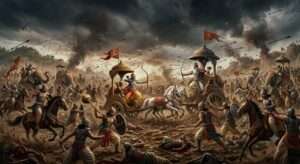
Seeing his armies thrown into confusion, Duryodhana summoned the Trigarta warriors once more. Vast divisions of chariots, cavalry, elephants, and infantry surged toward Arjuna. Gandiva answered with a relentless storm of arrows. Great Kshatriya heroes fell one after another, while entire battalions crumbled beneath the irresistible assault. Arjuna next entered the Kamboja formations, where his shafts severed limbs, heads, and armored trunks with astonishing precision. The battlefield resembled a mighty forest uprooted by the violence of a celestial hurricane.
The courageous brother of the Kamboja king advanced fearlessly and challenged Arjuna face to face. His arrows struck with remarkable skill, yet the contest ended almost as soon as it began. With four swift arrows released in perfect succession, Arjuna severed his opponent’s legs, arms, and head, leaving the assembled warriors speechless before such flawless mastery of archery.
Thereafter the united armies of the Yavanas and Sakas advanced in overwhelming numbers, employing every variety of weapon and celestial missile. Arjuna answered with an uninterrupted rain of arrows whose speed surpassed human vision. Rivers of blood flowed across the field while shattered armor, broken standards, and lifeless bodies covered the earth. Like mighty winds dispersing dense monsoon clouds, he scattered the combined host and reduced the fourfold army to fragments, presenting a vision at once terrible and magnificent.
Krishna guided the divine chariot with the swiftness of lightning, while Arjuna struck like a thunderbolt hurled from the heavens. Together they appeared less like mortal heroes than divine forces executing the will of destiny. From the celestial realms, gods, sages, and Gandharvas watched in admiration. Showers of fragrant flowers descended from the skies, heavenly instruments resounded, and voices of praise echoed through the firmament. A divine proclamation declared that Krishna and Arjuna shone with a brilliance surpassing even the radiance of the Sun and the Moon. They were hailed as manifestations of Brahma and Rudra, and as the eternal Nara and Narayana riding together upon the celestial chariot to protect righteousness.
These words reached Ashwatthama’s ears, but instead of inspiring reverence, they inflamed his heart with envy and fierce hostility. Blinded by resentment, the son of Drona hastened toward the divine warriors. Raising his bow, he challenged Arjuna with proud confidence, declaring that if Arjuna truly honored him as a worthy guest, he should offer battle as the proper hospitality due to a Kshatriya.
Arjuna glanced toward Krishna and answered with calm dignity that refusing such a challenge would itself be dishonorable. Yet he also reminded Krishna that the hostile armies still remained to be subdued and sought his guidance. Without hesitation, Krishna turned the celestial chariot toward Ashwatthama and urged him to repay the debt he owed Duryodhana by facing the full might of Arjuna.
Ashwatthama accepted the challenge without fear. He loosed sixty keen arrows against Krishna and three against Arjuna with astonishing speed, even shattering Arjuna’s bow for a brief moment. Instantly Arjuna restrung his weapon, while Ashwatthama seized another mighty bow and unleashed a dazzling succession of celestial missiles. According to Sanjaya’s narration to Dhritarashtra, the son of Drona displayed a marvel of archery rarely witnessed even among the greatest masters. Such was the density of his arrows that the chariot of Krishna, its steeds, and its lofty banner vanished completely beneath the impenetrable veil of shafts. For a moment neither the Pandava nor the Kaurava warriors could behold the divine chariot, and all stood astonished at the magnificent skill displayed by the son of the illustrious preceptor Drona.

