



Indian families hold gold equal to roughly two-thirds of what every central bank on earth holds combined. The instinct is sound, the instrument is flawed, and the popular claim that households move the gold price does not survive the data.
For decades economists have called Indian household gold dead capital: it pays no interest, no dividend, and cannot be lent out. That framing misses what the gold is for. It is a hedge against two risks at once, the debasement of the dollar in which gold is priced and the depreciation of the rupee in which families actually live. Seen that way, the habit looks less like sentiment and more like insurance. It is also a habit with real costs and limits, which the usual celebratory account leaves out.
The scale of the hoard
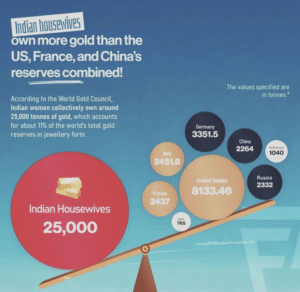
The World Gold Council estimates Indian household holdings, temples included, at about 25,000 tonnes, roughly 14% of the world’s private gold stock. Other estimates run higher; Morgan Stanley has put the figure near 34,600 tonnes. At spot gold of about $4,150 to $4,200 an ounce in October 2026, 25,000 tonnes is worth roughly $3.3 trillion, or ₹340 to 370 lakh crore depending on the purity assumed.
The comparison with official holdings is striking. The United States holds 8,133 tonnes, Germany 3,351, Italy 2,452 and France 2,437, about 16,400 tonnes between them. All the world’s central banks together hold roughly 36,000 tonnes. The RBI holds 880.52 tonnes, worth $115.4 billion in March 2026 and 16.7% of reserves, so the household stock is about 28 times the central bank’s. Much of it is held by women, through marriage gifts and inheritance, although no survey gives a reliable gender split.
What 1991 did and did not teach
In the 1991 balance of payments crisis, India raised dollars against gold in two operations. In May, the State Bank of India sent 20 tonnes of gold confiscated from smugglers to Union Bank of Switzerland in a sale with a repurchase option, raising about $200 million. In July, the RBI pledged 46.91 tonnes to the Bank of England and the Bank of Japan for about $405 million. The total was roughly 67 tonnes and $600 million. The pledged gold was redeemed between September and November 1991.
The 46.91 tonnes would be worth about ₹70,000 crore, or $6.3 billion, today, around 15 times the dollars it raised. But two corrections to the usual telling matter. The gold was the state’s, much of it seized contraband, not household gold. And the family habit long predates 1991, so the episode is better read as a lesson to policymakers than as the origin of private demand.
The double hedge
In August 1971 the United States ended dollar convertibility into gold at $35 an ounce. That same ounce costs about $4,150 today, so the dollar now buys roughly 0.8% of the gold it once did. Gold is priced in dollars, and Indian families hold it in rupees, which gives them a second layer of protection. The rupee price of gold is the dollar price multiplied by the exchange rate, so a family is long gold and, in effect, short the rupee.
The rupee’s own history shows why that matters. Until 1940, a rupee coin held about 10.7 grams of pure silver, which at August 2026 silver prices of roughly ₹2.4 lakh per kilogram would be worth about ₹2,500. The recent record shows both effects at work: the average gold price was ₹66,614 per 10 grams in the third quarter of 2024 and is about ₹1,49,000 now, a rise of 2.2 times in roughly two years. The RBI’s own accounts say the 63.6% rise in the value of its Banking Department gold in FY26 came from the gold price and from rupee depreciation against the dollar.
The mechanism usually offered for why cash loses out is that new credit reaches asset owners and borrowers before it reaches wage earners and depositors. That is plausible, and economists contest how strongly it applies, so it is best treated as a mechanism rather than as proof.
The oil constraint behind rupee weakness
The rupee is fragile partly because India must earn dollars before it can buy energy. Imported crude supplied 88.5% of consumption in July 2026, and the RBI’s own analysis puts FY26 dependence slightly above 90%. India’s crude basket averaged $82.04 a barrel in July. The crude import bill was $13.7 billion for the month and $63.4 billion for April to July 2026, up 56.5% from a year earlier, and equal to about 9% of the $691 billion in reserves held at March 2026. Crude is about a fifth of India’s merchandise imports.
An economy with that exposure is structurally exposed to a weaker currency in any energy shock, which is exactly the risk a household gold position offsets.
Do families behave the way the thesis says?
The common claim is that Indian households buy regardless of price and rarely sell. The World Gold Council data support the second half of that claim and contradict the first.
| Quarter | Total demand | Jewellery | Bars, coins, ETFs | Value |
| Q3 2025 | 209.4 t (down 16%) | 117.7 t (down 31%) | 91.6 t investment (up 20%) | ₹2,03,240 crore (up 23%) |
| Q2 2026 | 131.4 t (down 6%) | 75.1 t (down 15%) | 50.3 t bars and coins (up 9%), 4.2 t net ETF inflow | Record ₹1.98 lakh crore |
When prices climb, families buy less jewellery by weight, switch toward bars, coins and ETFs, and spend more in rupees. That is price sensitive, not price blind, and it is better evidence of rational behaviour than the folk version. The low propensity to sell holds up: UBS estimates that less than 2% of household gold is pledged as loan collateral, and recycling also fell in the third quarter of 2025. The World Gold Council expects 650 to 750 tonnes of Indian demand in 2026, against 710.9 tonnes in 2025.
Where the popular story breaks
Households follow the gold price; they do not set it. India’s expected demand of 650 to 750 tonnes is roughly 13 to 15% of global demand, which was 2,522 tonnes in the first half of 2026 alone. Central banks have bought more than 1,000 tonnes a year for three consecutive years, and investment flows have led recent price moves. India’s own demand fell while prices were setting records. The RBI itself added only 0.94 tonnes in FY26, after 54.13 tonnes in FY25, so the household has been accumulating while the state paused.

