


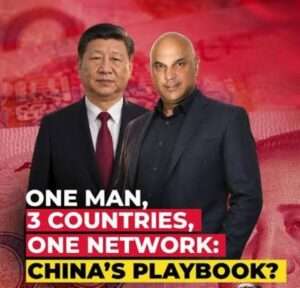
Democracies cannot afford to ignore the possibility that money, ideology and disinformation can be weaponised to weaken governments from within. The controversy surrounding Neville Roy Singham, a US-born technology entrepreneur based in Shanghai, raises uncomfortable questions about the global reach of Chinese Communist Party (CCP)-aligned propaganda and the role of opaque funding in political activism. George Soros has long faced criticism over his funding of political causes. Singham has now emerged as another controversial figure whose financial network warrants scrutiny, particularly over allegations that organisations linked to him promote narratives aligned with Beijing. A New York Times investigation in August 2023 traced substantial financial flows to organisations associated with Singham and reported that their messaging frequently echoed Chinese government positions. In 2025 and 2026, US congressional Republicans intensified scrutiny, seeking financial records and investigations into whether certain organisations should register under foreign-agent laws. These remain allegations and investigative demands, not proof of criminal wrongdoing. The sums involved are substantial. A 2026 Fox News Digital investigation examined $591 million in financial flows across a network of organisations between 2017 and 2025. It reported that Singham-linked entities channelled $22.44 million to The People’s Forum, $16.76 million to the Tricontinental Institute for Social Research and $1.098 million to BreakThrough BT Media. These figures do not establish that every dollar financed protests or originated directly from Beijing. Nevertheless, the scale demands independent scrutiny. The issue is not whether left-wing organisations have the right to exist or citizens the freedom to protest. They do. The real question is whether ostensibly independent activism can become a vehicle for advancing a foreign power’s strategic interests while concealing the source and purpose of its funding.
For Bharat, the controversy has acquired a domestic political dimension. BJP MP Nishikant Dubey has alleged connections involving Singham, opposition politics and financial channels. However, any alleged links to Rahul Gandhi, the Congress or protests against the Chief Election Commissioner must be established through verifiable financial and documentary evidence. Shared slogans, organisational overlaps and simultaneous demonstrations alone cannot prove a centrally directed conspiracy. But the photograph of the then Congress government, headed by Dr Manmohan Singh, signing an agreement with the Communist Party of China went viral, and the Congress’s stoic silence on the issue has indeed prompted people to connect the dots. Why would Beijing be interested in such networks? China has invested heavily in international media, digital influence and the projection of its political narrative. A polarised society, weakened institutions and declining public confidence can serve an adversary’s geopolitical interests without a single shot being fired. Even if activists are not knowingly serving a foreign power, their activities may sometimes amplify narratives that benefit it. Europe offers a cautionary backdrop. France, Britain and Italy have experienced contentious debates over immigration, living costs, public services and political discontent. These grievances have genuine domestic roots and should not be dismissed. Nor is there sufficient evidence to attribute unrest across these countries collectively to Singham or China. However, the possibility that external actors exploit legitimate grievances through coordinated messaging deserves investigation. Can French President Emmanuel Macron draw lessons from Prime Minister Narendra Modi’s approach to political mobilisation and ideological confrontation? The comparison is worth considering, although there is no established evidence that Macron has adopted Modi’s strategy. The broader lesson is that governments must confront disinformation and unlawful activity firmly without suppressing peaceful protest or civil liberties. The Trump administration’s scrutiny of alleged CCP-linked influence networks reflects growing recognition that geopolitical competition extends beyond trade, technology and military power into the information space. Congressional demands for records and investigations must be judged by evidence and due process, not partisan enthusiasm. Bharat must apply the same standard. Investigate suspicious funding, expose proven foreign interference and demand accountability from every political formation, irrespective of its affiliations. Treating every critic as a foreign agent would be as damaging as ignoring genuine interference. The real danger is not that every protest is engineered abroad, but that democratic freedoms can be exploited by those seeking to weaken democracies themselves. If the money trail establishes foreign interference, follow it without fear or favour.

