Upadhyayula Lakshman Rao
The sage Deerghatama, illumined in vision and steadfast in contemplation, raises his prayer to Mitra and Varuna in the expansive cadence of Jagati Chanda’s, wherein each syllable flows with measured dignity, reflecting the vastness of the cosmos itself. His hymn is not merely a plea but a profound inquiry into the order that binds the universe—an order where the moral, natural, and spiritual realms converge. The patrons, seekers of sustenance and harmony, approach these deities with reverence, invoking them as custodians of truth, guardians of cosmic law, and sustainers of life’s delicate balance.
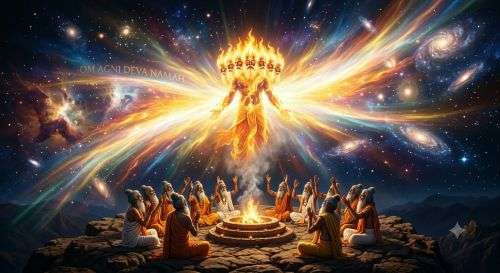
In their aspiration for prosperity, the patrons seek cows, symbols not merely of material wealth but of nourishment, continuity, and ecological harmony. Their worship reflects an early recognition of interdependence between human survival and natural abundance. Through their disciplined effort and sacred knowledge, they kindle Vaidyutha Agni—the electric fire—an embodiment of both physical energy and spiritual illumination. This fire, radiant like the sun, becomes the axis of ritual and transformation, its brilliance resonating with the universal principle of energy that sustains all existence. Its crackling force and luminous vigor are so potent that they seem to stir both earth and sky, suggesting an intuitive grasp of energy’s capacity to influence and transform matter.
Mitra and Varuna, embodiments of harmony and order, draw near to those who conduct Soma Yajna in accordance with Vedic discipline. These Somayajis, aligned in thought and action, become recipients of divine grace. The deities, in turn, bestow not only material blessings but also dignity and stability, enabling the patrons to live in accordance with dharma. Their benevolence reflects a reciprocal relationship—devotion met with sustenance, discipline rewarded with prosperity, and sincerity acknowledged with protection.
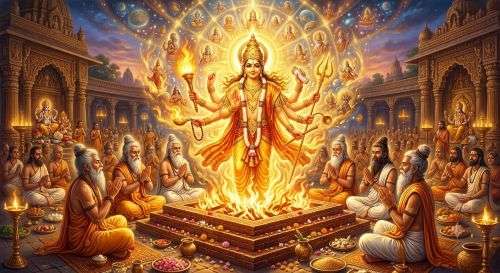
The hymns offered by the patrons are not mere utterances but refined vibrations shaped by intent and understanding. Mitra and Varuna, attuned to these resonances, accept the offerings and sanctify the rituals. Their presence is envisioned as pervading all realms—earth, atmosphere, and the luminous expanse beyond. They are invoked to partake in the yajna, to sit upon the sacred seats prepared with devotion, and to complete the ritual with their divine participation. The imagery of their arrival signifies not only divine acceptance but also the alignment of human endeavor with cosmic will.
In the unfolding of creation, the deities are praised for establishing space for the cow upon the earth, allowing life to flourish in abundance. The multiplication of cows into herds, their rhythmic movements at dawn and dusk, and their gentle calls echoing across the fields reflect a harmonious coexistence between nature and human society. These observations reveal an early ecological sensitivity, where cycles of life are noted with care and reverence. The comparison of their calls to the vigilance of a brave guardian hints at an awareness of instinct, protection, and communal order within the natural world.
As the yajna progresses, the fire rises with fervor, its flames likened to strands of hair standing upright, charged with energy and purpose. The oblations offered into this fire symbolize the transformation of matter into subtle essence, rising upward to invoke divine response. Mitra and Varuna, pleased by such devotion, are believed to release rains—an essential force for agricultural prosperity and ecological balance. This connection between ritual action and environmental response reflects an early attempt to understand causality, where human conduct is seen as influencing natural phenomena.
The intelligent patron, equipped with knowledge and sincerity, conducts the yajna with precision, employing the necessary instruments and adhering to sacred order. His prayers are deliberate, his offerings measured, and his intent pure. Mitra and Varuna are invited to witness and partake in this act, to hear the chants that are crafted in alignment with their divine qualities. These hymns, born of contemplation, seek not only material gain but also the favor of righteous disposition and enduring well-being.
Mitra and Varuna are further exalted as the primordial sources of rain, nourishment, and abundance. The patrons, focusing their minds upon these deities, recognize that all sustenance flows through their governance. Food, wealth, and vitality are seen as manifestations of their grace. Their supremacy is acknowledged as surpassing even the cycles of day and night, the force of rivers, and the might of opposing elements. Their riches are incomparable, their influence immeasurable, and their presence all-encompassing.
Thus, the hymn of Deerghatama becomes a tapestry of devotion, observation, and insight—a synthesis of spiritual reverence and proto-scientific awareness. It reflects a civilization striving to understand the laws that govern existence, expressing that understanding through ritual, poetry, and disciplined thought. In invoking Mitra and Varuna, the sage not only seeks blessings but also affirms the eternal principle that harmony between human action and cosmic order is the foundation of true prosperity and enduring peace.