


After deep contemplation regarding the course that destiny had laid before him, the venerable Bhishma lifted his mighty bow once more upon the battlefield. Before him stood Sikhandi, positioned deliberately by Arjuna, yet Bhishma regarded him with utter disregard, for he had long resolved not to engage Sikhandi in combat. Seizing that moment, Arjuna began to release a fierce and relentless volley of arrows. Those shafts pierced the grandsire from every side with a force that shook the field. Bhishma, though struck, received the attack with a strange and noble enthusiasm, for he felt that to contend with such a warrior as Arjuna might well become the gateway through which his life would pass into the higher realms.
Arjuna, advancing with unrestrained vigor, shattered the bow held by the grandsire and then discharged a powerful arrow deep into Bhishma’s chest. At that moment Arjuna surged forward like the irresistible tide of a vast ocean, impossible to restrain either by his own will or by the might of the assembled Kuru kings. Bhishma, observing this overwhelming force, became almost motionless in reflection. Turning to the princes who guarded him closely, and who stood stunned in awe, he spoke words filled with solemn admiration. He declared that even if one crore celestial beings were to oppose Arjuna, they would fail to restrain him, and even if one crore hosts of demons were to confront him, they would be unable to stand before his power.
Bhishma further proclaimed that when even gods and demons could not face Arjuna in battle, how then could mortal warriors hope to overcome him. The heroic son of Pandu alone, he said, possessed the power to secure victory for the Pandavas. Bhishma admitted that he might long ago have secured triumph for the Kauravas had Arjuna not stood upon the opposing side. Yet the very presence of that peerless warrior rendered it impossible for anyone to gain advantage over the sons of Pandu. Addressing Duryodhana with calm authority, Bhishma declared that when Arjuna stands firmly with his bow drawn and his opponent in sight, no warrior can even lift his weapon against him, much less fight with any hope of success. Where then, he asked, could there be any opportunity even to strike Arjuna with arrows.
While Bhishma was thus speaking to Duryodhana, Arjuna seized the moment with strategic brilliance. Standing concealed behind Sikhandi, he released continuous shafts toward the grandsire. His movements remained hidden, creating the impression that Sikhandi alone was assailing Bhishma. In truth, it was Arjuna’s unwavering resolve that directed those terrible arrows. Though this method lay beyond the strict code of chivalric warfare cherished by Bhishma, Arjuna had determined that the mighty pillar of the Kuru lineage must fall if the war were ever to end.
Feeling the relentless impact of the arrows, Bhishma spoke to Dussasana with grave insight. He declared that the shafts striking him were descending like thunderbolts and that they could not possibly have been discharged by Sikhandi. They bore the unmistakable force and precision of Arjuna’s hand, though released under the concealment of Sikhandi’s presence. Bhishma remarked that just as a crab is broken from within by its own offspring, so too the Kuru house seemed destined to fall through its own lineage. Yet he questioned how Sikhandi could possess arrows of such natural might, arrows whose power resembled the staff of Brahma itself.
Each shaft, Bhishma observed, struck like a messenger of death. They were strong, swift, blazing, and unfailing in their aim. Such arrows could belong only to Arjuna. The shafts of Sikhandi, he said, would never possess the strength or precision capable of penetrating his armored body. The staff of Brahma was known to contain immeasurable power. In ancient times the sage Vasistha had wielded it against the forces of Viswamitra, reducing them to ashes within moments. Yet every arrow of Arjuna seemed equal in potency to that celestial weapon. Thus Bhishma endured pain beyond description, a suffering that testified not to his weakness but to the incomparable prowess of the warrior who assailed him.
Having warned Dussasana, Bhishma gathered his remaining strength and hurled a mighty Shakti weapon toward Arjuna. But the vigilant son of Pandu shattered that weapon in midair before it could reach its mark. Then Bhishma, grasping a sword and shield, prepared to leap down from his chariot in a final act of heroic defiance. Before he could descend, however, Arjuna swiftly sliced both sword and shield into fragments. With a commanding voice he called to the warriors around him, declaring that he stood ready before them all and urging them to surround Bhishma and his defenders.
From the Pandava ranks arose thunderous cries as warriors rushed forward with swords, spears, and arrows. They closed in around Bhishma and the valiant warriors who protected him. Seeing this advance, the Kaurava forces hastened to resist with fierce determination, and the battle entered a new stage of violence and disorder. The clash grew increasingly terrible, filled with dreadful sights and deafening sounds as heroes from both sides fought with desperate intensity.
Sanjaya, narrating these events, told the blind monarch Dhritarashtra that Arjuna now blazed forth like a volcanic eruption among his enemies. With fearless and relentless energy he scattered the opposing forces and advanced steadily toward Bhishma. Warriors gathered around the grandsire with ruthless determination, striking him from every side. Weapons filled his body so densely that not even the space of a finger seemed left untouched.
At that solemn hour the blazing sun began its slow descent toward the western horizon. As twilight approached, Arjuna advanced nearer to the grandsire and released a final series of powerful shafts. Before the astonished eyes of the Kaurava army, Bhishma fell. The earth itself seemed to tremble at the fall of that mighty hero. While the sun rested in the west, the radiant glory of the Kuru lineage—its light, fragrance, power, courage, and chivalry—appeared to sink with him.
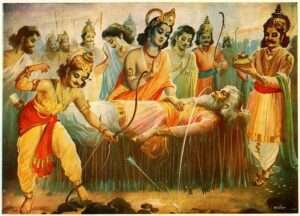
Bhishmacharya laid his head toward the east as he descended, yet his body did not touch the ground. The countless arrows that had pierced him stood upright beneath him, forming a strange and solemn bed upon which the aged warrior rested. Thus the great human spirit of Bhishma, through suffering and valor, seemed to assume a divine grandeur upon that bed of arrows. Sanjaya’s narration flowed onward like a slow and steady river, without pause or diversion, while the trembling and grief-stricken king Dhritarashtra listened in silent anguish to the fate of the greatest pillar of his house.

