



Having recovered his strength, the valiant Sātyaki once more turned his wrath upon Somadatta. With a torrent of arrows he struck the aged warrior so fiercely that Somadatta became bewildered and fell senseless upon his chariot. Observing this development, Duryodhana resolved to curb the growing pride and irresistible prowess of Sātyaki. Yet before he could advance far, the mighty Ghaṭotkaca, son of Bhīmasena and lord of the Rākṣasas, confronted him. Accompanied by vast and ruthless hosts of demonic warriors, Ghaṭotkaca appeared like a storm-cloud gathering over the battlefield. Karṇa and many renowned Kaurava heroes hastened to oppose him, and a terrible conflict erupted.
The day was drawing to its close. The sun descended toward the western horizon, and twilight spread its shadowy mantle across Kurukṣetra. Knowing well that the strength of the Rākṣasas multiplies during the evening and night, many warriors found themselves unable to endure Ghaṭotkaca’s dreadful onslaught and gradually withdrew from his path. Amid that terror, only Aśvatthāmā, son of Droṇa, stood firm and unshaken. Fearless and composed, he pierced Ghaṭotkaca’s broad chest with ten keen arrows, provoking the mighty Rākṣasa to furious anger.
Enraged beyond measure, Ghaṭotkaca hurled a blazing discus toward Aśvatthāmā. Yet the son of Droṇa severed the weapon in midair before it could reach its mark. Sanjaya, narrating the events to Dhṛtarāṣṭra, remarked that just as the intentions of a man become fruitless when the accumulated merit of his virtuous deeds is exhausted, so too did that celestial discus lose its power and fall ineffective. At that moment Añjanaparva, the brave son of Ghaṭotkaca, rushed forward and assailed Aśvatthāmā with a shower of arrows.
Aśvatthāmā remained unmoved before the youthful Rākṣasa. With effortless skill he shattered Añjanaparva’s bow and struck his chariot. Undeterred, the heroic youth leapt forward wielding a sword, but Aśvatthāmā cut the weapon into fragments. He then hurled a massive mace, which was likewise smashed to pieces. Rising into the sky through his supernatural powers, Añjanaparva rained arrows from above, yet Aśvatthāmā checked every assault. The young Rākṣasa resorted to bewildering illusions, filling the heavens with phantom forms, but none could overcome the mastery of Droṇa’s son. Countless arrows pierced his dark body, making him appear like a rain-cloud penetrated by shafts of sunlight. Mounting another chariot, Añjanaparva renewed the struggle, but Aśvatthāmā, angered by his relentless demonic stratagems, severed his head with a deadly arrow. Having slain the young hero, he turned his attention toward the destruction of the Pāṇḍava army.
When news of his son’s death reached Ghaṭotkaca, grief and rage surged through him like a blazing fire. Roaring aloud, he challenged Aśvatthāmā. “Stand and fight, O slayer of my son! You shall not escape me today. Witness the fury that now approaches you.” Aśvatthāmā replied calmly, “O Ghaṭotkaca, you are but a youth. I am of your father’s generation. It is not fitting that I should direct my anger toward you. Seek another opponent worthy of your strength.” These words only inflamed the Rākṣasa further.
Ghaṭotkaca answered, “How can I refrain from battle when my son lies slain by your hand? You are no equal to my father, nor can your words cool the fire of my grief. Born of the Pāṇḍava line, I must repay the debt of vengeance and fulfill the duty of a warrior. Today I shall tear you apart and avenge my son.” With that terrible vow, he launched a storm of arrows. Aśvatthāmā cut them all down with astonishing speed.
Employing his illusory powers, Ghaṭotkaca assumed a gigantic form that towered above the battlefield like a mountain. Uprooting a vast hill, he hurled it at Aśvatthāmā. The son of Droṇa instantly invoked the Indrāstra and shattered the mountain into countless fragments that rained harmlessly upon the earth. Ghaṭotkaca renewed his attack with innumerable arrows, but Aśvatthāmā dispelled them through the Vāyavyāstra. Surrounded by fierce Rākṣasa warriors who spread terror among the Kaurava ranks, Ghaṭotkaca continued to fight with relentless fury.
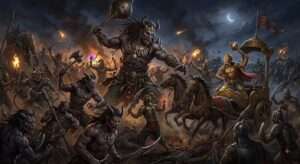
When Duryodhana moved to support him, Aśvatthāmā declared confidently, “Why do you trouble yourself with this battle? I shall crush Ghaṭotkaca in a moment. Not only these demonic hosts but the entire Pāṇḍava army shall fall before me.” Delighted by such confidence, Duryodhana turned to Śakuni and said, “The Pāṇḍavas will be shattered by Aśvatthāmā. Take your forces and secure our victory.” Addressing Kṛpa, Karṇa, and his brothers, he ordered them to accompany Śakuni and join the battle. Thus encouraged, Śakuni advanced proudly toward the raging conflict.
Meanwhile the duel between Ghaṭotkaca and Aśvatthāmā intensified. Ghaṭotkaca pierced his foe with sharp arrows, but Aśvatthāmā seized another bow and answered with a devastating shower that wounded and enraged the Rākṣasa. In a short time vast numbers of demonic warriors were slain, greatly pleasing Duryodhana. As Aśvatthāmā tore through Ghaṭotkaca’s forces like a blazing forest fire, the Pāṇḍava soldiers watched helplessly in astonishment. Ghaṭotkaca hurled a powerful celestial weapon at him, but Aśvatthāmā redirected it back upon its sender, destroying the Rākṣasa’s chariot. Escaping swiftly, Ghaṭotkaca mounted the chariot of Dhṛṣṭadyumna.
Standing together upon a single chariot, Ghaṭotkaca and Dhṛṣṭadyumna attacked Aśvatthāmā from both sides. Soon Bhīmasena arrived with a vast force to support them. Yet Aśvatthāmā displayed extraordinary dexterity, striking all three warriors simultaneously while continuing to devastate the surrounding army. His arrows fell like relentless rain. Soldiers, elephants, horses, chariots, and charioteers collapsed everywhere, resembling mighty trees uprooted by a violent tempest. Overwhelmed by his assault, Ghaṭotkaca eventually lost consciousness and was carried away by Dhṛṣṭadyumna for safety. After some time he recovered, armed himself anew, and prepared once more to enter the battle.
As darkness deepened, Dhṛṣṭadyumna burst forth with renewed vigor and led the Pāṇḍava forces into carefully arranged formations. The Kauravas responded with counter-formations, placing Somadatta and Bāhlīka at the forefront. The battle now reached a stage of utter confusion and ferocity. Twilight merged into darkness, and little could be seen across the field except the glittering ornaments of warriors and soldiers. Gem-studded armor, shining shields, fluttering standards, and jeweled banners sparkled like stars scattered across the night.
During this fearful hour, Sātyaki and Somadatta resumed their duel. Bhīmasena came to Sātyaki’s aid, declaring that Somadatta was no match for the Vṛṣṇi hero. He wounded the Kaurava veteran with sharp arrows, while Sātyaki struck him with a blazing shaft. At the same time Ghaṭotkaca hurled a massive iron pestle that struck Somadatta with crushing force. Exhausted and grievously wounded, the old warrior again fell unconscious.
Then the venerable Bāhlīka advanced to confront the Pāṇḍava heroes. Bhīma showered him with arrows, whereupon Bāhlīka hurled a fierce Śakti weapon. For a brief moment Bhīmasena staggered beneath its impact, but quickly regaining his composure, he seized a massive double-edged iron mace. With tremendous strength he struck Bāhlīka upon the head. The ancient Kuru warrior fell to the earth with a thunderous crash, resembling a mountain peak shattered by Indra’s thunderbolt and hurled from the heavens.
The death of Bāhlīka filled the Pāṇḍavas with renewed enthusiasm and confidence. Their warriors raised triumphant cries that echoed across the darkened battlefield. Sanjaya then reported the fall of the venerable elder to King Dhṛtarāṣṭra, whose heart was burdened with sorrow as yet another pillar of the Kuru host had been cast down amidst the inexorable destruction of the great war.

