



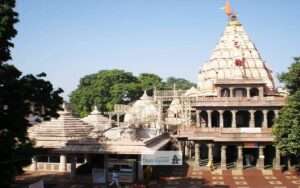
Sri Nagchandreshwara Temple is situated in the holy city of Ujjain, Madhya Pradesh, within the famous Sri Mahakaleshwar Jyotirlinga Temple complex. Located on the third and uppermost storey of the temple, it is one of Ujjain’s most unique shrines. The temple remains closed throughout the year and is opened for darshan only once a year, on Nag Panchami.
The shrine and its sacred image are traditionally associated with the medieval period and are often described as dating to around the 11th century. There is also a tradition that the image was brought from Nepal. However, the exact age and provenance of the present image are not firmly established archaeologically.
The deity is Sri Nagchandreshwara Mahadev, a rare serpent-associated form of Lord Shiva. The sacred image shows Shiva seated upon a serpent, with Goddess Parvati and Lord Ganesha beside him. The prominent serpent imagery gives this form of Mahadeva its distinctive character.
Nagchandreshwara forms part of the multi-level Mahakaleshwar temple. The Mahakaleshwar Jyotirlinga is situated at the lower level, while Omkareshwar and Nagchandreshwara occupy the upper levels. The larger temple complex reflects Bhumija, Chalukya and Maratha architectural influences, with carved pillars, ceilings and ornamental features.
Ujjain has been a major centre of Shaiva worship for centuries. The present Mahakaleshwar temple largely took its present form during the Maratha period, with its 18th-century reconstruction traditionally associated with Ranoji Rao Shinde and his Diwan, Ramchandra Baba Shenvi.
Nagchandreshwara preserves an older sacred tradition within this later structure. Its image is traditionally associated with the medieval period, with some accounts placing it around the 11th century.
The sacred legend of Nagchandreshwara is closely connected with Nagraja Takshaka, the king of serpents and an important Naga figure mentioned in the Mahabharata.
According to the Sthalapurana, Takshaka performed severe penance to please Lord Shiva. Pleased with his devotion, Mahadeva granted him his divine grace. Takshaka then wished to remain in the presence of Shiva and continue his meditation in complete solitude.
He chose the sacred Mahakalavana of Ujjain as his place of meditation. Lord Shiva accepted his devotion and allowed him to remain in his divine presence.
Takshaka’s only wish was that his meditation should not be disturbed. According to tradition, this led to the unique practice associated with Nagchandreshwara: the shrine remains closed throughout the year, allowing Takshaka to continue his meditation undisturbed, and its doors are opened only on Nag Panchami.
On this one sacred day, devotees are allowed to have darshan of Nagchandreshwara Mahadev. Thus, the annual opening of the shrine is itself part of the sacred legend and is considered a continuation of Takshaka’s devotion to Shiva.
The image beautifully reflects this tradition. Lord Shiva is shown seated upon the serpent, accompanied by Parvati and Ganesha. The serpent therefore becomes not merely an ornament but an integral part of the divine form.
Naga worship has a very ancient place in Hindu tradition. Vasuki is closely associated with Lord Shiva, Ananta or Shesha with Lord Vishnu, and Takshaka is among the great Naga figures of Hindu sacred literature. At Nagchandreshwara, the ancient Naga tradition and devotion to Lord Shiva come together in a unique form.
Nag Panchami is the principal festival of Nagchandreshwara. On this day, the doors are opened after remaining closed for an entire year, and special pujas and traditional rituals are performed. Thousands of devotees gather for the rare darshan of Nagchandreshwara Mahadev, with the Mahanirvani Akhara having a traditional role in the worship.
The festival falls during the sacred month of Shravan, making the occasion especially significant for Shiva devotees. After the Nag Panchami observances are completed, the doors of the shrine are closed again, continuing the unique tradition associated with Nagraja Takshaka.


