Lakshmanrao Upadhyayula
The sacred hymn revealed by the sage Vachya, the son of the great sage Viswamitra, and dedicated to the Viswedevas in the majestic Tristubh meter of the Rigveda, unfolds a profound vision of the harmony between the divine universe and the natural world. It portrays creation as an eternal sacrifice in which every force of nature participates according to the divine order, revealing that spiritual wisdom and the laws governing the cosmos are inseparable expressions of the same eternal truth.
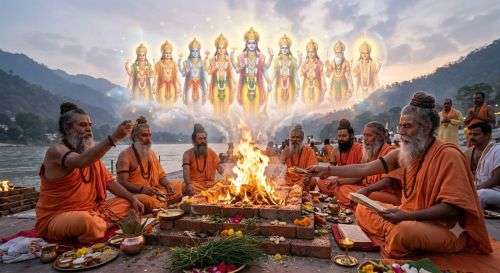
As the ancient dawn, Usha, gently withdraws her radiant veil, the everlasting Aditya rises from the horizon, whether perceived as emerging from the cosmic ocean or ascending through the heavens. This daily sunrise is not merely an astronomical event but a sacred proclamation of the triumph of light over darkness and knowledge over ignorance. At the first glow of dawn, devoted patrons kindle the sacrificial fires, and their offerings, carried by Agni, swiftly reach the celestial realms. The hymn proclaims that although the gods manifest in countless forms and functions, their divine strength is rooted in one eternal source. Therefore the worshipper prays that Agni, the Sun moving between heaven and earth, the divine ancestors, and all those who have attained celestial status may bless humanity with protection rather than affliction.
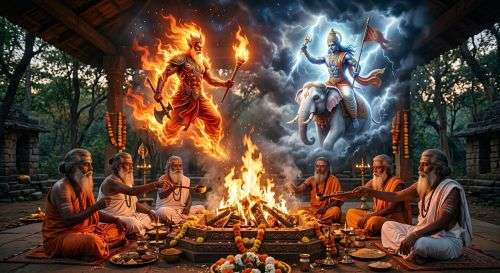
Agni is celebrated as the divine priest who carries every aspiration of the devotee in all directions. During the sacred Stoma sacrifice, the hymns composed by the ancient Vedic seers resound with truth and devotion, illuminating both the sacrificial altar and the hearts of the worshippers. When the sacred fire is kindled, truth itself is invoked, for every genuine sacrifice rests upon righteousness. Agni becomes the universal king of humanity, established upon altars sanctified by sacred mantras throughout the holy lands. Though fire appears to emerge from the friction of kindling wood, the hymn teaches that its divine essence is eternal, merely revealed through ritual. Heaven and Earth are revered as Agni’s two mothers. Heaven nourishes him with the power that later descends as life-giving rain, while Earth lovingly provides his dwelling place among all living beings.
The hymn further reveals Agni’s hidden presence within medicinal herbs, fresh vegetation, and every living plant. His subtle rays silently nourish seeds, stimulate growth, and enable herbs to produce flowers and fruits without visible effort. This poetic vision beautifully reflects an intuitive understanding of the hidden energies sustaining life. The warmth of the Sun, the fertility of the soil, moisture, and the invisible processes governing germination are recognized as sacred manifestations of Agni’s divine power. Thus the wealth of the gods is revealed not merely in celestial splendor but in every flourishing forest, healing herb, and fertile field that sustains life.
Heaven and Earth together establish the two great realms of existence, while their radiant son, Surya, completes his daily journey by setting in the western horizon before rising again to illuminate the skies. His uninterrupted movement symbolizes the perfect rhythm governing time, seasons, and cosmic order. All sacred rites belong to Mitra and Varuna, who uphold truth, moral discipline, and universal law. Agni is simultaneously the architect of the sacrificial universe, the sacred fire upon the altar, and the radiant Sun traversing the heavens. He becomes the prime mover of all activities, dwelling upon Earth while illuminating the sky, receiving the lyrical hymns offered by devoted priests.
The hymn compares hostile earthly forces confronting Agni to an army incapable of overcoming an invincible warrior. Though obstacles arise, divine light remains unconquered. Agni bears the waters within his very being, symbolizing the mysterious unity of fire and water that governs the cycles of nature. Modern understanding recognizes similar harmony in the continuous exchange of energy through evaporation, cloud formation, rainfall, and renewal. Agni is therefore praised as the divine messenger carrying offerings to the gods, the universal ruler dwelling within herbs, traveling between Earth and Heaven, and protecting all creation with boundless compassion. His brilliance never diminishes, and he safeguards the celestial waters while possessing perfect knowledge of the past, present, and future.
Day and Night are portrayed as twin sisters clothed in contrasting garments, one radiant with brilliant light and the other wrapped in profound darkness. Together they sustain the rhythm of existence without conflict. Earth becomes the nurturing mother while Heaven appears as her daughter, both likened to gentle cows nourishing one another through the life-giving waters suspended in the atmosphere. The celestial waters flowing between Heaven and Earth are honored through sacred hymns, acknowledging their indispensable role in preserving life. Agni is lovingly caressed by these streams of water, while the heavenly cow pours nourishing rains upon the thirsty Earth. The Sun draws water upward only to return it again as refreshing rain, revealing an early spiritual insight into the continuous hydrological cycle that sustains all living beings.
The Earth embraces countless forms of life that rise throughout the three worlds beneath the life-giving light of the Sun. Humanity, endowed with wisdom, recognizes itself as a servant rather than a master of creation. Between Day and Night lies the mysterious junction where transitions occur, symbolizing both auspicious beginnings and the dual nature of worldly existence. Heavy rains bring joy to every creature, while clouds continually assume fresh forms, shaking the horizons with thunder and lightning. Though appearing childless in the sky, they become life-bearing mothers when they release nourishing rain upon the Earth.
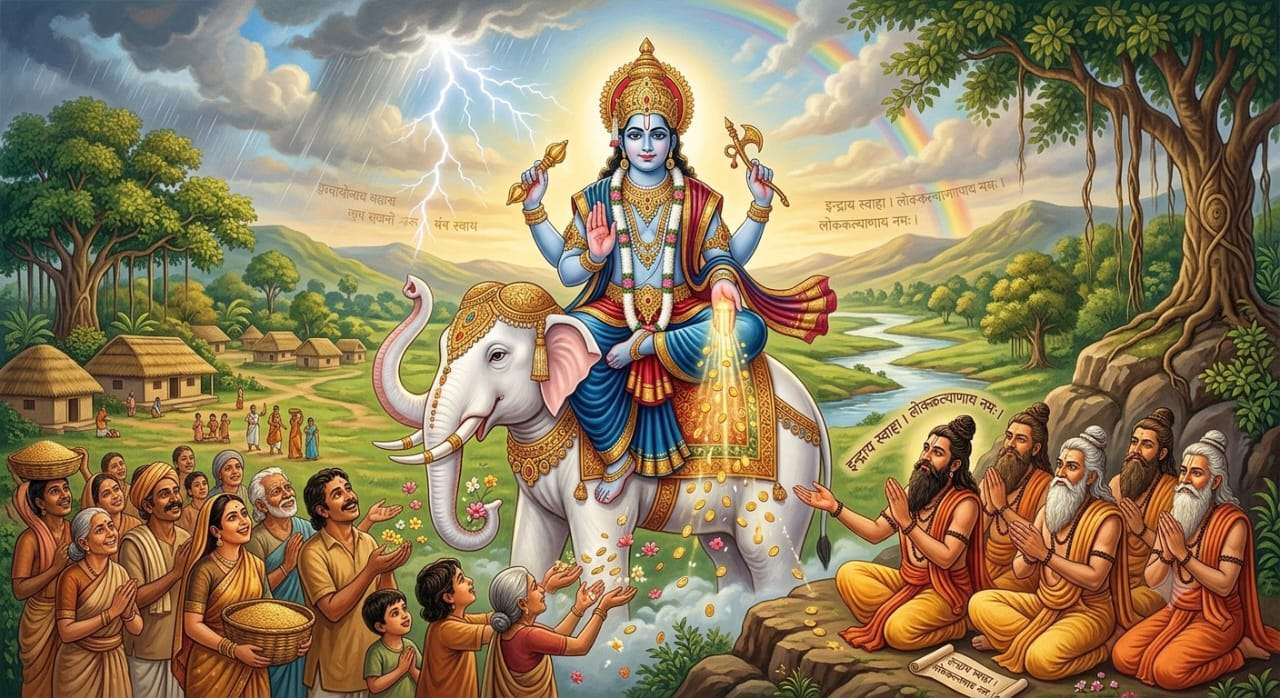
Indra manifests as Parjanya, the lord of rain-bearing clouds, releasing life-giving showers accompanied by thunder across every direction. Water becomes both his weapon against drought and his blessing upon creation. Worshipped by all beings, Indra reigns as the sovereign protector whose magnificent horses symbolize the ceaseless movement of clouds, winds, seasons, and celestial energies. The six seasons, formed through the orderly progression of the months, reflect the rhythmic stride of these divine steeds. Ancient traditions also recognize a five-season cycle when Hemanta and Shishira are considered together, revealing careful observation of climatic patterns woven into sacred symbolism.
The divine artisan Tvashta dwells within creation as its hidden inspirer and master craftsman. Manifesting through countless forms, he fashions diverse beings according to the divine plan while sustaining the entire universe. All worlds belong to his creative intelligence. Indra expands Heaven and Earth with abundant cattle, birds, vegetation, and every form of life. His immeasurable brilliance enlarges the cosmos itself, while his victories over destructive forces restore prosperity to the righteous. Thus he is glorified as the generous giver whose friendship extends throughout Earth and Heaven alike.
The mighty hosts of the Maruts advance before Indra like fearless warriors, preparing the way for divine victory. Through their power the herbs flourish, rivers flow, clouds gather, and fertile lands yield abundance. The Earth adorns herself with inexhaustible richness through Indra’s sustaining grace. The worshippers finally approach him with humility, acknowledging themselves as his children and praying to become worthy participants in the divine wealth of righteousness, wisdom, prosperity, and spiritual realization. The hymn concludes by affirming that the entire universe functions as one sacred organism in which every natural phenomenon, every living being, and every cosmic law reflects the eternal harmony established by the Supreme Reality through Agni, Indra, and the immortal guardians of the Vedic order.