


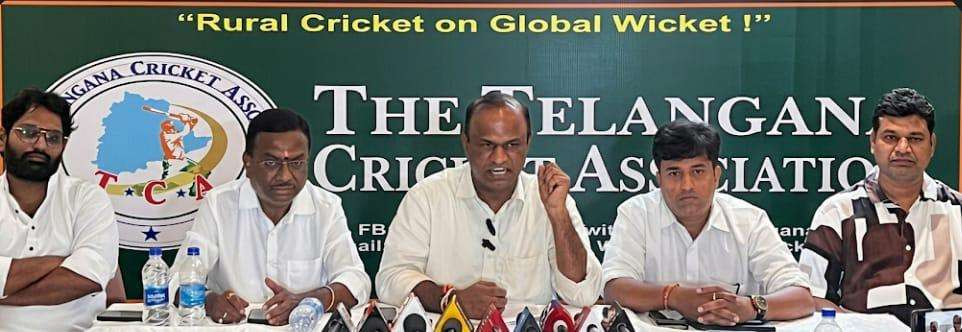
Hyderabad: The Telangana Cricket Association (TCA) has demanded a Central Bureau of Investigation (CBI) inquiry into the Hyderabad Cricket Association (HCA), alleging that it submitted fabricated records on district-level cricketing activities before the Bombay High Court with an intention to mislead the judiciary.
Addressing a press conference, TCA General Secretary Dharam Guruva Reddy claimed that the association had obtained a copy of a report submitted by the HCA detailing cricket activities across Telangana districts. According to him, the document, allegedly signed by an HCA functionary, projected an extensive grassroots cricket structure across the State that was “completely inconsistent with the ground reality.”
Guruva Reddy, who has been spearheading a prolonged legal battle against the HCA, in an official press statement released on Thursday, described the report as “deeply disturbing” and alleged that it sought to portray an active district cricket ecosystem that, according to the TCA, has never existed.
“If the report is accurate, it would represent one of the greatest success stories in grassroots cricket. Yet neither the media, district administrators, local authorities nor thousands of aspiring cricketers have witnessed such activity over the years,” he said.
The TCA maintained that cricket administration by the HCA has historically remained confined largely to Hyderabad city and questioned how a comprehensive district-wide network had suddenly surfaced in documents submitted before the court.
Backing its allegations, the TCA pointed to what it described as several glaring inconsistencies in the report.
Among them, it alleged that tournament records from multiple districts, including Adilabad, Khammam, Karimnagar, Mahabubnagar and Medak, reflected identical numbers of matches across different age groups—15 matches each in Under-25 and Under-19 categories and nine matches each in Under-16 and Under-14 competitions.
According to the TCA, such uniformity was highly improbable in independent district tournaments, where factors such as weather, ground availability and scheduling typically result in varying numbers of matches. It alleged that the identical figures suggested the data had been replicated rather than compiled from actual tournaments.

The association also highlighted what it termed as “timeline anomalies” in the report. While the document largely pertained to the 2025-26 season, certain pages reportedly carried the heading “District Report for the Season 2024-25” while simultaneously recording summer coaching camps conducted during May and June 2025.
In another instance cited by the TCA, a cricket centre at Jagitial in the Karimnagar district section was shown as operational despite recording zero player participation, raising further questions over the authenticity of the data.
Seeking greater accountability, the TCA posed a series of questions to the HCA and the authorities overseeing cricket administration.
It questioned why district units claimed to be active had remained absent from successive HCA elections over the past decade. It also sought disclosure of audited financial statements, tournament schedules, scorebooks, photographs and other records to establish whether funds earmarked by the Board of Control for Cricket in India (BCCI) for grassroots development had actually been utilised in rural Telangana.
The TCA further questioned whether adequate verification had been carried out before the report was placed before the Bombay High Court.
Calling for an independent probe, Guruva Reddy said the matter had gone beyond administrative irregularities and involved the credibility of judicial proceedings.
“If any fabricated information has knowingly been submitted before a constitutional court, it is a serious issue warranting an impartial investigation,” he said, adding that the TCA was prepared to face scrutiny of its own functioning as well.
The association reiterated that the latest developments strengthened its long-pending demand before the BCCI for Associate Membership, arguing that rural cricketers in Telangana deserved an independent district-based cricket administration.
The HCA’s response to the allegations was not immediately available.



As a former office-bearer of the Hyderabad Cricket Association (HCA), I completely agree with the author’s observations. I sincerely ask: who authorised Agam Rao to file the alleged report before the Bombay High Court? The report appears to be inconsistent, and several of its claims are far removed from the facts.
It is true that the HCA may have released grants, out of the funds received from the BCCI, to a few hand-picked district associations. However, is it not also a fact that some of these districts were subsequently accommodated as HCA members by installing individuals of their choice as Secretaries, allegedly with ulterior motives? The Telangana Cricket Association (TCA), in my view, has raised several pertinent questions that deserve answers. How many league, inter-school, or inter-collegiate tournaments are these district associations actually conducting? Are the respective District Collectors involved in the nomination or election of district representatives, as mandated? These are legitimate questions that cannot simply be brushed aside.
Further, Hyderabad and Rangareddy cannot realistically be treated as independent cricket districts. Both are integral to the territorial jurisdiction and functioning of the Hyderabad Cricket Association and cannot be equated with standalone district cricket associations.
Grievances / Facts
1. Genesis and Historical Evolution of the First Respondent’s Affiliate (HCA)
a. The Hyderabad Cricket Association (HCA) is the sole custodian and regulatory body for the sport of cricket in the city of Hyderabad and all constituent districts of Telangana. It has been an affiliated constituent unit of the Board of Control for Cricket in India (BCCI) since its inception.
b. The roots of formal cricket in this region trace back to the launch of the historic first-class tournament, the Moin-ud-Dowla Gold Cup, during 1930–1931. This tournament served as the premier crucible for unearthing raw cricketing talent. Following the initiation of the national first-class competition (the Ranji Trophy) in 1934, the urgent necessity arose for a centralized local officiating body to govern, regulate, and select representative squads for the Hyderabad State.
c. In April 1934, the HCA was formally established by founding visionaries including Nadir Shah Chenoy, D.N. Dittia, Ganesh Rao, Hussain Ali Khan, S. Ali Raza, Mahmood Hussain Khan, P.F. Durrand, Dattatriya, and Rangannah. They elected Nawab Turab Yar Jung as its first President and legendary sportsman S.M. Hadi as its Secretary.
d. The Association was formally registered on December 28, 1961, under the Andhra Pradesh (Telangana Area) Public Societies Registration Act (1350 Fasli, Reg. No. 207 of 1961). For over six decades, the HCA has enjoyed a complete state-sanctioned and BCCI-recognized monopoly over cricket administration in this region, functioning as a public body discharging vital public duties.
2. Structural Consolidation
a. League Structure: The Hyderabad Cricket Association (HCA) organizes league cricket through its affiliated clubs. Instead of individual players entering leagues directly, clubs register players and field teams. This club affiliation system has become the fundamental unit for domestic cricket administration.
b. Development of Cricket: Private clubs are responsible for recruiting players, organizing practice sessions, participating in league competitions, and maintaining cricket infrastructure wherever possible. These clubs play a crucial role in nurturing and developing cricket talent.
c. Lack of Government Infrastructure: In earlier decades, government sports facilities were limited across Hyderabad. Consequently, private individuals and clubs took the initiative to invest in playing grounds and coaching facilities. Their efforts significantly contributed to the growth and expansion of cricket in the region.
d. BCCI Affiliation Model: Historically, most state cricket associations affiliated with the Board of Control for Cricket in India (BCCI) function through member clubs. The HCA has adopted this same structure, relying on club affiliations to administer cricket activities effectively.
3. Three Historical Waves of Club Affiliation: Rather than expanding dynamically or equitably, the HCA’s voting and league structure consolidated historically through three distinct waves:
a. The Pre-Independence/Foundational Era (1930s–1950s):
Initial integration of private clubs belonging to feudal elites, colonial administrators, and localized clubs within the Secunderabad and Hyderabad municipalities.
b. Corporate & Industrial Boom Era:
Following official registration in 1961, the expansion was heavily driven by major Public Sector Undertakings (PSUs), government institutions, and industrial conglomerates setting up bases in Hyderabad. These bodies established sports boards, employed cricketers under sports quotas, and introduced formidable institutional squads to the HCA leagues during 1960 to 2018. Those are : VST Industries Ltd. (Vazir Sultan Tobacco), BHEL (Bharat Heavy Electricals Limited), IDL Chemicals (later Gulf Oil), Hyderabad Bottling Cricket Club, Income Tax Department, The Institutional & Banking Boom (1980s): The HCA expanded its institutional tiers. Nationalized banks and defense/railway sectors vastly increased their cricket team presence: SCRSA (South Central Railway Sports Association):, Andhra Bank Colony C.C. / Union Bank, BDL (Bharat Dynamics Limited), IICT Staff Club (Indian Institute of Chemical Technology), Throughout this era, the HCA strategically structured its affiliations with these institutional and corporate clubs to ensure secure livelihoods for cricketers. This shift effectively transferred the control of cricket administration in Hyderabad from private elites to institutional bodies.
c. Post-1990 Urban Expansion of Private Clubs
Following the 1990s, the Hyderabad Cricket Association (HCA) significantly expanded its affiliated clubs by recognizing numerous private clubs and cricket academies, largely in response to the rapid urbanization of Greater Hyderabad, particularly the Secunderabad suburbs and emerging IT/cyber corridors. Clubs such as West Marredpally C.C., East Marredpally C.C., Marredpally Blues, Marredpally Sporting, Venus Cybertech Cricket Club, Budding Stars Cricket Club, Gemini Friends, Hyderabad Cricket Academy, Ensconce Cricket Club, Crown Cricket Club, Indochem Cricket Club (later Vijay Bharat C.C.), Chanchalguda Sharks, CCOB, Ghadeer, and Green Lands were affiliated during this period. This expansion primarily benefited Hyderabad-based private clubs and academies seeking access to HCA’s league structure.
4. Telangana states representation in cricket Before 2014: The HCA governed cricket mainly in the areas of the former Hyderabad region of undivided Andhra Pradesh. Many districts outside Hyderabad were administered under the Andhra Cricket Association or through zonal arrangements. For the purpose of nomenclature, the HCA adopted ten districts, but until 2024, none of them received league teams or the ability to vote in HCA elections.
5. Formation of Telangana in 2014: When Telangana became a separate state, a need arose for a single cricket governing body for the entire state. HCA recognized 8 district cricket associations, corresponding to the 8 districts of the erstwhile Telangana region. These were district associations—not individual cricket clubs. And finally in the year 2021, only 8 teams were allotted to all the 33 districts. It means one team for more than 3 districts.
6. Demographic and Geographic Disparity:
• The above pattern reveals a significant demographic and geographic imbalance. As the sole governing body for cricket in Telangana, the HCA expanded its affiliated clubs mainly in Hyderabad, driven by the growth of public sector undertakings, government institutions, industries, and private urban clubs. Despite Telangana’s districts having a rural population several times larger than Hyderabad’s, there was no comparable expansion of affiliated clubs or cricket infrastructure outside the city. The affiliation of private clubs appears to have evolved through historical and administrative practices rather than a uniform, state-wide policy, resulting in the concentration of organized cricket opportunities within Hyderabad while largely overlooking the rural districts of Telangana.
• Following the bifurcation of the state and the creation of Telangana in 2014, the geopolitical reality shifted dramatically. The state now comprises 33 distinct districts. However, the HCA completely failed to re-align its administrative or league structures to match this constitutional and geographic reality. Due to familiarisation of All the districts in Telangana have developed number of private cricket academies and having infrastructure. The boys are facing difficulties to find a place in their district as only one team / club is allotted by HCA for all the age groups.
• Currently, Hyderabad City, with a population of approximately 80 Lakh residents, holds an absolute administrative monopoly with over 250 voting clubs/teams operating within the HCA league ecosystem. Conversely, the remaining districts of Telangana, housing a combined population exceeding 3.5 Crores, are squeezed into a mere 10 consolidated district units or clubs.
Region / Jurisdiction Approx. Population Total Affiliated Voting Clubs/Teams Opportunity Vector per Capita
Hyderabad Metropolitan Area 80 Lakhs
250+ Clubs Nearly every urban league player secures multiple matches and structural visibility.
Rest of Telangana (30 Districts) 3.5 Crores 33 District Teams Only 15 players of all age groups squad get to represent an entire district of 15+ lakh people .
• This spatial and structural inequality means that an urban cricketer in Hyderabad enjoys access to dozens of multi-tier league structures, institutional jobs, and academy exposure. Meanwhile, a rural cricketer from remote districts like Adilabad, Asifabad, Bhupalpally, or Gadwal faces an mathematical impossibility. They must compete for a singular slot in a solitary district squad that represents millions of people, with virtually /no local institutional league framework to showcase their skills.
7. Institutional Inaction, Private Monopolies, and the Creation of “Paper Clubs”
• While the legacy institutional clubs (PSUs and Banks) historically sustained talent through structural sports-quota employment, they have largely ceased all active recruitment over the past decade. Despite abandoning their public-interest function of nurturing new talent, these institutional bodies continue to maintain their voting privileges and club slots within the HCA league system. They function as stagnant “paper entities” used primarily to preserve administrative voting weight during HCA apex elections.
• Based on the HCA Full Members/Voters Lists (2019, 2023 and 2026), a number of institutional members continue to enjoy voting rights and League team participation even though the original institutions have either ceased to exist, merged into other organizations, or undergone major restructuring. IDL (closed), APCOB, Andhrabank, AP High court, AP cicil service teams Etc,.
Institutions that may require closer scrutiny
The following institutional members appear to warrant verification regarding whether they still maintain an active cricket team, employees’ sports club, or satisfy HCA affiliation criteria:
• Air India
• Andhra Bank (after merger with Union Bank)
• AP Civil Services
• AP High Court
• APCOB
• IDL Chemicals Ltd.
• Hyderabad Industries Ltd.
• Deccan Chronicle Cricket Club (depending on present organizational status)
• Hyderabad Bottling Cricket Club (ownership/continuity may require verification)
• Furthermore, the 150+ private clubs allocated to the city have devolved into highly valuable, tradeable commodities due to the HCA’s artificial cap on total membership slots. These clubs are routinely leased, transferred, or captured through backroom management alterations by a closed network of city-based families, politicians, and private administrators. Operating as personal electoral fiefdoms, these clubs completely bypass merit, fail to maintain basic practice facilities or ancestral grounds as mandated by HCA Bylaws, and offer zero outreach programs to rural districts.
• It is to submit that is pointed out by the Single Member Committee headed by Justice L. Nageswara Rao that many clubs controlled by private individuals. A significant issue arose because many affiliated clubs gradually came under the control of private persons. According to the Many clubs were originally registered as private clubs.
Some clubs merely used municipal (MCH/GHMC) grounds.
During 1986–1993, some clubs were represented by the Municipal Corporation because the Corporation provided assistance like grounds, cricket kits, and summer camps.
Later these clubs again came under private management.
The Committee noted that GHMC did not challenge this arrangement for nearly thirty years.
8. Violation of Natural Justice and Age-Group Integration.
a. The Board of Control for Cricket in India (BCCI) strictly structures competitive youth cricket across explicit age brackets: Under-14, Under-16, Under-19, and Under-23. Most progressive state associations align their local leagues with these age brackets at the district level to ensure fair, peer-to-peer athletic evaluation.
b. In stark contrast, the HCA permits its 250 city-centric clubs to field unrestricted, open-age rosters where developmental players as young as 15 or 16 are forced to compete directly against seasoned semi-professionals up to 40 years of age on sub-standard pitches. This structural distortion dilutes youth talent identification, exposes developing skeletons to severe injury, and violates the basic principles of fair play and natural justice in competitive sports.
9. Breach of the Public Trust Doctrine & the “Public Function” Test
Although the HCA operates as a registered society, it discharges an exclusive, state-sanctioned public function: selecting the official representative teams for Telangana and managing state-owned or state-allocated sporting infrastructure. It is well-settled law (Zee Telefilms Ltd. v. Union of India) that bodies performing such monopolistic public duties are amenable to the writ jurisdiction of the High Court under Article 226. By permitting defunct public and private sector institutional clubs to lock up voting rights while completely freezing their sports-quota talent recruitment, the HCA has committed a structural breach of the Public Trust Doctrine.
10. Unfair Play and Geopolitical Arbitrariness
The complete omission of rural territory from the HCA’s developmental consciousness since 1961 forces rural players into hyper-competitive, single-elimination district trials. Meanwhile, their urban counterparts enjoy long-term developmental cycles across multi-tier, season-long division leagues. This structural imbalance institutionalizes an unfair playing field, systematically filtering out elite athletic talent based purely on their place of birth.
11. It is humbly submitted that the Hyderabad Cricket Association (HCA) received Rs 200 crore from the BCCI over two years but spent less than 0.1% on district-level cricket development. The HCA failed to build turf grounds or cricket infrastructure in districts, limiting opportunities for district players who lacked professional coaching and tournament exposure. Many players had to move to Hyderabad for costly private coaching. Unlike Maharashtra and Gujarat, which have multiple cricket bodies under BCCI, Telangana’s districts lack representation. Hyderabad has 250 cricket clubs favored by HCA, while districts have only eight and were largely ignored. Cricket professionals demand that BCCI disband HCA and create two separate cricket boards for Hyderabad and the districts.
12. It humbly submits this Public Interest Litigation to bring to the kind notice of this Honorable Court the urgent need to reform and modernize the cricket administration system governing Telangana state, particularly concerning the current outdated club-based structure managed predominantly in Greater Hyderabad. The existing system, which revolves around a large number of affiliated private clubs concentrated mainly in Hyderabad, is no longer suitable or equitable for the present-day scenario. It fails to address the diverse and widespread cricketing talent emerging from rural and district areas of Telangana.
13. It is a matter of public interest that thousands of aspiring cricketers from rural districts are deprived of fair representation and opportunity to showcase their talents at state and national levels due to the monopolistic club-based structure that restricts participation to a limited number of teams.
14. the following reforms for consideration and implementation:
15. District-based Academies and Ground Facilities: All districts in Telangana have developed cricket academies and infrastructure. These should be fully utilized to nurture talent locally rather than relying solely on Hyderabad-based clubs.
16. Age-Group Wise Teams for Each District: Instead of a single team representing the entire district, age-group wise teams should be constituted for each district under categories such as Under-14, Under-16, Under-19, Under-23, and Open Age. This will provide a broad and inclusive platform for young players across Telangana.
17. Abolishment of Club-Based Teams: The current club-based team system should be abolished to eliminate monopolies and promote merit-based selection. This will ensure equitable opportunities for players irrespective of club affiliations.
18. Revenue Demography-Based Demarcation of Greater Hyderabad: The Greater Hyderabad area should be divided into four or five sectors based on revenue boundaries demographically for better governance and distribution of resources in cricket administration within the city. All these revenue units will have voting and governing bodies for administration and to develop the cricket in their districts as like as in other states in india.
19. Allocation of Funds Based on revenue Districts Instead of Clubs: The current practice of allocating funds to over 250 clubs must be replaced by a district-wise fund allocation system. This will increase transparency, accountability, and efficient utilization of resources towards grassroots development.
20. Expansion of Cricket Facilities Across Telangana: The State Government and concerned authorities should actively promote and expand cricket facilities, coaching infrastructure, and talent scouting initiatives in all districts of Telangana to foster holistic cricket development.
21. Revision of Electoral System for Cricket Administration: The electoral system governing cricket administration should be reviewed and restructured. Voting rights and representation should be allocated revenue division-wise to ensure better control, fairness, and democratic functioning of cricket bodies.
22. It is submit that these measures are essential to break the entrenched monopoly of private clubs, democratize cricket administration, and provide equal opportunities to all aspiring players from Telangana’s diverse regions, thereby promoting sportsmanship and excellence.