



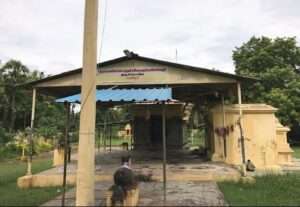
Sri Kadambavaneswarar Temple is a small and lesser-known ancient Shiva temple located at Erumbur in Cuddalore district, on the Sethiyathope–Virudhachalam road. During the Chola period, Erumbur was known as Urumur, and the temple was referred to as Urumur Siru Tirukkoyil Perumanadigal. Though modest in size, it preserves an important chapter of early Chola temple history.
The present stone temple dates back to around 935 CE, during the reign of Parantaka Chola I, making it more than 1,000 years old. An inscription on the southern wall of the main shrine belongs to the 28th regnal year of Parantaka Chola I and records the construction of the stone temple.
The presiding deity is Lord Shiva, worshipped as Kadambavaneswarar, facing east. The Goddess is Kalyanasundari, facing south. Shiva is enshrined in the sanctum as a lingam. Other important deities include Yoga Dakshinamurti, Arunachaleswara, Brahma, Vinayaga, Muruga, Durga and Bhairava. The temple also has a sacred Kadamba tree and a temple tank known as Easwaran Kulam.
The temple is a fine example of early Chola architecture. The original stone structure consisted mainly of the sanctum and ardhamandapa, along with eight subsidiary shrines for the Ashta Parivara Devatas.
The vimana carries early Chola sculptures, including a distinctive yogic form of Dakshinamurti, along with Brahma and Arunachaleswara. The Goddess shrine and mukha mandapa were added during the later Pandya period.
An inscription records that Irungolan Gunavan Aparajitan constructed the stone vimana and the eight subsidiary shrines in 935 CE with the permission of Parantaka Chola I. Earlier records indicate that an older shrine existed at the site before the present stone structure was built. Later Chola inscriptions also record the village under different names.
According to the local tradition, a woman once faced doubts and accusations about her character. Before she died, she asked her son to carry her ashes to different Shiva temples. She told him that at the temple where her remains turned into flowers, her innocence would be proved.
The son began his journey, carrying his mother’s ashes from one sacred Shiva shrine to another. He visited several temples, including Chidambaram, but the sign he was looking for did not appear.
At last, he reached Erumbur and came to the shrine of Lord Kadambavaneswarar. While he was bathing, a crow is said to have struck the vessel containing the ashes. The vessel fell to the ground, and the ashes were scattered. To his amazement, the bones were believed to have transformed into flowers.
The miracle was accepted as proof of his mother’s purity and innocence. The legend is traditionally connected with the name Elumbur, from the Tamil word “elumbu”, meaning bone, which is said to have later become Erumbur.
Another local tradition associates the temple with King Aparajita. During a difficult military campaign, the king is said to have rested at this place. Lord Shiva appeared to him in a dream and instructed him to build a temple here. The inscriptional evidence records that Irungolan Gunavan Aparajitan subsequently constructed the stone temple in 935 CE with the permission of Parantaka Chola I.
The ancient name Kadambavanam is also associated with the sacred Kadamba trees believed to have once surrounded the place and with the nearby Kadambaaru. Thus, the temple preserves a fascinating combination of local legends, sacred traditions and early Chola history.
Maha Shivaratri is an important festival celebrated at the temple, along with regular Pradosham observances. Guru Peyarchi is especially significant here as the temple is traditionally regarded as one of the seven Guru Sthalams. Special worship is offered to Dakshinamurti on Thursdays, and the temple receives many devotees during Guru Peyarchi.

