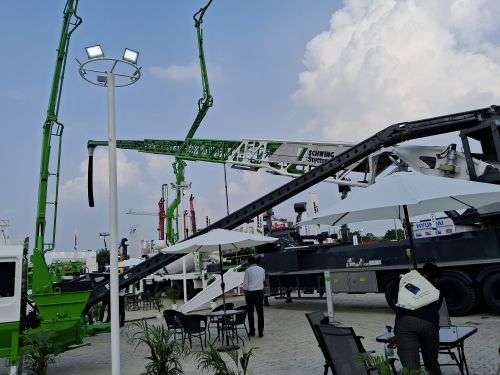
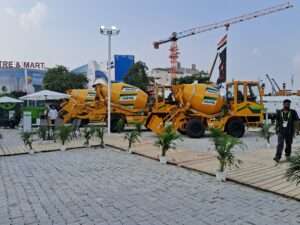
Walking through SCHWING Stetter India’s Outdoor Stall F01 at bauma CONEXPO INDIA 2026, the first impression came from the sheer spread of equipment.
Twenty-seven concreting and construction solutions occupied the display, the company’s largest showcase at the event, covering batching, transportation, pumping, placement, self-loading, crushing, recycling and specialised applications.
The second impression was less obvious.
The company’s traditional strength in concrete equipment was still everywhere, but the portfolio has widened around it. Electric and CNG truck mixers stood alongside pumps and batching equipment, while crushing and tunnelling solutions extended the range into other areas of construction. Digital technologies, intelligent controls and application-specific systems were also part of the display.
I could not help but think of how the stand offered a useful view of how the Indian operation has developed since SCHWING Stetter India was incorporated in 1998.
Equipment Evolved
The SB 40 Single Belt Conveyor Batching Plant was among the new introductions and the company’s first batching plant based on a single-belt conveyor feeding concept.
The equipment line-up included the AM 7 EV and AM 7 CNG Truck Mixers, SP 1907 E Stationary Pump, LP 1807 D City Line Pump and a more efficient version of the S 43 SX III Concrete Boom Pump. The SLM 4300 NEU Self Loading Mixer, DMM H30 Dry Mix Mortar Plant and TSR 22.11 Shotcrete Machine extended the range into self-loading, dry-mix and tunnelling applications, while the FBP 29 Truck Mixer Pump combined transportation and pumping in one unit.
The AFDS-1000 Automatic Fiber Dosing System and the crushing equipment — SCC 300 Cone Crusher, SJC 4232 Jaw Crusher and RM 60 Rubble Master — completed a display that reached well beyond conventional concrete pumping. Concrete production and pumping remain central, but the range now reaches into several adjoining areas of construction activity.
Technology At Work
Technology was woven into the equipment rather than presented as a separate futuristic proposition.
AI, IoT, connected equipment and intelligent control systems were demonstrated with an emphasis on productivity, safety, machine utilisation and operational visibility. A high-pressure, camera-assisted cleaning system for batching plant mixers addressed a much simpler jobsite requirement by reducing manual intervention.
That combination was interesting because it put sophisticated digital systems alongside practical operating improvements.
For an equipment owner, technology has to earn its place through better operation, monitoring, maintenance or utilisation. At the SCHWING Stetter display, those different aspects appeared together.
The exhibition theme, “engineering future”, consequently had a practical character.
Northern Presence
The latest addition to the manufacturing story has come from Jamshedpur.
The newly established SCHWING Jamshedpur Concrete Mixer Factory has added a second manufacturing location to the company’s existing base in Tamil Nadu. The facility was inaugurated earlier in 2026, and the first fully built SCHWING truck mixer on a Tata chassis subsequently rolled out from the plant. That development adds substance to the localisation story.
Jamshedpur brings SCHWING Stetter into an established industrial ecosystem and creates a new base for concrete mixer manufacturing. The company has also been working towards developing the local vendor base around the operation.
For India’s construction-equipment industry, localisation is moving beyond the substitution of individual imported components towards building deeper manufacturing capability, supplier networks and engineering support.
Jamshedpur fits into that broader industrial evolution.
Cheyyar’s Role
Tamil Nadu provides another important part of the picture. The Cheyyar facility has become a manufacturing and engineering base, with product lines being designed and engineered there to global standards. The Indian operation has also developed R&D capabilities and an export presence spanning more than 30 countries.
That gives the Indian manufacturing footprint a significance beyond domestic supply.
The operation is now connected not only with the requirements of Indian infrastructure but also with overseas markets, including the U.S. and Europe.
V.G. Sakthikumar, Chairman & Managing Director of SCHWING Stetter India, is led to say, “India’s infrastructure requirements are becoming larger, faster and more demanding, while customers are looking closely at productivity, energy consumption, safety and lifecycle operating costs. At bauma CONEXPO INDIA 2026, we are showcasing 27 solutions with new products and more efficient variants across almost every major category.
“What is equally important is the technology behind these machines. AI, IoT, alternative power, intelligent controls and application-specific engineering are increasingly becoming part of how we develop equipment. Our focus is simple: understand what is changing at the jobsite and engineer a practical solution for it.
“As we grow, our ambition extends beyond India. We are gaining ground in developed markets, including the U.S. and Europe, where our Cheyyar facility now designs and engineers product lines to global standards. It reflects the direction we’re building toward: an Indian manufacturing base built to compete anywhere in the world.”
His comments brought together three elements visible across the display: changing jobsite requirements, the increasing role of technology and the use of Indian engineering and manufacturing capabilities for international markets.
Beyond The Machine
The equipment was accompanied by connected technologies and intelligent controls, but also by the less glamorous essentials of ownership: service, maintenance, diagnostics, spare parts and support.
That matters because construction equipment ultimately earns its value at the jobsite.
A pump, mixer, batching plant or crusher has to remain productive over its working life, making the support system around it an important part of the equipment proposition. SCHWING Stetter India’s manufacturing, sales, service and R&D capabilities therefore form part of the same picture.
The Indian Footprint
The Indian operation today covers concrete production, transportation, pumping, placement, recycling, crushing and specialised construction applications.
Those capabilities serve a wide range of infrastructure work, including roads and highways, bridges, metros, railways, airports, tunnels, high-rise construction, power projects, industrial infrastructure, mining and ready-mix concrete.
The company remains a 100 percent subsidiary of Germany’s SCHWING Group, but its Indian operation has developed considerable depth through manufacturing, engineering, R&D, sales, service and exports.
That is what made the bauma display more revealing than a conventional product showcase. What remained on top of my mind after viewing the SCHWING Stetter display was not simply the number of machines – it was the sheer industrial capability visible behind them.
The pumps, mixers and batching plants remained central. Around them were crushing and tunnelling equipment, alternative-power machines, digital systems and specialised applications.
Behind those products sit Cheyyar, Jamshedpur, R&D, engineering, localisation, service, and an export presence reaching more than 30 countries.
For SCHWING Stetter India, bauma CONEXPO INDIA 2026 was therefore more than an exhibition of equipment. It showed how an Indian operation that began with the requirements of a growing domestic construction market has developed manufacturing and engineering capabilities, connecting India with the wider SCHWING world.
That, to me, was the real MACHINE MATTERS story.