



Sanjaya reported to King Dhritarashtra the dreadful events unfolding upon the field of Kurukshetra. He said that both armies fought with equal strength, courage, and determination. Amid the confusion and fury of the struggle, it often seemed impossible to discern who fought against whom. The forces of the Pandavas shattered chariots, severed the heads of horses, and slew mighty elephants. The fallen beasts and warriors lay heaped together in ghastly piles of flesh and blood, resembling dreadful streams of terror flowing across the battlefield. Over these crimson torrents and mounds of ruin the warriors advanced, crossing them without hesitation and confronting one another with unwavering valor.
While the battle raged fiercely, murmurs arose within the Kaurava ranks. Many soldiers whispered among themselves that Dhritarashtra and his sons were driven by greed and wickedness, and that their ambition had compelled them to wage this terrible war against the Pandavas. These greedy rulers, they said, were the cause of the deaths of countless innocent warriors. They spoke of Dharmaraja Yudhishthira as the very embodiment of virtue and righteousness, and wondered how such a noble soul could be conquered by a band of selfish and unrighteous men. The soldiers feared that the Pandavas would surely triumph over the unjust Kauravas, and they anxiously questioned what fate would befall them, who had chosen to stand on the side of Duryodhana.
These words of doubt and discouragement soon reached the ears of Duryodhana. Angered by the wavering spirit of his men, he spoke sharply to Bhishma and the other commanders, asking why they should heed such malicious whispers. The warriors, however, continued to fight as though they had heard nothing, displaying remarkable chivalry and valor. At first, the battle seemed almost like a great martial contest, but gradually it swelled into a massive and dreadful war.
Bhima moved across the battlefield like a warrior celebrating the festival of the mace. Swiftly mounting his chariot, he released a storm of arrows and shattered the chariot of Bahlika. The celestial beings watching from the heavens praised the fierce endurance and astonishing swiftness of Bhimasena in battle. Meanwhile, Chitrasena attacked Abhimanyu, showering him with arrows and provoking his wrath. Abhimanyu responded with brilliant skill, killing Chitrasena’s charioteer, slaying his horses, and crushing his pride. Deprived of his chariot, Chitrasena mounted the chariot of Durmukha and continued the fight.
Elsewhere, King Drupada confronted Dronacharya and filled him with piercing arrows. Enraged by the attack, Drona struck back with terrible force, tearing apart the armor of the Panchala king and piercing his body with shafts. Unable to withstand the assault, Drupada withdrew from the field in humiliation. At another part of the battlefield, Susarma challenged Arjuna and showered him with arrows, even striking Sri Krishna himself. This insult inflamed Arjuna’s anger, and he released a relentless torrent of arrows that swept through the enemy ranks like a flooding river. The forces of Susarma could not endure this terrible storm and fled in panic. Many warriors threw away their bows, spears, and weapons and ran for their lives.
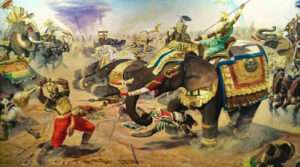
Then Bhishma himself advanced against Arjuna, but Satyaki quickly intervened to shield his ally. Bhishma hurled a mighty Shakti weapon at Satyaki. With astonishing agility, Satyaki bent down, seized the weapon, and hurled it back at the grandsire. Bhishma, however, cut it into pieces while it was still in mid-air. He then struck Satyaki with nine sharp arrows, wounding and enraging him. Soon, the battlefield around Bhishma filled with chariots, elephants, horses, and infantry from both sides.
Observing the growing pressure upon Bhishma, Duryodhana commanded his brother Dussasana and Shakuni to go at once and support the grandsire with all their forces. They rushed to Bhishma’s aid, while on the other side, Yudhishthira, Nakula, and Sahadeva came forward to reinforce their troops. Duryodhana then deployed ten thousand cavalry warriors to strengthen Bhishma’s position. These reinforcements surged forward like powerful waves, drenching the Pandava forces with arrows and weapons. The Pandava army momentarily resembled a disturbed lake stirred violently by swirling fish.
Yet Dharmaraja, Nakula, and Sahadeva responded with remarkable composure. They shot numerous arrows at the advancing cavalry. Many horses collapsed upon their forelegs, throwing their riders violently to the ground. Some struck their mouths against the earth and lost all sense of direction, while others wandered wildly after their masters had fallen to the deadly shafts. Witnessing the pitiful state of the Kaurava cavalry, the Pandava warriors sounded their trumpets and kettledrums in triumphant challenge.
Seeing the tide of battle turning, Duryodhana appealed to King Shalya, declaring that the Pandava forces were surging like the waves of a mighty ocean. He urged Shalya to stand firm like the shore that restrains the sea. Shalya then advanced with his troops and attacked Dharmaraja, Nakula, and Sahadeva with formidable skill, creating terrible havoc with his mastery of warfare. Soon Arjuna and Bhima confronted Shalya and pressed him hard. To rescue him, Bhishma and Drona rushed forward, and a fierce battle erupted that resembled a blazing inferno under the scorching sun of midday. The fourfold armies of both sides clashed together like the churning of the cosmic ocean.
Bhishma then rose in terrible might, shining like the midday sun whose rays dominate the sky. From his bow, he released blazing shafts that covered the entire battlefield. The grandsire struck twelve arrows into Dharmaraja, twelve into Bhima, three each into Nakula and Sahadeva, seven into Satyaki, and seven into Dhrishtadyumna, roaring like a lion as he fought. In response, the forces of Matsya, Pandya, Somaka, Magadha, Kashi, and Karusha united and attacked Bhishma together. But Dronacharya swiftly intervened and prevented Satyaki and Dhrishtadyumna from approaching the grandsire.
Drona fought with astonishing energy, moving like a swirling wind that seemed to appear everywhere at once, battling many warriors simultaneously. Meanwhile, Bhishma rained down fiery arrows upon the Pandava army. He shattered soldiers, cut bows and weapons, slew elephants, and struck terror throughout the ranks. The grievous suffering of the Pandava forces only emboldened him further, and he filled the battlefield with his deadly shafts. Wherever the eye turned, Bhishma seemed to stand there, like the very embodiment of destruction.
The field of war soon became a ghastly spectacle. Severed arms and legs, broken chariots, shattered wheels and yokes, slain horses and elephants lay scattered everywhere. Heads crowned with jewels, ornaments entwined with sinews, glittering weapons, and precious gems sparkled amid the heaps of the dead, creating a dreadful vision as though the shadows of death itself danced across the field. The surviving warriors roared, murmured, and shouted in terror as the horror around them deepened.
At that moment, Sri Krishna carefully observed the devastation and spoke to Arjuna. He said, “O Arjuna, behold how Bhishma has wrought terrible destruction among our forces. At once, he displays the strength of his arms, the firmness of his sinews, the mastery of his warfare, and the perfection of his archery. This is the moment for you to reveal your unconquerable valor.”
Thus Sanjaya narrated the terrible events of the battlefield to the blind king Dhritarashtra, and the account of these fierce struggles brought the troubled monarch a brief and passing comfort.

