Upadhyayula Lakshman Rao
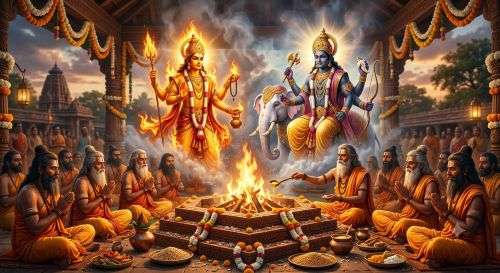
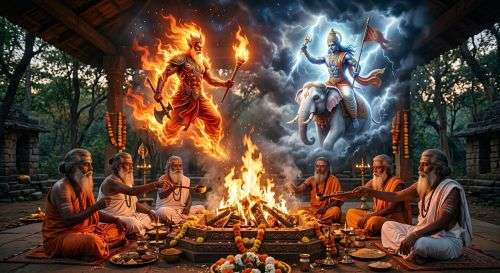
In the solemn cadence of the Rigveda, the sage Puruchhepa raises a universal invocation to the Vishvedevas, employing the dignified measures of Antyeṣṭi and Triṣṭubh metres. At the northern altar, the sacred Agni has been duly installed as Āhavanīya, the divine mediator between the mortal and the celestial. From this consecrated flame arises not merely physical fire but an inner illumination, a force of divine vitality that sustains the yajña. The sacrificial ground becomes a living field of energy, where the luminous vibrations of hymns reflect both devotion and a disciplined inquiry into cosmic harmony.
In this flourishing arena of sacred action, the worshippers invoke Indra and Vayu, calling them to partake in the resonance of their chants. The prayers, though directed to many forms, arise from a unified aspiration—that all sincere offerings, regardless of the deity invoked, reach their destined divine recipient. Here lies a subtle philosophical insight: multiplicity in worship is not fragmentation, but a coordinated expression of a singular truth, revealing an early scientific temperament that recognizes diversity as a pathway to unity.
The sage then turns to Mitra and Varuna, whose brilliance is likened to the radiant Surya. Their golden forms, perceived within the sanctified precincts, symbolize both physical phenomena and moral order. Their governance over waters reflects an understanding of natural cycles, where the regulation of rain and cosmic law are interwoven. The vision of these deities, attained through purity of mind and virtuous action, suggests that perception itself is both sensory and intellectual, bridging observation with inner realization.
The invocation of the Ashvins introduces a vivid imagery of motion, nourishment, and healing. Their golden chariot, overflowing with honey, becomes a poetic representation of abundance and the sweetness of life-sustaining forces. The falling drops symbolize the distribution of natural resources, while their swift journey across the skies reflects the dynamic cycles of nature. The patrons who worship them partake in a system where ritual, sustenance, and cosmic reciprocity are intimately connected, suggesting an early ecological awareness embedded within sacred practice.
The sage further contemplates the Ashvins’ ability to traverse sorrowless realms, guided by a celestial charioteer who ensures effortless passage. This imagery reflects not only spiritual transcendence but also an understanding of order, direction, and movement within the cosmos. Their role in subduing adversities and releasing rains emphasizes the balance between struggle and sustenance, reinforcing the idea that natural forces operate within a regulated and purposeful framework.
Turning again to Indra, the lord of rains and vitality, the purified Soma is offered with reverence. This sacred extract, prepared through careful processes, reflects both ritual precision and empirical observation. The transformation of Soma through pressing and purification mirrors an experimental approach, where substance, method, and outcome are intimately linked. The offering is not merely symbolic; it represents an interaction between human effort and natural forces, culminating in nourishment, rainfall, and continuity of life.
Agni, as the divine messenger, is entreated to receive the oblations and distribute them appropriately among the gods. In this role, Agni embodies the principle of transformation—converting material offerings into subtle essence. This reflects an intuitive grasp of conservation and conversion, where matter and energy are not lost but transmitted through different states. The connection to the lineage of the Angirasa sages reinforces continuity of knowledge, as ancestral wisdom guides present action.
The remembrance of sages such as Dadhyanga, Priyamedha, Atri, and Manu establishes a lineage of insight, while the identification with the son of Divodasa reflects a continuity of spiritual heritage. The invocation becomes not an isolated act but part of an enduring intellectual and spiritual tradition, where each generation refines and extends the understanding of cosmic principles.
The Maruts are praised for their inexhaustible strength, symbolizing the forces of nature that are both powerful and sustaining. The prayer for unceasing wealth, stable habitation, and protection from adversaries reflects a balanced aspiration—not for excess, but for harmony and security. The imagery of multi-hued dwellings and abundant cattle signifies prosperity aligned with natural order, rather than dominance over it.
The concluding vision of the thirty-three gods—eleven in the heavens, eleven on earth, and eleven in the intermediate space—reveals an organized cosmology, where divine forces are distributed across different realms. This structured understanding reflects a proto-scientific classification of existence, where observation, categorization, and reverence coexist. All these deities, it is affirmed, partake in the yajña, receiving their due share, thus completing the cycle of offering and reciprocation.
Thus, the hymn of Puruchhepa stands as a profound synthesis of devotion and disciplined thought, where ritual becomes a medium for exploring universal laws. It embodies a vision in which spirituality is not divorced from inquiry, but enriched by it, presenting the yajña as both a sacred act and an intellectual pursuit aimed at harmonizing human life with the vast and ordered cosmos.