Lakshmanrao Upadhyayula
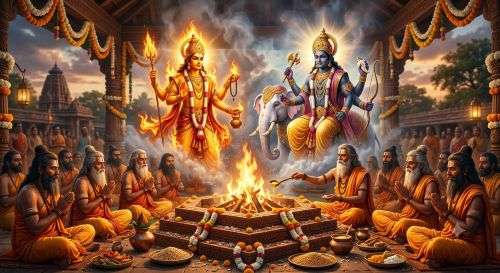
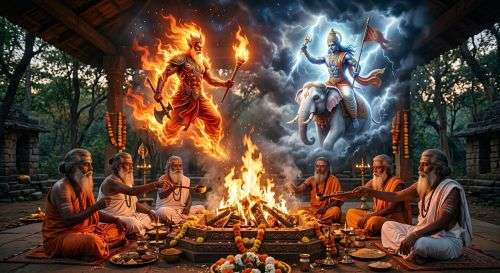
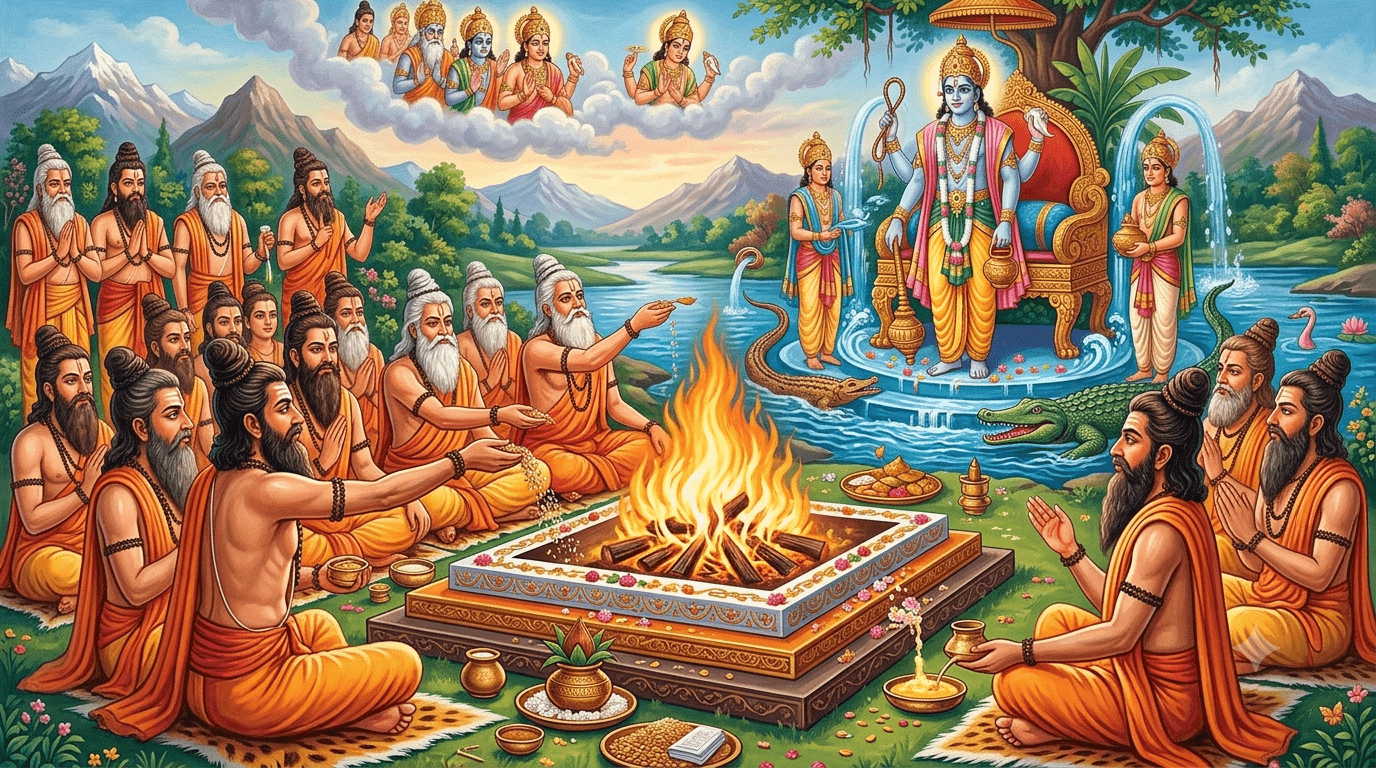
The venerable sages Śaunaka, the illustrious descendant of Gṛtsamada, and his son Kūrma, immersed themselves in profound contemplation and offered a sacred hymn to Varuṇa in the majestic Triṣṭubh metre of the Rigveda. In the Vedic vision, Varuṇa is not merely the lord of waters; he is the sovereign guardian of Ṛta—the cosmic law that sustains truth, order, morality, and the harmonious movement of the universe. He is hailed as a divine poet, for he shapes creation with wisdom and rhythm, just as a sage composes a hymn. Every star in its orbit, every river in its course, and every moral action in human life unfolds under his all-seeing governance.
The sages began their invocation with reverence: “O Varuṇa, adorned with celestial splendour and clothed in the brilliance of the cosmos, we offer these oblations unto you. By your immeasurable strength, you subdue all hostile forces, both external and internal. You are the supreme ruler, resplendent with majesty, and the gracious protector who blesses those who sustain the sacred fire of sacrifice.” In the Vedic understanding, sacrifice is not a mere ritual but a disciplined alignment of human consciousness with the universal order. When thought, word, and action are harmonized, the individual becomes a participant in the rhythm of creation itself.
With deep humility they prayed, “O Varuṇa, we meditate upon you, we serve you, and we sing your praises through these ancient mantras. Those who dedicate themselves to your divine law are blessed with prosperity, inner peace, and righteous discernment.” Prosperity in the Vedas signifies more than material abundance; it denotes a life enriched by wisdom, health, noble relationships, and freedom from mental agitation. Scientific temperament likewise teaches that order, discipline, and ethical conduct create stable and flourishing societies. Thus, the Vedic sages united spirituality with rational insight, seeing moral law and natural law as reflections of the same eternal principle.
At the advent of Uṣas, the radiant goddess of dawn, whose gentle rays awaken the world, the sacred fires were kindled. Dawn was revered as a daily revelation of hope and renewal. The transition from darkness to light symbolized the awakening of consciousness from ignorance to knowledge. Even in modern science, sunrise regulates circadian rhythms, governs hormonal balance, and sustains life on Earth. The Vedic seers recognized in Uṣas not only poetic beauty but the universal principle of renewal that animates both nature and the human spirit.
The sages proclaimed, “O universal Lord, noble and compassionate Varuṇa, we seek to dwell in your abode of truth and purity. O luminous and non-violent son of Aditi, be gracious unto us. Forgive our offences, whether committed knowingly or in ignorance.” This prayer reflects an extraordinary spiritual maturity. Sin is understood as any thought or act that disrupts harmony within oneself and with the cosmos. Repentance becomes the conscious restoration of balance, just as science seeks to identify and correct errors to restore equilibrium in natural systems.
“O Varuṇa,” they continued, “you envelop the universe. You fashioned the waters and set the rivers in motion by your divine ordinance.” Water, the foundation of life, was regarded as a sacred manifestation of divine intelligence. The sages marveled that rivers flow tirelessly toward the ocean, never reversing their course, moving with swiftness like birds traversing the sky. Today, hydrology explains this through gravity, precipitation, and watershed dynamics; yet the Vedic seers perceived behind these laws the unwavering operation of Ṛta, the principle that governs all movement with precision and purpose.
In a deeply personal confession, the sages prayed, “I am bound by the ropes of sin; release me, O Varuṇa.” These “ropes” symbolize the psychological bonds of guilt, fear, attachment, and habitual ignorance. The prayer reveals a timeless insight into the human condition: that liberation begins with self-awareness and sincere surrender. They further implored that the streams of life may remain abundant, that the threads they weave may not break, and that their sacred works may reach completion without interruption. The weaving of threads serves as a metaphor for the continuity of life, where every intention and action forms part of a larger tapestry of destiny.
Recognizing Varuṇa as the embodiment of truth, they pleaded, “Remove fear from our hearts. Release us from sin as a calf is gently untied from its tether.” This tender image conveys that divine grace liberates not through violence, but through compassion and understanding. Fear is the natural consequence of alienation from truth; when one lives in harmony with moral and cosmic law, fear subsides and inner freedom arises.
The sages then sought protection from the consequences of wrongdoing: “May the weapon by which you punish the wicked not come near us. Remove tormentors from our lives.” Here, Varuṇa’s weapon symbolizes the unavoidable law of cause and effect. Just as science teaches that every action has measurable consequences, the Vedic worldview affirms that ethical actions generate harmony, while destructive actions return as suffering. The wise therefore seek not to escape justice, but to align themselves with truth.
“O Varuṇa,” they declared, “though you manifest in countless forms and dwell in many realms, we bow to you in the past, present, and future.” This profound vision transcends linear time. The divine is recognized as the eternal presence underlying all moments. The sages compare Varuṇa to a mountain in whose immovable vastness all virtuous deeds find shelter. Truth stands firm amidst the changing currents of existence, just as the laws of nature remain constant through the ages.
The hymn turns toward social and economic wisdom with a prayer of remarkable practical insight: “Clear the debts inherited from our ancestors, and protect us from dependence on wealth earned by others.” Debt is viewed not merely as financial obligation but as a burden that steals peace and diminishes the joy of life. “The borrower,” they observed, “loses many beautiful dawns.” Anxiety over obligation clouds the mind and obscures the splendour of each new day. Freedom from debt, both material and karmic, allows every Uṣas to shine with hope and possibility.
The sages conclude with a prayer that all the dawns of life may be radiant and auspicious. Through discipline, honesty, gratitude, and devotion to truth, they seek a life in which each day unfolds as a fresh revelation of divine grace. The hymn to Varuṇa thus stands as one of the most profound expressions of Vedic spirituality. It unites cosmology, ethics, psychology, ecology, and social wisdom into a single vision of existence governed by truth.
In this sacred invocation, Varuṇa emerges as the eternal witness within and without—the lord of the waters, the guardian of conscience, and the upholder of universal law. To meditate upon him is to cultivate reverence for truth, responsibility for one’s actions, and harmony with the natural order. When human beings live in accordance with Ṛta, their lives flow as effortlessly as rivers toward the sea, and every dawn becomes a testament to renewal, freedom, and the boundless compassion of the Divine.