When every controversy becomes a reason to sack Modi
Every Opposition has the right – even the duty – to hold the government accountable. It must question, protest and expose wrongdoing wherever it finds it.
But accountability and resignation are not synonymous. For LOO (Leader of the Opposition) Rahul Gandhi, however, they increasingly seem to be.
Whether it is an ED probe, a CBI investigation, allegations of electoral malpractice, or now the agitation over the NEET paper leak led by the Cockroach Janta Party (CJP), the Congress leader’s political prescription remains remarkably consistent: Prime Minister Narendra Modi and Home Minister Amit Shah must resign.
It raises an obvious question. Is resignation the constitutional remedy for every political controversy, or has it become the Congress’ default political slogan?
From support to centre stage
The CJP-led agitation illustrates the pattern. What began as a campaign over the NEET controversy attracted nationwide sympathy because it appeared spontaneous and non-partisan.
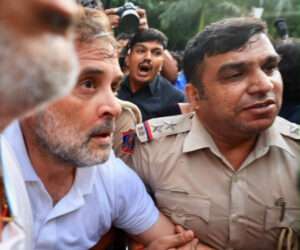
Then came Rahul, returning from yet another vacation just before another Parliament session. Within hours, television screens were dominated not by the original protesters but by Rahul’s march towards the prime minister’s residence, his confrontation with the police, his detention and, inevitably, his demand that Modi and Shah resign.
The movement suddenly found itself competing with its own political patrons for attention. Supporting a public movement is one thing. Becoming its principal face is quite another.
From one grievance to many agendas
The transformation did not stop there. The CJP’s platform is no longer occupied only by those directly affected. Opposition politicians, activists, pressure groups and professional protesters have all found space under the same banner, each bringing a separate political agenda.
The result is predictable. A movement that began with one grievance now carries many. The original issue risks being drowned out by unrelated political demands. That may suit political parties. Whether it serves the original cause is another question.
The familiar script
This is hardly an isolated episode. An issue erupts. Congress launches a nationwide campaign. Rahul demands the resignation of Modi and Shah. The issue changes. The prescription rarely does.
Whether the controversy concerns investigative agencies, election-related allegations, parliamentary disputes or the latest NEET agitation, the conclusion is almost always the same.
There is nothing wrong with demanding accountability. That is the Opposition’s job. But when resignation becomes the first response instead of the last constitutional consequence, it loses both its gravity and its persuasive force.
Governments don’t resign on demand
Bharat is a parliamentary democracy. Governments do not fall because the Opposition demands it. They fall when they lose the confidence of Parliament or when the people vote them out.
Repeated calls for resignation may generate headlines. They do not, by themselves, alter political reality.
If every issue ends with the same call for the PM’s resignation, the demand itself begins to lose its force. What initially sounds like righteous indignation eventually starts resembling political routine.
Prime ministers are elected by the people, command the confidence of Parliament and leave office only when they lose one or the other – not because the Opposition repeats the same slogan after every controversy.
Politics or perpetual campaign?
By attaching the demand for Modi’s resignation to almost every issue, Congress risks overshadowing the issue itself. The public begins debating Rahul’s politics rather than the protesters’ demands. The messenger overtakes the message.
The prime minister’s chair
Rahul’s politics also creates another impression. At times, he appears to behave as though the prime minister’s office is merely awaiting a vacancy – as though repeated demands for Modi’s resignation will somehow bring that moment closer.
In a democracy, prime ministers are chosen by the electorate. If Rahul wishes to occupy the office, the route lies through the ballot box, not through repeated calls for resignation.
The protesters’ dilemma
The greatest casualty could well be the protesters themselves. Every mass movement welcomes political support. Few survive political ownership.
The protesters ignited the movement and gave it credibility. If the agitation comes to be identified more with Rahul and Opposition politics than with those who launched it, its original purpose will inevitably recede into the background.
Support strengthens a movement. Appropriation weakens it. That is the fine line every political party must recognise – and every citizens’ movement must guard against.