The drone never reached Mecca. The message did.
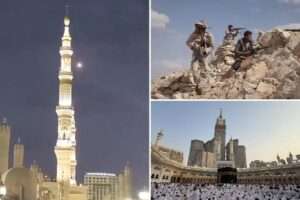
On September 15, Saudi Arabia said its air defences intercepted and destroyed a Houthi drone south of Mecca before it entered the holy city’s restricted airspace. The Houthis denied that they had targeted Mecca. Yet the incident immediately became a powerful geopolitical story because the mere possibility of a drone approaching Islam’s holiest city carries a significance far beyond the battlefield.
The obvious narrative is simple: Houthis, backed by Iran, versus Saudi Arabia. But geopolitics is rarely that simple. While headlines focus on the drone, the more consequential story is about how security, capital, energy, technology and alliances are being rearranged across the Middle East.
Consider Washington’s 2026 National Defense Strategy, released on January 23. Its Middle East section explicitly says the United States wants regional allies and partners to take primary responsibility for deterring and defending against Iran and its proxies. It also calls for stronger cooperation with Gulf partners and greater integration between Israel and the Arabian Gulf states.
That is a significant strategic signal. Washington may remain deeply involved in the region, but it wants regional partners to carry more of the security burden. That makes interoperability, intelligence, surveillance, air defence, cyber capabilities and advanced technology increasingly important.
Now consider Saudi Arabia itself.
The kingdom is no longer thinking only in terms of oil. Its Public Investment Fund’s 2026–2030 strategy places greater emphasis on domestic investment, including advanced manufacturing, innovation, industrials, logistics, clean energy and infrastructure. At the same time, Saudi Arabia is positioning itself as an important centre for artificial intelligence and computing infrastructure.
HUMAIN, established by the PIF, is building large-scale data-centre capacity and AI infrastructure, with partnerships involving NVIDIA, Microsoft, AMD, AWS and Google Cloud. The ambition is unmistakable: energy and capital are being connected with data, cloud computing and artificial intelligence.
That changes the strategic equation.
Iran may not be able to match Saudi Arabia’s financial resources, but geography gives Tehran and its regional partners enormous leverage. The Strait of Hormuz lies beside Iran, while the Houthis operate along Yemen’s Red Sea coastline near the Bab el-Mandeb. Saudi Arabia consequently finds itself between two strategically important maritime theatres.
The objective, therefore, need not be territorial conquest. Pressure itself can become leverage.
The timing is also revealing. Reuters reported that US officials held a confidential meeting with Houthi representatives in Muscat over the weekend, with Oman facilitating the talks. Around the same period, US, Israeli and Arab military chiefs reportedly met in Germany under CENTCOM leadership to discuss Iran and regional security.
Then came the Mecca incident.
Whether or not the Houthi drone was actually intended for Mecca, the episode demonstrates how quickly a regional conflict can alter Saudi Arabia’s security calculations. The protection of the Two Holy Mosques is not an ordinary military requirement. It is a national, religious and international security priority.
And that could accelerate precisely the kind of regional security architecture Washington has been encouraging: stronger Saudi air defence, deeper intelligence-sharing, counter-drone capabilities, cyber protection, satellite surveillance, AI-enabled threat detection and greater military interoperability with regional partners.
This is where the larger economic story enters.
Security crises require spending. Spending creates procurement. Procurement creates infrastructure. Infrastructure creates technological ecosystems. And technological ecosystems create long-term strategic dependencies.
That is how power increasingly moves in the 21st-century Middle East.
Not merely through Iran versus Saudi Arabia.
Not merely through Houthis versus Riyadh.
The deeper contest involves chokepoints, capital, energy, data, compute, artificial intelligence and alliances.
The drone may have been intercepted before reaching Mecca. But its strategic message has already travelled much farther.
Mecca is today’s headline.
2030 is the target.