
M Jayshree
या देवी सर्वभूतेषु शक्तिरूपेण संस्थिता। नमस्तस्यै नमस्तस्यै नमस्तस्यै नमो नमः॥
या देवी सर्वभूतेषु मातृरूपेण संस्थिता। नमस्तस्यै नमस्तस्यै नमस्तस्यै नमो नमः॥
Salutations again and again to the Divine Mother who abides in all beings in the form of universal energy and motherhood.
The timeless spiritual traditions of Bharata perceive the universe not as a lifeless arrangement of matter, but as a magnificent manifestation of cosmic consciousness, governed by the eternal principles of Dharma, Rita (cosmic order), and the dynamic force of Shakti. Within this profound vision, the manifestation of Goddess Mahishasuramardini occupies an extraordinary place, symbolising the invincible power of the universe to overcome evil, restore righteousness, and re-establish harmony whenever destructive forces threaten the balance of existence. The narrative of the Divine Mother is not merely an account of a celestial battle between gods and demons; it is a spiritual declaration that no power, however formidable, can permanently prevail against the fundamental order of the cosmos. It affirms that the preservation of creation requires the awakening of divine strength whenever arrogance, oppression, and unrestrained ambition undermine the foundations of life.
The philosophical foundations of this understanding find a profound parallel in the Vedic vision of existence. The Rigveda invokes the universal powers of nature through hymns dedicated to Agni, Indra, Varuna, Surya, and other manifestations of the divine. These deities represent distinct yet interconnected dimensions of cosmic functioning, through which the universe sustains its order and vitality. The Vedic conception of Rita establishes that existence is not governed by arbitrary power but by an enduring principle of truth, order, and rightful conduct. Although the celebrated narrative of Mahishasuramardini is primarily elaborated in the Devi Mahatmya, embedded within the Markandeya Purana, its spiritual significance resonates with the wider Indic understanding that the forces sustaining creation must ultimately overcome those that threaten its harmony. The Divine Mother embodies this universal principle in its most dynamic and compelling form.
According to the sacred narrative, Mahishasura, empowered by a boon granted by Brahma, became increasingly arrogant and destructive. The boon made him confident that the celestial powers could not defeat him, and his pride gradually transformed his strength into an instrument of oppression. Leading his formidable demon hosts, he challenged the gods, defeated the celestial forces, and occupied the throne of Indra. The heavenly realms, once governed by the guardians of cosmic order, fell under the domination of a power that recognised neither restraint nor righteousness. Mahishasura’s ambition extended beyond the assertion of strength; it threatened the very principles upon which the stability of the universe depended.
The spiritual significance of this episode lies in the distinction between power and righteousness. Strength, in itself, is neither virtuous nor destructive; its moral character depends upon the purpose it serves. When power is governed by wisdom, it becomes a means of protection and social welfare. When it is governed by ego, it degenerates into domination. Mahishasura represents this degeneration of power, wherein an extraordinary gift becomes the foundation of arrogance rather than humility. The story reminds humanity that privilege, authority, knowledge, and material prosperity acquire legitimacy only when exercised in accordance with Dharma. A boon may provide extraordinary capabilities, but it cannot transform unrighteousness into righteousness or make arrogance a permanent principle of existence.
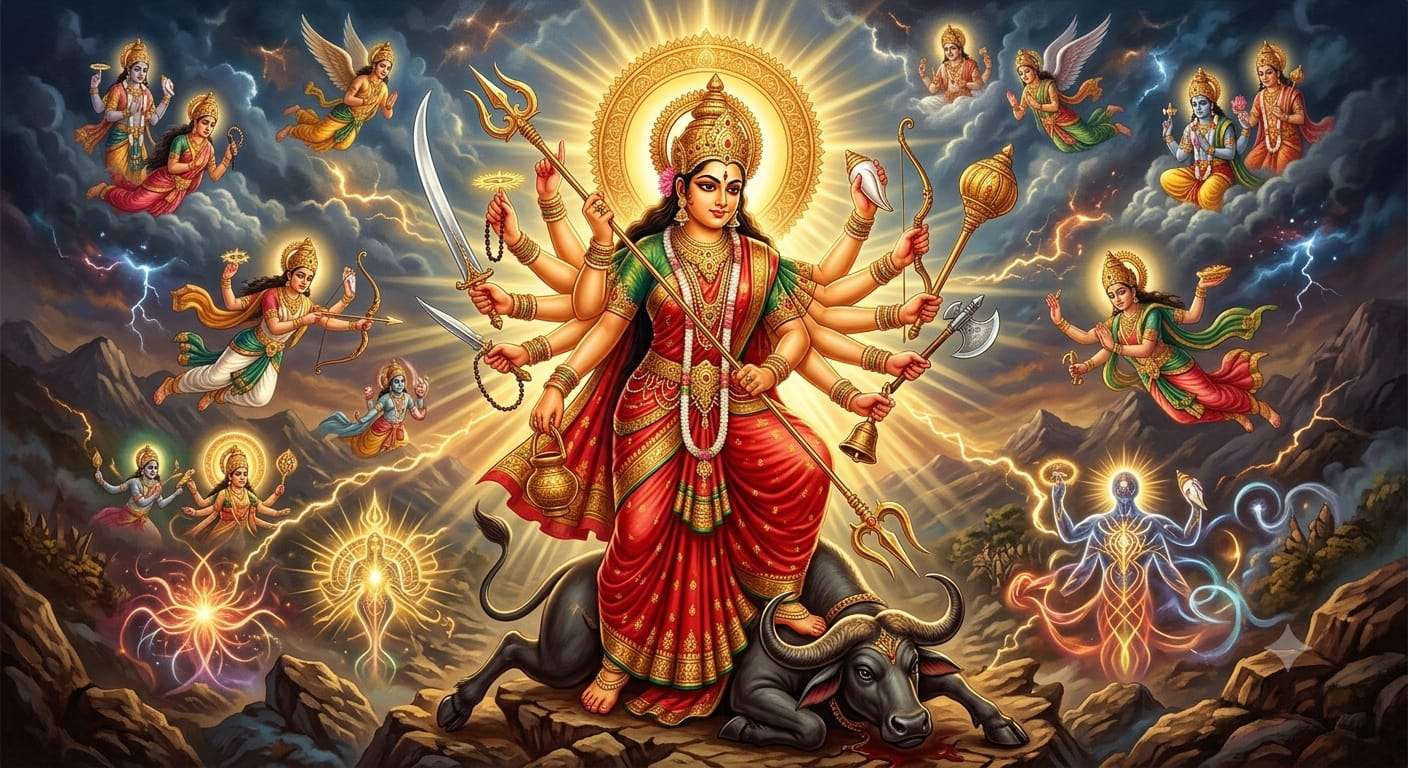
Defeated and dispossessed, Indra and the other gods approached the divine Trinity—Brahma, Vishnu, and Shiva—and appealed for the restoration of cosmic balance. Their collective distress symbolised the helplessness of established powers when confronted by an adversary whose strength had exceeded their individual capacities. The response of the Trinity was not merely a demonstration of anger; it was the awakening of a greater, integrated power. The radiance emanating from the gods converged into an extraordinary brilliance, from which the Divine Mother manifested herself. In the Devi Mahatmya, this manifestation signifies that the energies of the divine are not isolated or mutually exclusive. When united in a common purpose, they become an irresistible force capable of overcoming even the most entrenched disorder.
The emergence of the Goddess is particularly significant because the ultimate instrument of universal restoration is a feminine divine power. In the traditional account, the radiance of Shiva, Vishnu, Brahma, and the other gods contributes to her magnificent form. Her face, limbs, and other features embody the combined brilliance of the celestial powers. She is not a subordinate participant in the divine order but its sovereign, active energy, capable of confronting the crisis that the gods themselves could not resolve. The name Mahishasuramardini, meaning the destroyer of Mahishasura, expresses this decisive role. She is also Durga, the unconquerable one, whose power arises from the deepest foundations of cosmic existence.
This manifestation carries a profound philosophical resonance with the concept of Shakti. In the Shakta tradition, Shakti is the dynamic, creative, sustaining, and transformative power of the universe. Consciousness and its power of manifestation are understood as inseparable dimensions of reality. The Goddess therefore represents far more than a divine personality appearing at a particular moment in sacred history. She embodies the principle that creation itself possesses the power to resist destruction, that life contains the possibility of renewal, and that the forces of restoration may emerge from a unity greater than the sum of its individual elements. Her manifestation teaches that cooperation, collective purpose, and the integration of diverse strengths can overcome challenges that remain insurmountable when approached separately.
The Goddess is traditionally depicted with eighteen arms in many artistic representations, although the number of arms varies across different textual and regional traditions. Each arm bears a divine weapon or sacred emblem, signifying the many dimensions of her power. Shiva offers his trident, representing the mastery of the fundamental forces of existence; Vishnu contributes his discus, symbolising the power that cuts through disorder and restores cosmic balance; and Indra offers the vajra, the thunderbolt of irresistible force. Other gods provide weapons and attributes, including the noose, the sword, the bow, the arrows, and the conch. Brahma is associated with the rosary and water vessel in traditional iconographic descriptions. The Himalayan sovereign, Himavan, offers her the lion, which becomes her majestic vehicle.
These sacred attributes must not be understood merely as instruments of physical warfare. Their symbolic meanings penetrate the deeper dimensions of spiritual life. The trident represents the capacity to transcend and regulate the conflicting dimensions of existence; the discus evokes the unceasing movement of time and the restoration of order; the vajra signifies firmness and indomitable resolve; and the sword represents discriminating wisdom, which separates truth from falsehood. The bow and arrows suggest concentration, direction, and the disciplined application of energy. The noose evokes the power to restrain destructive impulses, while the conch announces the awakening of consciousness and the proclamation of victory. The lion embodies courage, sovereignty, and the disciplined mastery of primal strength. Together, these symbols portray the Goddess as the embodiment of wisdom, courage, determination, restraint, and decisive action.
Armed with the collective brilliance of the celestial powers, the Goddess confronted the demon armies. The encounter that followed was fierce and prolonged. Mahishasura’s commanders and warriors advanced against her with formidable determination, believing that their numerical strength and accumulated power would secure victory. The sacred narrative describes the destruction of numerous demon leaders, including Chikshura, Chamara, Udagra, Mahahanu, Asiloma, Baskala, and Bidala, among others. The lion accompanying the Goddess charged into the enemy ranks, scattering and destroying the forces that stood in her path. The battlefield became the setting for a cosmic confrontation in which destructive arrogance encountered a power that could neither be intimidated nor subdued.
The lion’s participation adds another dimension to the symbolism of the narrative. In Indian spiritual imagination, the lion represents majesty, fearlessness, and the unrestrained vitality of nature. Under the command of the Divine Mother, this powerful animal becomes an instrument of righteous action. The image suggests that strength, when governed by higher wisdom, ceases to be a threat and becomes a protector. It also conveys a message relevant to society: courage without discernment may become aggression, while courage guided by moral purpose becomes the foundation of protection and justice. The Goddess does not reject strength; she transforms strength into an instrument of universal welfare.
Mahishasura himself resisted the Goddess through successive transformations, appearing in the form of a buffalo, a lion, a warrior, and other manifestations. These changing forms are among the most powerful elements of the sacred narrative. The buffalo form, in particular, evokes brute force, stubbornness, and the refusal to submit to moral restraint. Each transformation may be read symbolically as the capacity of evil to change its outward appearance when confronted by truth. Destructive tendencies do not always announce themselves openly. They may disguise themselves as strength, necessity, ambition, or entitlement. Yet their essential nature remains unchanged as long as they are governed by arrogance and the desire to dominate.
The Goddess confronted each manifestation with unwavering resolve. The final battle culminated in the defeat and destruction of Mahishasura at her hands. Her victory restored the celestial order and released the gods from the domination of the demon king. In devotional understanding, this moment represents the triumph of Dharma over Adharma, wisdom over ignorance, disciplined strength over arrogance, and the collective welfare of creation over the selfish pursuit of supremacy. The Goddess’s victory is therefore not simply the elimination of an adversary; it is the restoration of the conditions necessary for life, justice, and harmony to flourish.
The spiritual message becomes even more profound when the narrative is understood as an allegory of the human mind. Every individual carries within the inner world tendencies that can either support or undermine the pursuit of a meaningful life. Pride, anger, greed, envy, intolerance, and the desire to control others resemble the many forms assumed by Mahishasura. These tendencies become formidable when nourished by ignorance and unchecked ambition. The Divine Mother, in this inward interpretation, represents awakened intelligence, moral courage, self-discipline, and the spiritual strength required to overcome one’s own destructive impulses. Her weapons become the instruments of inner transformation, and her victory becomes the possibility of liberation from the domination of one’s lower inclinations.
This interpretation also explains why the worship of Durga has remained meaningful across generations. Devotion to the Goddess is not confined to the expectation of supernatural protection or the fulfilment of personal desires. At its highest level, it encourages the devotee to cultivate the virtues that the Goddess embodies. Prayer should awaken courage; ritual should strengthen self-discipline; and reverence should deepen compassion and responsibility. The true significance of worship emerges when the values celebrated in the temple are carried into the home, the workplace, and the wider community. A society that invokes the Divine Mother while neglecting the dignity of women, tolerating injustice, or remaining indifferent to the suffering of the vulnerable has yet to realise the full ethical implications of its own devotion.
The celebration of Navaratri and Vijayadashami, widely known as Dasara or Dussehra in different parts of India, preserves this sacred memory through a rich synthesis of ritual, music, dance, fasting, public celebration, and family traditions. Navaratri, the nine nights dedicated to the Goddess, is observed in diverse forms across the country. In many traditions, the Divine Mother is worshipped as Durga, Lakshmi, and Saraswati, representing the powers of protection, prosperity, and wisdom. In other traditions, the nine manifestations of Durga receive particular reverence. Although customs and theological interpretations vary by region, the central devotional movement remains the same: the worshipper seeks purification of the mind, strengthening of character, and renewal of commitment to righteous living.
The culmination of the festival on Vijayadashami signifies the auspicious victory of righteousness. The word Vijaya denotes victory, while Dashami refers to the tenth lunar day associated with the festival. In the Durga tradition, it recalls the defeat of Mahishasura and the restoration of cosmic balance. In other celebrated narratives, the day is associated with Lord Rama’s victory over Ravana. These traditions are not identical in their narrative origins, yet they converge in their affirmation that destructive power cannot claim eternal legitimacy and that the restoration of righteousness is a cause for collective celebration. The festival thus brings together different strands of Indian sacred memory under a shared moral vision.
The worship of the Shami tree on Vijayadashami adds a particularly evocative dimension to this cultural inheritance. Known botanically as Prosopis cineraria, the Shami tree is revered in several Indian traditions for its auspicious associations with victory, resilience, and sacred protection. Its ability to flourish in arid environments has also made it a symbol of endurance and vitality. Across communities that observe the custom, devotees offer prayers to the tree, seek blessings for their endeavours, and exchange its leaves as tokens of goodwill and prosperity. The practice connects sacred remembrance with the rhythms of the natural world, reminding people that spiritual life is not separated from the environment but is woven into a larger relationship between humanity, nature, and the divine.
In certain traditions, the Shami tree is associated with Goddess Aparajita, the unconquered Divine Mother, whose name expresses the assurance that righteousness cannot be permanently subdued. The worship of Aparajita on Vijayadashami symbolises the invocation of invincible spiritual strength before undertaking new responsibilities or confronting life’s challenges. The association of the Shami tree with the Goddess may vary across regional and textual traditions, but its devotional meaning remains deeply rooted in the aspiration for courage, success, and the protection of Dharma. Through this ritual, an ordinary element of the natural landscape acquires sacred significance, becoming a living reminder of the spiritual ideals that sustain cultural continuity.
The Shami tree also occupies a prominent place in the epic traditions associated with Lord Rama and the Pandavas, although these narratives must be distinguished according to their respective sources and customary interpretations. In the Ramayana tradition, Rama’s victory over Ravana is celebrated as the triumph of righteousness over the destructive misuse of power. Some regional Vijayadashami traditions connect the worship of sacred trees and weapons with Rama’s preparations for victory. The symbolism is clear: righteous action requires both moral conviction and readiness to confront wrongdoing. Rama’s struggle against Ravana is remembered not merely as a military achievement but as a demonstration that courage must remain answerable to duty, justice, and the protection of the vulnerable.
The Mahabharata provides another enduring connection between Vijayadashami customs and the worship of weapons. During their period of incognito exile, the Pandavas concealed their weapons in a Shami tree near the kingdom of Virata. At the conclusion of their concealment, Arjuna recovered the weapons and prepared to confront the forces threatening the kingdom. This episode has become associated with the auspicious recovery and worship of weapons in several regional traditions. The story does not suggest that victory comes from weapons alone. Rather, it presents the disciplined preservation of strength, patience during adversity, and readiness to act when duty demands as essential dimensions of righteous conduct. The Shami tree becomes a witness to the passage from concealment to action, from enforced restraint to the responsible exercise of courage.
The custom of Ayudha Puja, or the worship of instruments and tools, extends this symbolism into everyday life. In different parts of India, artisans, farmers, workers, soldiers, students, traders, and professionals honour the instruments through which they perform their duties. Tools, books, machinery, vehicles, and implements may be worshipped according to regional practice. This tradition reflects a distinctive cultural philosophy: work is not merely a means of earning a livelihood but an opportunity to fulfil responsibility and contribute to society. The instrument is honoured because it enables productive action, while the person using it is reminded to exercise skill, care, integrity, and discipline. Vijayadashami consequently becomes an occasion for renewing one’s relationship with labour, knowledge, and service.
The social significance of the Divine Mother’s manifestation is especially compelling in the context of women’s dignity and agency. The Goddess is not portrayed as powerful because she imitates the male deities; she is powerful because she embodies an autonomous and sovereign dimension of divinity. The gods contribute their energies, yet the decisive confrontation is undertaken by the Goddess herself. Her victory establishes the feminine principle as indispensable to the preservation of cosmic order. In devotional culture, this understanding has inspired reverence for motherhood, womanhood, courage, and the protective power of feminine strength. Nevertheless, the deeper social obligation is to translate symbolic reverence into lived equality, safety, opportunity, and respect for women in every sphere of life. The worship of the Divine Mother finds its fullest ethical expression when the dignity celebrated in sacred narratives is honoured in human relationships.
Across the centuries, the image of Mahishasuramardini has found expression in temple sculpture, classical dance, folk performance, devotional music, painting, literature, and regional festivals. From monumental temple reliefs to intimate household shrines, the Goddess has been represented as both a fierce defender of cosmic order and a compassionate mother who responds to the distress of her devotees. These seemingly contrasting dimensions are united in the concept of divine motherhood. Compassion does not always mean passive acceptance, and protection sometimes requires decisive resistance to destructive forces. The Goddess’s ferocity is therefore understood as an expression of protective love, directed not towards domination but towards the restoration of harmony.
The enduring cultural vitality of this tradition also lies in its ability to speak to different generations in different ways. For the devotee, the Goddess is a living source of grace and protection. For the philosopher, she embodies the dynamic power underlying manifestation. For the artist, she represents the magnificent union of beauty, movement, and strength. For the social thinker, she raises questions about justice, authority, gender, and collective responsibility. For the individual confronting personal adversity, she becomes a symbol of the courage necessary to persevere without surrendering one’s moral convictions. The tradition survives not because its symbols remain unchanged in interpretation, but because their spiritual depth allows them to illuminate changing human circumstances.
In the contemporary world, the Mahishasura narrative offers a framework for reflecting upon the dangers of unchecked power, institutional arrogance, social oppression, and the erosion of ethical responsibility. The demons of the modern age need not be imagined as supernatural beings; they may be recognised in corruption, exploitation, violence, environmental destruction, discrimination, and the deliberate suppression of truth. The corresponding power of the Goddess may be understood through enlightened citizenship, moral leadership, social solidarity, education, compassion, and the courage to protect those who cannot adequately protect themselves. This is not a replacement for devotional belief but an ethical extension of its central message. The sacred story acquires contemporary relevance when its ideals guide action in the world.
Equally important is the recognition that the restoration of harmony requires more than anger at injustice. The Divine Mother is armed with many different instruments because complex challenges demand wisdom, discernment, perseverance, restraint, and courage in appropriate measure. Indiscriminate hostility cannot substitute for justice, just as strength without compassion cannot create lasting peace. The Goddess’s victory teaches that destructive tendencies must be confronted firmly, but the purpose of confrontation is the restoration of order and the protection of life. This distinction separates righteous strength from the very arrogance that the narrative condemns.
The Shami tree, the worship of weapons, the observance of Navaratri, and the celebration of Vijayadashami together reveal the remarkable capacity of Indian civilisation to preserve philosophical ideas through embodied cultural practices. Sacred memory is transmitted not only through scriptures and formal teachings but also through family rituals, seasonal observances, songs, stories, shared meals, temple traditions, and the participation of children in community celebrations. Each generation receives these practices and gives them renewed meaning. In this manner, cultural continuity becomes a living process rather than a static inheritance, joining spiritual aspiration with social belonging and collective memory.
Ultimately, Mahishasuramardini represents the eternal assurance that evil, however powerful its temporary appearance, does not possess an unquestionable or everlasting claim upon existence. The Divine Mother embodies the power to resist oppression, the wisdom to distinguish truth from falsehood, the courage to defend righteousness, and the compassion necessary to restore harmony after conflict. Her manifestation reminds humanity that the highest purpose of strength is protection, the highest expression of knowledge is discernment, and the highest achievement of devotion is the transformation of character.
When Vijayadashami arrives and devotees offer prayers to the Goddess, worship the Shami tree, honour their tools, or gather in celebration, they participate in a tradition extending far beyond the memory of a celestial battle. They affirm their hope that darkness can be dispelled, that courage can awaken in moments of helplessness, and that collective effort can overcome forces that threaten the common good. The victory of the Goddess becomes a promise renewed within every individual and every community willing to stand for truth, justice, compassion, and responsibility.
Thus, the glory of Mahishasuramardini lies not merely in the destruction of Mahishasura but in the profound spiritual vision that her victory communicates to humanity. The universe, in this sacred understanding, is sustained not by brute force alone but by the enduring relationship between consciousness, moral order, and divine energy. The Divine Mother is the radiant embodiment of that relationship—the power that arises when harmony is threatened, the courage that confronts destructive arrogance, and the grace that restores balance to existence. Her timeless message continues to illuminate the spiritual and cultural life of Bharata: whenever Adharma rises, the responsibility to uphold Dharma must awaken with equal determination, for the ultimate purpose of divine power is not domination, but the preservation of life and the triumph of righteousness.