



The reported Iranian plot to assassinate US President Donald Trump is not merely another episode in the increasingly dangerous confrontation between Washington and Tehran. It is a chilling reminder of how far state-sponsored hostility can go—and why threats against elected national leaders must never be normalised, justified or politically romanticised.
According to reports based on a Washington Post investigation, Trump’s departure from Ankara following the NATO summit in July involved an extraordinary deception operation after US intelligence received what was regarded as a credible Iranian threat against him. Trump publicly boarded an older Air Force One before being secretly moved in an airport catering vehicle to a smaller Air Force C-32A military aircraft. The aircraft carrying him flew secretly to Britain while the decoy aircraft followed later. The White House confirmed that security concerns had prompted the elaborate deception.
That is not routine presidential travel. It is the kind of extraordinary precaution normally associated with wartime conditions.
The disturbing backdrop is equally difficult to ignore. During the funeral ceremonies for Iran’s slain Supreme Leader Ayatollah Ali Khamenei, banners openly declaring “We will kill Trump” were displayed by mourners. The slogan was reported by Iranian state-linked media itself and independently documented by international media.
There must be no ambiguity here: political disagreement is legitimate; assassination is not. A state or its proxies seeking to eliminate another country’s elected leader is not an act of resistance. It is a criminal conspiracy with potentially catastrophic consequences for international peace.
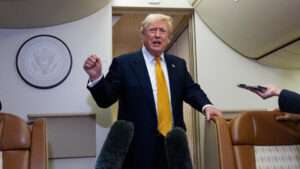
The reported episode also exposes the extraordinary complexity of protecting a head of government in the modern era. A presidential aircraft can become a target. Flight tracking, satellite imagery, electronic surveillance, drones, missiles and insider information can potentially turn a routine movement into a vulnerability. The fact that American security agencies resorted to a decoy aircraft and a secret transfer show that even the world’s most powerful military cannot take presidential security for granted.
And this should concern Bharat.
Prime Minister Narendra Modi is not merely a political leader; he is the head of government of a rising nuclear power with an increasingly consequential role in global geopolitics. His positions on terrorism, Pakistan, China, Russia, the Middle East and Bharat’s strategic autonomy inevitably generate adversaries. That makes the protection of the Prime Minister a matter of national security, not merely personal security.
Bharat has the Special Protection Group precisely for this purpose. Under the SPG Act, the force provides proximate security to the Prime Minister, including protection during road, rail, aircraft, watercraft and foot movements, with access-control and security cordons built into its mandate. The SPG itself says its arrangements are developed in coordination with the Intelligence Bureau and state and Union Territory police forces.
But sophisticated threats demand continuous evolution. The Ankara episode should prompt Bharatiya agencies to examine every assumption surrounding VIP movement—from aviation security and route sanitisation to intelligence sharing, electronic surveillance, decoy arrangements, cyber threats and the possibility of hostile actors exploiting crowds or local infrastructure.
There is another lesson. Security cannot be allowed to become predictable. The moment adversaries learn precisely when a leader travels, which aircraft he boards, which routes he takes or how his protection teams operate, they gain an advantage.
The reported Iranian plot therefore deserves unequivocal condemnation—not because Trump is above criticism, but because no political grievance can justify assassination as an instrument of statecraft.
If the allegations are established, Tehran must understand one fundamental reality: attempting to eliminate a democratically elected leader does not demonstrate strength. It risks triggering consequences far beyond the intended target.
For Bharat, the message is equally clear: protecting Narendra Modi is protecting the continuity of Bharat’s elected government and strategic decision-making. In an increasingly volatile world, vigilance is not paranoia. It is national responsibility.


