Lakshmanrao Upadhyayula
In the sacred Tristubh meter of the Rigvedic hymns, the sage Vishwamitra raises his voice in reverence to Indra, the mighty sovereign of celestial power, whose presence is woven into the rhythms of nature and the destiny of humankind. Indra is praised as the divine force behind life-giving rain, the nourisher of the earth, and the protector of those who gather and prepare food for sacred offerings. Through his benevolence, the cycles of nature are sustained, crops flourish, and humanity receives the means to perform yajña, the holy act of harmonizing earthly existence with cosmic order. The hymns celebrate him not merely as a deity of physical phenomena but as a guardian of the sacred relationship between nature, devotion, and divine providence.
The Vedic seers describe Indra as ever youthful, radiant, and resplendent with divine charm. From the moment of his birth, he possessed an extraordinary longing for Soma, the sacred essence revered as the source of vigor, inspiration, and spiritual exaltation. Before all other gods, Indra desired to partake of the Soma mixed with honey and the nourishing milk of the cow, symbolizing the union of heavenly vitality and earthly abundance. In the Vedic worldview, Soma represents both a ritual offering and a profound spiritual principle, signifying the awakening of higher consciousness and the infusion of divine strength into the seeker’s life.
The hymns recount that even in his infancy, Indra sought this sacred nourishment. Born in the noble household of the sage Kashyapa and the revered mother Aditi, he received Soma before tasting his mother’s milk. This remarkable imagery conveys the Vedic understanding that divine wisdom and spiritual power precede worldly experience. Aditi, the boundless mother of the gods, nurtured him with the pure essence of Soma, symbolized through clear and nourishing milk. Thus, Indra emerged as one whose strength was rooted not merely in physical might but in the sustaining power of sacred knowledge and cosmic truth.
Empowered by this divine nourishment, Indra displayed extraordinary intelligence and irresistible energy. The hymns portray him as shaking the strongholds of darkness and moving freely throughout the worlds. His actions symbolize the triumph of order over chaos and illumination over ignorance. The ancient seers recognized in these narratives a deeper spiritual lesson: whenever divine wisdom awakens within the human heart, the fortresses of fear, confusion, and falsehood begin to crumble. Indra’s journeys across the cosmos reflect the dynamic movement of life itself, constantly overcoming obstacles and establishing harmony.
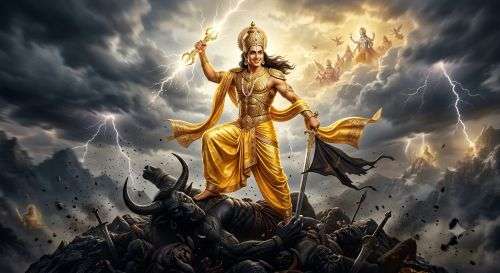
Among his countless heroic deeds, the destruction of the serpent-demon Vritra stands as the most celebrated. Vritra had imprisoned the waters, preventing rain from nourishing the earth. By defeating this adversary, Indra released the rivers and restored fertility to the world. Spiritually, this act signifies the liberation of life-giving energies that become trapped by ignorance, selfishness, or stagnation. Scientifically viewed, the hymn reflects the ancient observation of natural cycles in which storms break droughts and restore ecological balance. Thus, the Vedic sages expressed profound truths about both inner transformation and the workings of nature through symbolic and poetic language.
Indra is further praised as fierce against unrighteousness and swift in overcoming hostile forces. His courage, vigor, and adaptability are extolled throughout the hymns. Appearing in diverse forms according to the needs of cosmic order, he embodies the principle of responsive strength guided by wisdom. The references to his victory over powerful adversaries, including Twashta’s demonic manifestations, emphasize that no force opposing truth can ultimately prevail. His drinking of Soma from the sacred vessel symbolizes the continual renewal of divine energy necessary for sustaining righteousness and protecting the worlds.
The Rigvedic vision also celebrates Indra as the source of prosperity and food production. Through the release of rain and the maintenance of natural order, he enables seeds to germinate, crops to mature, and communities to thrive. In this respect, the hymns reveal a remarkable scientific temperament, recognizing the intimate connection between atmospheric phenomena, water cycles, agricultural abundance, and human survival. The Vedic seers perceived these natural processes as expressions of a deeper cosmic intelligence, and their hymns united observation, gratitude, and spiritual reflection into a harmonious worldview.
Indra is portrayed as a mighty leader, endowed with far-reaching vision and inexhaustible wealth. His riches are not limited to material abundance but include strength, wisdom, protection, and the capacity to inspire noble action. As one who hears sacred chants and responds to sincere prayers, he represents the accessibility of divine grace to those who approach with faith and purity of intention. The hymns teach that the universe is not indifferent to human aspiration; rather, divine forces cooperate with those who strive to uphold truth, discipline, and reverence.
Therefore, Vishwamitra’s prayer culminates in a heartfelt appeal for shelter, safety, and blessing. Indra is invoked as the defender of the righteous, the conqueror of enemies, and the bestower of wealth earned through honorable effort. The sage seeks not merely worldly success but alignment with the cosmic order that Indra upholds. In this sacred vision, Indra stands as a symbol of divine strength, enlightened leadership, and life-sustaining power. His story reminds humanity that true victory arises when courage is united with wisdom, when abundance is guided by gratitude, and when the forces of light are allowed to triumph within the human soul and throughout the living universe.