There is something slightly unusual about the timing of bauma CONEXPO INDIA 2026. The industry comes to one of its biggest gatherings after a difficult year for domestic sales, yet with exports providing a distinctly different signal – they are accelerating and the bigger industrial story is beginning to move beyond the market itself.
India sold 136,995 construction equipment machines in FY26, about 2 per cent fewer than the 140,191 sold in FY25. Domestic sales fell around 7 per cent, while exports jumped 31.5 per cent.
That contrast is worth pausing over. India remains a large and important CE market, but the industry’s fortunes are no longer being shaped entirely by what happens on Indian construction sites. Manufacturers are finding customers elsewhere, while the capabilities being built here are becoming relevant to markets outside the country.
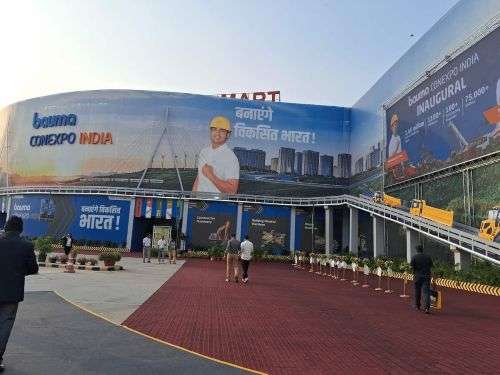
This gives the current edition of bauma CONEXPO INDIA an added dimension. From September 15 to 18 at the India Expo Centre in Greater Noida, the exhibition will put construction machinery, mining equipment, building-material machinery and construction vehicles on display. Behind all that hardware sits a less visible story involving components, engineering, productivity, digital systems, localisation and after-sales support.
Execution Matters
The domestic slowdown had little to do with contractors suddenly losing their appetite for equipment. Project execution slowed in several areas, highway activity faced delays, liquidity remained tight in parts of the contracting community and higher equipment costs added to the pressure.
Deepak Shetty, President of ICEMA and CEO and Managing Director of JCB India, South Asia and Africa (East), sees some improvement in the immediate picture. “The last three months have been very positive,” he says, with “the execution of projects” beginning to accelerate.
The industry has raised its FY27 domestic sales growth expectation to 9–12 per cent. It is a useful indication of confidence, although anyone familiar with infrastructure contracting knows how quickly equipment demand follows the movement of projects, payments and work fronts.
Deepak Garg, Vice Chairman and Managing Director of SANY Heavy Industry India, made much the same point while assessing the Budget. He described it as a “strong and positive signal”, but his more telling observation was that “the key to success now lies in execution.”
For equipment manufacturers, that distinction between announcements and actual work is hardly academic. An excavator sitting in a dealer yard does nothing for infrastructure output. The machine starts earning when the project starts moving.
Demand Shifts
The equipment mix tells its own story.
Earthmoving remained by far the largest segment in FY26, accounting for roughly 71 per cent of sales. Road construction equipment, however, grew by about 6 per cent, while concrete equipment was broadly flat. Material handling moved in the opposite direction.
The differences reflect the projects behind the numbers. A road contractor, for example, is looking increasingly closely at paving and compaction productivity, fuel consumption, machine availability and the consistency of the finished work. A machine’s specification sheet is only part of that calculation.
Ramesh Palagiri, Managing Director and CEO of Wirtgen India and President-Designate of ICEMA, describes the direction of road equipment in terms of “intelligent, connected, and sustainable equipment solutions”.
There is a practical reason for that language. Connectivity can help track utilisation and maintenance, machine control can improve consistency, and better data can reduce the amount of guesswork involved in keeping equipment productive. None of this replaces the operator or contractor, but it changes what they can see and act upon.
Customer Economics
The purchasing decision is changing in other segments too.
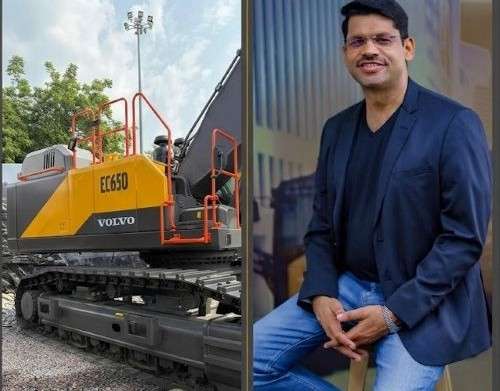
Dimitrov Krishnan, Managing Director of Volvo Construction Equipment India, puts it plainly: “Customers today are looking beyond the purchase price.” Fuel efficiency, uptime, total cost of ownership and lifecycle value are becoming harder to ignore when equipment represents a substantial investment.
It is easy to understand why. A cheaper machine that loses days waiting for parts or service may prove expensive in the field. A machine with a higher initial price can make better sense if it works longer, consumes less fuel and receives faster support.
That is also where India’s large installed equipment base becomes important. The aftermarket is becoming more closely tied to information, with telematics, predictive maintenance and parts availability influencing the economics of ownership.
Shalabh Chaturvedi, Vice President of ICEMA and Managing Director – India & SAARC at CASE Construction Equipment India, describes FY26 as a “year of temporary moderation”. His emphasis on timely project execution, faster implementation and liquidity reflects the less glamorous side of the market, where equipment utilisation ultimately depends on whether projects are actually moving.
For customers, uptime is beginning to matter as much as the machine parked in front of them.
Competitive Reset
The competitive landscape is getting more demanding.
Indian manufacturers, global OEMs and Chinese companies are all operating in a market where price remains important, but a low purchase price cannot answer every question a fleet owner has.
How quickly can the machine earn back its cost? How readily are parts available? How long will the equipment remain supported? What happens when a machine goes down in the middle of a project? How much information can the owner get about its performance?
Those questions have little to do with where a manufacturer comes from. They do, however, put pressure on the entire supply chain. Localisation is no longer simply about replacing an imported component with a domestic one. If a manufacturer wants to offer dependable uptime, the suppliers behind that machine have to be dependable as well.
That makes the quality and depth of the Indian component industry increasingly important.
Manufacturing Moves
The export numbers make this part of the story particularly interesting.
India already manufactures the overwhelming majority of the construction equipment sold domestically. Export growth of more than 30 per cent in FY26 means that an increasing number of those machines are also being judged by customers operating under different conditions and requirements.
Export markets can be unforgiving. Emission regulations vary, operating conditions change, specifications are different and service expectations can be higher. A machine that works well in India still has to prove itself elsewhere.
That process can strengthen the industry at home.
A machine exported from India can represent far more than assembly. It can include locally sourced components, engineering, hydraulics, electronics, software, testing and a supplier network capable of meeting international requirements.
The question is how much of that value can be created here.

Engineering Advantage
This is where the longer-term opportunity becomes more complicated.
India’s attraction to manufacturers is not simply a question of production cost. There is a large domestic market, a substantial engineering talent pool, an expanding supplier base and growing export potential. Those factors make it possible to develop capabilities here that can serve markets elsewhere.
But capability has to be built component by component.
Hydraulics matter. Electronics matter. Controls and software matter. So do testing, certification and supplier quality. Moving from manufacturing relatively straightforward parts to producing the systems that determine how a machine performs is a considerably harder task.
The next stage of localisation will therefore tell us more about India’s industrial depth than the number of machines assembled here ever could.
Technology Reality
Electrification offers a good example of the industry’s changing priorities, and also of why predictions need to be treated carefully.
Electric equipment is beginning to find real applications, particularly where operating cycles and charging arrangements make sense. The practical questions are now becoming clearer: where will the machine work, how long will it operate, when will it charge and what will ownership actually cost?
Krishnan says electrification is “starting to show up on real construction sites”, while noting that “knowing how and when to charge will become an operational consideration.”
V.G. SakthiKumar, Chairman and Managing Director of Schwing Stetter India, takes the argument further, describing electrification as “far more than a fuel swap” and “a fundamental reimagining of how equipment is designed, operated, and supported.”
That is probably the more useful way to look at the transition. Powertrain technology is only one part of it. Charging infrastructure, application, duty cycle, financing, maintenance and resale value will all have a say in what gets adopted and where.
There is unlikely to be one answer for every machine.
Export Test
Exports could become one of the more revealing measures of India’s CE development.
The domestic market will remain the industry’s foundation. India’s infrastructure requirement is too large for that to change. But international customers impose a different discipline on manufacturers and suppliers.
They test quality, consistency, engineering, documentation, compliance, service and supply-chain reliability. Meeting those expectations can make an Indian manufacturer stronger even when the machine eventually returns to a domestic job site in another form.
That is why the export growth deserves more attention than its percentage alone suggests.
It gives manufacturers another market to serve when domestic demand moves through its inevitable cycles. More importantly, it provides an external test of the capabilities being developed inside India.
The Real Opportunity
This is what makes bauma CONEXPO INDIA 2026 worth watching beyond the machines themselves.
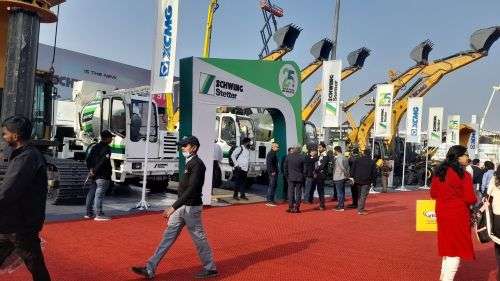
There will be plenty to see on the exhibition floor: excavators, cranes, road equipment, concrete machinery, attachments, components and digital systems. That is what makes a major equipment exhibition visually impressive.
The more interesting part will probably be harder to photograph. It is in the component factories, engineering centres, supplier parks and service networks that sit behind the machines.
India has already demonstrated that it can manufacture equipment at scale. The next test is deeper: whether more of the technology, engineering and component value can be developed here, and whether those capabilities can meet the standards of customers outside India.
The domestic market is expected to recover in FY27, with the industry’s 9–12 per cent growth expectation reflecting that confidence. That recovery will remain important. So will the export markets that are beginning to give Indian manufacturers another outlet for what they make.
For the industry, the interesting years ahead may be the ones in which these two sides begin to reinforce each other.
A stronger domestic market gives manufacturers scale. Export customers raise the bar. Local suppliers get pushed to improve. Engineering capabilities deepen because there is somewhere to use them. Service networks become more sophisticated because machines are working for longer and in more places.
That is a fairly practical way for an industrial ecosystem to mature.
And perhaps that is the better way to look at India’s CE opportunity today. Not simply through the number of machines sold in a year, but through what is increasingly going into those machines before they leave the factory — and how much of that capability can travel with them when they leave India.
That is where bauma CONEXPO INDIA 2026 gets particularly interesting.