U Lakshmana Rao.
या देवी सर्वभूतेषु शक्तिरूपेण संस्थिता। नमस्तस्यै नमस्तस्यै नमस्तस्यै नमो नमः॥
Yā Devī Sarvabhūteṣu Śaktirūpeṇa Saṃsthitā, Namastasyai Namastasyai Namastasyai Namo Namaḥ.
Salutations again and again to the Divine Goddess who abides in all beings in the form of universal energy.
Among the most precious jewels of Bharata Varsha’s spiritual and cultural heritage, Navaratri occupies an exalted position. It is not merely a festival of nine nights, nor simply an occasion for ceremonial worship and communal celebration; it is a profound expression of humanity’s perpetual reverence for the supreme feminine principle, the inexhaustible power of creation, protection, nourishment, wisdom, and transformation. Rooted in the spiritual vision of ancient India, Navaratri represents the conviction that the universe is sustained not by physical power alone, but by an underlying divine intelligence that governs the movement of existence, preserves the harmony of creation, and restores righteousness whenever disorder threatens the cosmic balance. The worship of Durga is, therefore, a celebration of the eternal power that protects life, dispels ignorance, and enables the world to renew itself through successive cycles of struggle, endurance, and regeneration.
The Vedic tradition offers a profound foundation for understanding this universal energy. The Rigveda invokes the Divine through numerous manifestations, including the majestic feminine presence of Uṣas, the dawn; Vāc, the power of sacred speech; and Aditi, the boundless mother associated with cosmic vastness and the freedom of existence. Although the fully developed theology of Durga and the Navadurga traditions belongs to later layers of Hindu sacred literature, the reverence for divine feminine power finds deep spiritual affinities in these early expressions of Vedic wisdom. The Devi Sukta of the Rigveda, traditionally attributed to the seer Vak Ambhrini, proclaims the extraordinary cosmic authority of the Goddess, who declares herself present in the powers through which the universe operates. This vision transcends the limitations of any single form or name. The Divine Feminine is understood not merely as a celestial personality to be worshipped, but as the power through which divine purpose becomes effective in the world.
The celebrated verse from the Devi Mahatmyam declares, “Ya Devi Sarvabhuteshu Shaktirupena Samsthita,” affirming that the Goddess abides in all beings as energy itself. This teaching provides the philosophical heart of Navaratri. The same divine power manifests as courage in the courageous, compassion in the compassionate, intelligence in the wise, endurance in those who suffer, and determination in those who struggle for justice. The worshipper is thus invited to recognise divinity not only in temples, sanctified images, and sacred rituals, but also in the living universe and the moral responsibilities of human existence. The true significance of devotion emerges when reverence for the Goddess inspires the worshipper to cultivate her virtues in thought, speech, and action.
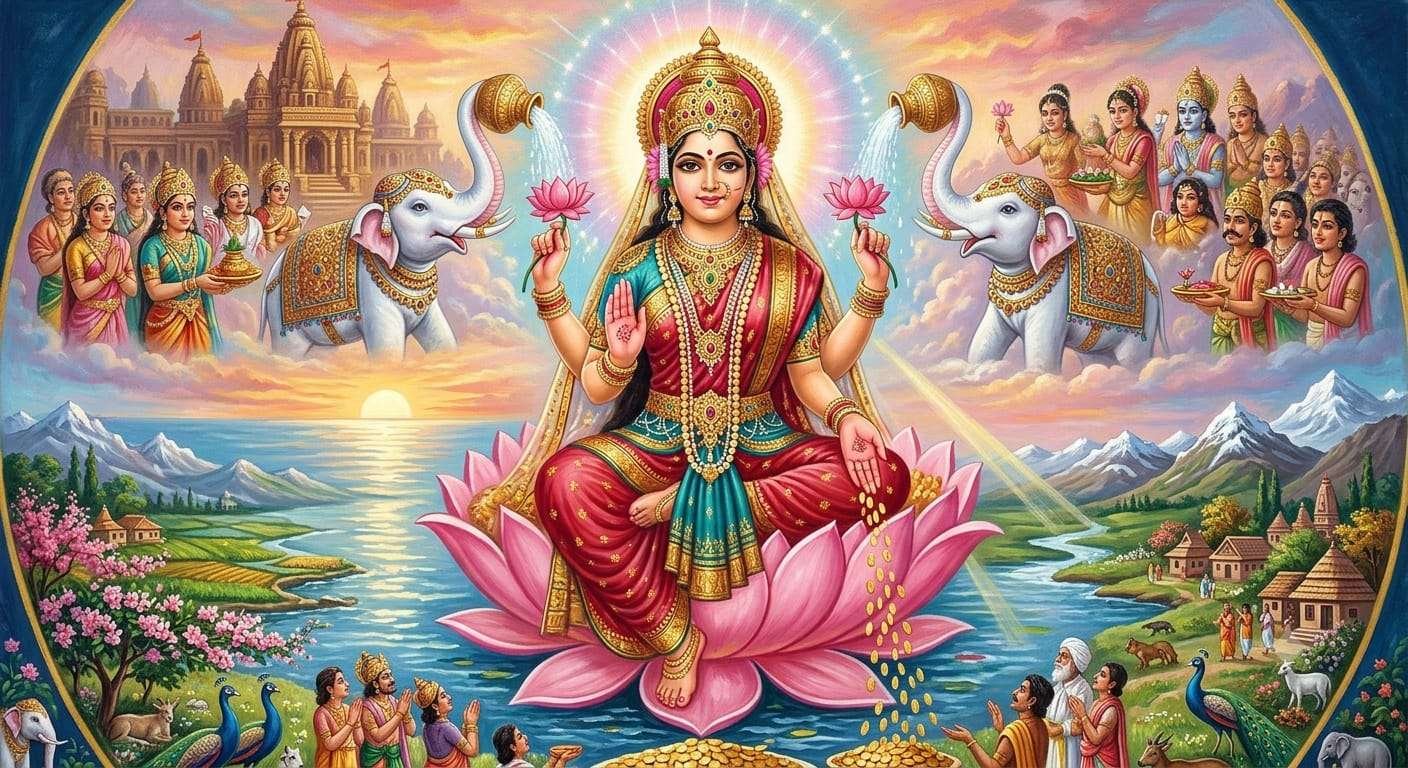
Throughout Bharata Varsha, Navaratri is observed through diverse regional traditions, languages, customs, and artistic expressions. In its widely followed nine-day pattern, the first three days are devoted to Durga or Parvati, the next three to Lakshmi, and the final three to Saraswati. Though particular traditions differ in their ritual details and the forms of the Goddess they emphasise, the spiritual progression is deeply meaningful. Durga represents the strength required to confront destructive tendencies and overcome adversity; Lakshmi signifies prosperity, nourishment, generosity, and the responsible enjoyment of material blessings; Saraswati embodies learning, discernment, artistic excellence, and spiritual knowledge. These are not isolated powers competing with one another, but complementary dimensions of a complete and harmonious life. Strength without wisdom can become destructive, prosperity without righteousness can become oppressive, and knowledge without compassion can lose its humane purpose. Navaratri brings these principles together in a single spiritual journey.
The nine nights also invite a deeper interpretation of the human condition. Every individual must confront inner enemies such as anger, greed, arrogance, jealousy, selfishness, fear, and ignorance. These forces may not always appear as visible adversaries, yet their consequences can be more enduring than those of an external conflict. Durga’s battle against the forces of disorder can therefore be understood as an eternal reminder that the first field of righteous struggle lies within the human mind. The discipline of worship, fasting according to one’s capacity, prayer, meditation, charitable action, and self-examination helps devotees transform celebration into an exercise in moral and spiritual refinement. The victory of the Goddess becomes meaningful when it is reflected in the victory of discernment over delusion, restraint over excess, compassion over cruelty, and duty over selfish desire.
The rich traditions surrounding Navaratri reveal how this spiritual understanding has been preserved and renewed through the centuries. In many households, the arrangement of Bommala Koluvu or Golu, the ceremonial display of dolls and figurines, becomes an expression of devotion, creativity, and collective memory. The carefully arranged figures may represent deities, sages, scenes from the Ramayana and Mahabharata, village life, occupations, animals, and the interconnected relationships that constitute society. Such displays are more than decorative arrangements. They bring sacred narratives into the domestic sphere, enabling children and younger generations to encounter the moral imagination of their ancestors through visual storytelling. The household becomes a place of learning in which mythology, art, family tradition, and social responsibility meet naturally.
Puppet shows, classical and folk dances, devotional singing, recitations, dramatic performances, and community gatherings further extend the significance of the festival. Through these artistic expressions, sacred stories are not confined to written texts or formal religious institutions; they become living experiences shared by people of different ages and backgrounds. A puppet performance may communicate the consequences of arrogance more effectively than a lengthy discourse, while a devotional song can convey surrender, gratitude, and hope through melody and emotion. Dance transforms spiritual narratives into movement, rhythm, and symbolic expression. In this manner, Navaratri preserves not only religious beliefs but also the cultural vocabulary through which Indian civilisation has transmitted its collective wisdom. The arts become instruments of remembrance, education, and social cohesion.
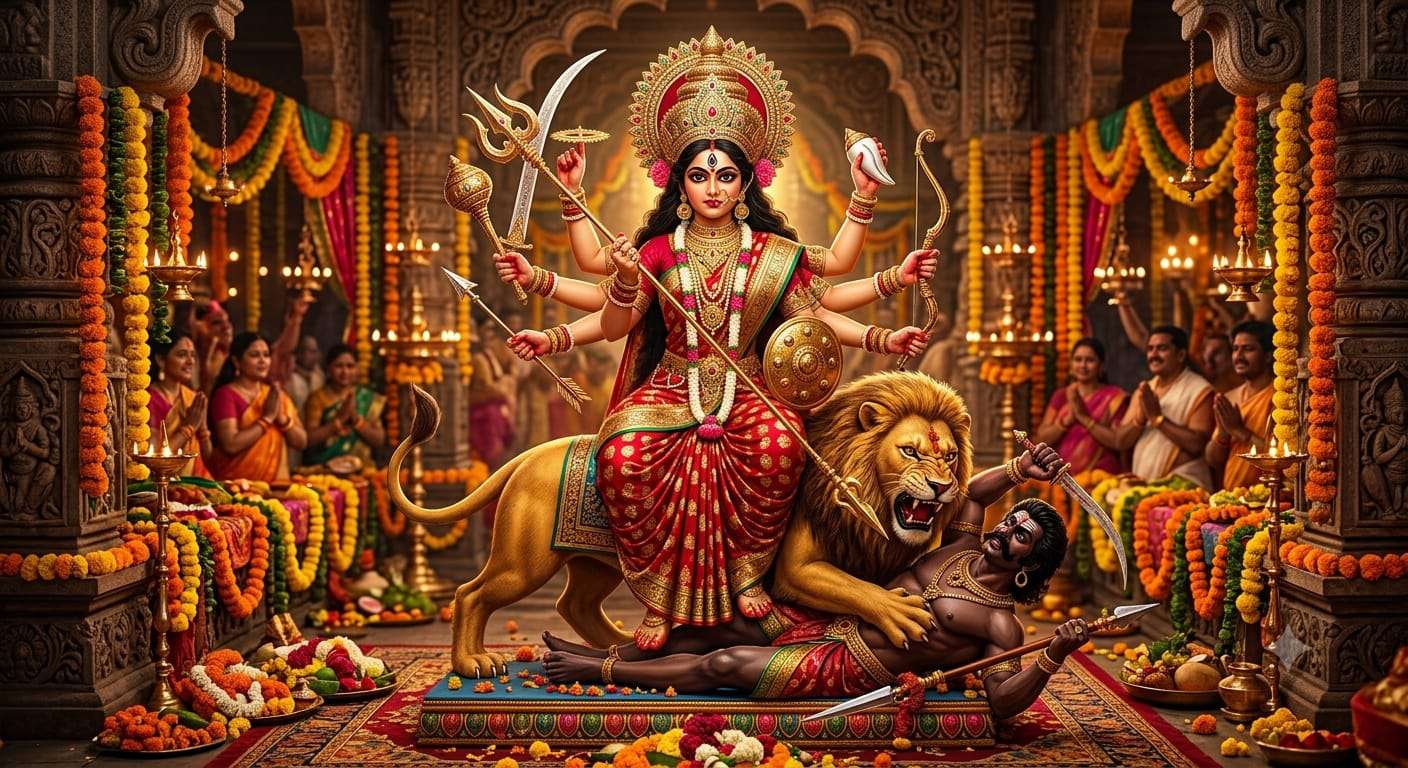
The legends associated with the festival provide another dimension to its enduring significance. In the sacred narrative of the Devi Mahatmyam, the Goddess confronts Mahishasura, whose power and arrogance threaten the established order. The gods, unable individually to overcome the crisis, unite their energies, and from their combined divine radiance emerges Mahadevi, the supreme Goddess. Armed with the gifts of the various deities, she embodies the principle that destructive forces may require the coordinated strength of many powers to be overcome. Her battle with Mahishasura is not merely a tale of supernatural warfare. It symbolises the danger of power divorced from humility and responsibility, as well as the necessity of collective resolve when the welfare of the world is threatened. The Goddess’s victory establishes that no force, however formidable, possesses an eternal right to dominate others through fear and oppression.
The association of the nine nights with the Goddess’s struggle and ultimate triumph has inspired numerous regional interpretations. In popular devotional understanding, her different manifestations reveal the many forms through which divine protection operates. Traditions of worship may invoke Bala Tripura Sundari, Gayatri, Annapurna, Mahachandi, Lalita Tripurasundari, Saraswati, Mahalakshmi, and Kanaka Durga, among other revered forms. The precise sequence and theological classification vary across traditions, and these names do not constitute a single universally prescribed list of nine manifestations. Their spiritual unity, however, is unmistakable. Bala Tripura Sundari evokes divine beauty and the purity of spiritual consciousness; Gayatri represents the illumination of the intellect; Annapurna signifies the sacredness of nourishment and the responsibility to relieve hunger; Chandi embodies uncompromising strength against evil; Lalita expresses divine grace and sovereign wisdom; Saraswati illuminates learning and the arts; Mahalakshmi represents auspiciousness and abundance; and Kanaka Durga is especially revered in Andhra Pradesh as a powerful manifestation of the Mother Goddess. Each form directs the devotee towards a particular aspect of the same boundless divine reality.
The understanding of Durga as the supreme Shakti also illuminates the relationship between the Goddess and the divine functions traditionally associated with Brahma, Vishnu, and Maheshwara. Brahma is associated with creation, Vishnu with preservation, and Shiva with dissolution and transformation. These functions are indispensable to the continuing rhythm of the universe. Creation without preservation would be fleeting; preservation without transformation would become stagnation; and transformation without the possibility of renewal would extinguish the continuity of existence. Shakti represents the effective power through which divine purpose operates. In the Devi Mahatmyam and other Shakta traditions, the Goddess is not merely a subordinate force assisting the gods; she is celebrated as the supreme reality from which their powers arise and through which cosmic order is maintained. This theological vision places the feminine principle at the very centre of universal existence.
Durga’s relationship with the divine family further enriches the symbolism of the festival. Parvati, revered as the consort of Shiva, is also the mother of Ganesha and Kartikeya, known in many regions as Kumara or Subrahmanya. Ganesha represents auspicious beginnings, discernment, and the removal of obstacles, while Kartikeya embodies courage, discipline, leadership, and the destruction of hostile forces. Together with the cosmic functions associated with Brahma, Vishnu, and Shiva, these deities represent complementary dimensions of divine order. Their significance is not best understood as a competition over which deity possesses the greatest power, but as an affirmation that the universe requires many interrelated capacities to remain harmonious. In Shakta philosophy, Durga’s greatness lies in her encompassing power: she is both the compassionate mother who nurtures life and the invincible warrior who confronts whatever threatens it.
Her martial prowess and maternal kindness are therefore not contradictory qualities. They are two expressions of the same commitment to the protection of life and the restoration of righteousness. A mother may nurture a child with tenderness, yet demonstrate extraordinary firmness when the child’s welfare is endangered. In a similar manner, the Goddess is praised as benevolent towards those who seek refuge and formidable towards forces that perpetuate injustice. The weapons she carries in traditional iconography symbolise the diverse capacities required to confront different forms of adversity, while her composed countenance signifies mastery over fear and agitation. Her strength is not the uncontrolled expression of anger; it is disciplined power directed towards a righteous purpose. Her compassion does not imply helplessness, and her courage does not exclude mercy. The ideal embodied by Durga is the union of strength with responsibility and authority with benevolence.
Ancient narratives associated with kings, sages, and the restoration of lost kingdoms have also contributed to the devotional understanding of Navaratri. A tradition sometimes related in regional retellings speaks of King Sukethana, who, after losing his kingdom and being driven into the forest by his enemies, sought spiritual refuge and divine assistance through the guidance of a sage. Such accounts should be distinguished from the best-known scriptural narrative of King Suratha in the Devi Mahatmyam, who loses his kingdom, encounters the sage Medhas, and learns about the mysterious power of the Divine Mother. Suratha and the merchant Samadhi approach the sage with questions concerning attachment, suffering, and the human tendency to remain bound to what causes distress. Through the sage’s teaching, they come to understand the profound influence of Mahamaya, the divine power that both veils understanding and leads the sincere seeker towards spiritual insight. They worship the Goddess and receive her blessings according to the traditional narrative.
The story of King Suratha is particularly significant because it brings together the political, psychological, and spiritual dimensions of human life. Although deprived of his kingdom, Suratha remains concerned about his people and the responsibilities associated with kingship. The merchant Samadhi, despite suffering from the conduct of his own family, remains troubled by his attachment to those who have wronged him. Their experiences illustrate how the human mind may remain bound to duty, affection, identity, and desire even when circumstances become painful. The sage does not dismiss their concerns as meaningless; instead, he directs them towards an understanding of the deeper forces governing consciousness. Their worship of the Goddess becomes a path from confusion towards clarity, from helpless attachment towards purposeful action, and from personal suffering towards a renewed relationship with duty. In the traditional account, Suratha eventually regains his kingdom, while the merchant seeks spiritual liberation. Their different aspirations reveal that divine grace may be understood both as support for righteous worldly responsibilities and as illumination leading beyond worldly attachment.
Such narratives also offer a timeless lesson in leadership. A ruler’s authority becomes legitimate not merely through possession of a throne, military superiority, or the accumulation of wealth, but through the protection of the people and the discharge of public responsibility. When a leader loses power, the true measure of character lies in whether he seeks only revenge or also reflects upon the responsibilities that accompany authority. The spiritual discipline associated with the Goddess encourages courage without arrogance, ambition without injustice, and determination without the abandonment of ethical principles. The restoration of a kingdom, when interpreted through this moral framework, is not simply a personal victory; it represents the possibility of restoring order and fulfilling neglected duties. Thus, the traditional association of the Goddess with kingship and protection carries a broader message for administrators, institutions, families, and all who exercise power over others.
The social significance of Navaratri extends far beyond the sanctum of a temple or the boundaries of a household. The festival creates opportunities for people to gather, exchange greetings, share food, support artists, teach children, and renew relationships that may have weakened under the pressures of everyday life. In many communities, the exchange of haldi-kumkum, the distribution of prasadam, the invitation of neighbours, and the organisation of collective worship strengthen bonds of belonging. Artisans and small businesses receive opportunities through the preparation of dolls, garments, flowers, decorations, musical instruments, and ceremonial objects. Musicians, dancers, craftsmen, cooks, and performers contribute their knowledge and labour to a shared cultural experience. The festival thereby connects spiritual aspiration with economic activity and community welfare.
Its social impact becomes still more meaningful when the underlying principle of Shakti is applied to the dignity and advancement of women. The worship of Durga as the embodiment of courage, Lakshmi as the source of prosperity, and Saraswati as the presiding power of knowledge creates a powerful symbolic affirmation of feminine potential. Yet the true measure of such reverence cannot be limited to ritual offerings or ceremonial praise. It must also be reflected in respect for women’s autonomy, access to education, freedom from violence, fair opportunities for work, recognition of intellectual achievement, and participation in decisions affecting society. If the Goddess is celebrated as the power that sustains creation, then every individual has a responsibility to help create conditions in which women and girls can live with dignity, security, and opportunity. Devotion acquires its fullest social meaning when the values expressed in worship become principles of conduct.
The festival’s message of prosperity likewise invites reflection on the ethical use of material resources. Lakshmi’s blessings are traditionally associated with wealth, fertility, well-being, and auspiciousness, but abundance becomes a true blessing only when it supports stability, generosity, and the welfare of others. Wealth accumulated through exploitation or used for selfish display cannot fulfil the deeper ideal of prosperity envisioned in dharmic thought. Similarly, Saraswati’s blessings remind humanity that education is not merely a means of gaining employment or social recognition; it is also a means of developing discernment, understanding the consequences of one’s actions, and distinguishing lasting values from passing attractions. Durga’s strength, Lakshmi’s abundance, and Saraswati’s wisdom must therefore operate together. Their combined message is that a flourishing society requires moral courage, material responsibility, and enlightened knowledge.
The celebration of Navaratri across different regions demonstrates how a shared spiritual foundation can accommodate remarkable cultural diversity. In Gujarat, the rhythms of Garba and Dandiya Raas transform devotion into collective movement and joyous participation. In West Bengal, the worship of Durga culminates in elaborate community celebrations that combine sacred iconography, artistic achievement, and public fellowship. In Mysuru, royal traditions and ceremonial splendour preserve distinctive historical associations, while in Andhra Pradesh and Telangana, devotees worship Kanaka Durga and other manifestations of the Goddess with particular fervour. In Tamil Nadu, Karnataka, and other parts of southern India, Golu displays, music, domestic rituals, and community visits preserve distinctive forms of celebration. These traditions differ in language, ritual, artistic style, and local history, yet they converge upon the conviction that divine power sustains life and that humanity must cultivate courage, wisdom, generosity, and devotion.
This diversity is not a departure from spiritual unity; it is one of its most remarkable expressions. The same sacred aspiration finds a voice in different musical traditions, the same reverence appears through different forms of iconography, and the same longing for protection and well-being inspires different rituals. Bharata Varsha’s cultural continuity has never depended solely upon uniformity. It has also rested upon the capacity of communities to preserve local traditions while participating in a larger civilisational inheritance. Navaratri provides a living example of this principle. Each region contributes its own artistic and devotional language, enriching the collective experience without necessarily diminishing the significance of other traditions. The festival consequently becomes a meeting ground between inherited memory and contemporary life.
Its endurance across generations also reveals the importance of transmitting culture through lived experience. A child who watches a grandmother arrange sacred dolls, listens to a parent recite a hymn, joins a dance, or participates in a community celebration encounters tradition not as an abstract historical account but as a meaningful part of family and social life. These experiences can inspire questions about the gods, the epics, the symbolism of the Goddess, and the ethical lessons embedded in sacred narratives. When elders explain the meaning behind rituals rather than insisting upon their mechanical repetition, inherited customs become opportunities for understanding. When younger generations contribute new artistic forms while respecting the values of the tradition, cultural continuity becomes dynamic rather than stagnant. Navaratri thus provides a bridge between the wisdom of the past and the creative possibilities of the future.
The philosophical depth of the festival also lies in its understanding of time. The nine nights are a finite period within the calendar, yet the spiritual reality they commemorate is regarded as eternal. The Goddess does not become powerful only when a festival begins, nor does her protective significance disappear when the celebrations conclude. The ritual calendar merely directs collective attention towards a truth that devotees believe is continuously present. The cycle of creation, preservation, and transformation unfolds without interruption; generations arise and pass away; societies encounter prosperity and crisis; individuals experience hope, fear, achievement, and loss. Through these changing circumstances, the image of Durga remains a symbol of the enduring possibility that courage can emerge in moments of weakness, wisdom can arise from confusion, and order can be restored after disorder.
The concluding victory associated with Vijayadashami reinforces this message. The triumph of the Goddess over Mahishasura and the broader association of the day with the victory of righteousness affirm that the struggle between constructive and destructive tendencies is not confined to a single mythical age. Every generation must confront its own forms of arrogance, injustice, violence, and ignorance. Every society must determine whether its institutions will serve the common good or become instruments of domination. Every individual must examine whether personal ambitions remain governed by conscience and whether power is exercised with restraint. The spiritual significance of the Goddess’s victory lies not in encouraging hostility towards human adversaries, but in awakening the resolve to resist wrongdoing while preserving fairness, compassion, and moral discipline.
Perpetual devotion, therefore, is not measured exclusively by the number of prayers offered, the splendour of decorations, the duration of fasting, or the magnificence of public ceremonies. These practices may provide sincere and valuable expressions of faith, but their deeper purpose is to transform the inner life of the worshipper. A person who invokes Durga should strive to become more courageous in defending the vulnerable, more disciplined in confronting personal weaknesses, and more compassionate towards those who suffer. One who worships Lakshmi should recognise the responsibility accompanying prosperity, while one who honours Saraswati should pursue knowledge with humility and use learning for constructive purposes. When these values become part of everyday conduct, the festival extends beyond its appointed nights and becomes a continuous discipline of life.
Ultimately, Durga represents the inexhaustible Shakti through which the universe is protected, the forces of disorder are challenged, and the possibility of renewal is preserved. Her many manifestations communicate the understanding that divine assistance may be experienced through strength, nourishment, wisdom, beauty, compassion, and the courage to confront injustice. The traditions of Navaratri bring this expansive vision into the lives of individuals, families, and communities through prayer, music, dance, storytelling, artistic creation, and collective celebration. Across the immense passage of time, these practices have continued to unite reverence for the sacred with the preservation of cultural memory and the aspiration for a more harmonious society.
As long as humanity seeks protection in times of adversity, wisdom in moments of confusion, nourishment in periods of scarcity, and courage when confronted by injustice, the spiritual message of Durga will remain relevant. Her worship reminds humanity that strength must be guided by righteousness, prosperity enriched by generosity, and knowledge illuminated by compassion. The nine nights may come to an end, the lamps may be extinguished, the sacred displays may be dismantled, and the melodies of celebration may gradually fade, but the values they awaken need never diminish. In this lies the enduring glory of Navaratri: a perpetual invocation of the Divine Mother, an affirmation of the dignity of life, and a timeless assurance that the power to protect, transform, and renew the world must be cultivated within every human heart.