
When we use the word “sine” in a mathematics classroom today, few of us pause to consider the extraordinary journey hidden behind that seemingly simple term. Its history stretches across three major intellectual worlds—India, the Islamic civilisation and medieval Europe—and illustrates how mathematical knowledge travelled across languages, cultures and centuries.
The story begins in ancient India, where astronomy and mathematics developed together under the broad tradition of Jyotiṣa. Indian astronomers needed increasingly sophisticated mathematical tools to calculate planetary positions, eclipses and other celestial phenomena. In this process, they developed techniques that became foundational to what we now call trigonometry.
One of the most important contributions was the concept of jya, a Sanskrit term referring to the half-chord of an arc. In modern mathematical language, this corresponds closely to the sine function. Indian mathematicians and astronomers developed tables and computational methods involving such quantities centuries before trigonometry acquired its familiar European terminology.
The intellectual journey then moved westward.
Indian astronomical knowledge, particularly works associated with the great astronomer Āryabhaṭa and later mathematical traditions, reached the Islamic world through translations and scholarly exchanges. During the Abbasid era, Baghdad emerged as a major centre of learning, where Indian, Persian and Greek mathematical and astronomical knowledge was studied, translated and developed further.
It was in this Arabic mathematical tradition that the Sanskrit jya entered a new linguistic environment. It was rendered in Arabic as jība. Arabic script traditionally did not mark short vowels in ordinary writing, and this contributed to an intriguing linguistic development. The written form could subsequently be read as jayb, an Arabic word meaning a “fold,” “bay” or “bosom.”
When Arabic scientific works were translated into Latin in medieval Europe, translators encountered jayb and rendered it as the Latin word sinus, meaning a bay, fold or curve.
And from sinus came the modern mathematical word:
Sine.
The linguistic chain is therefore commonly represented as:
Sanskrit jya → Arabic jība/jayb → Latin sinus → English sine
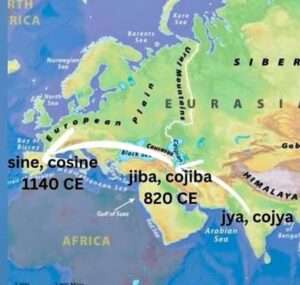
The significance of this story goes far beyond one mathematical term. It demonstrates how scientific knowledge rarely travels in a straight line. Ideas can originate in one civilisation, be translated and refined in another, and eventually acquire entirely new terminology in a third.
The development of cosine provides another fascinating example. The concept is related to the sine of the complementary angle, and the modern term “cosine” ultimately reflects this relationship. European mathematicians gradually developed the terminology and notation that eventually became standard.
It is important, however, not to portray this as a one-way transfer in which one civilisation merely “gave” mathematics to another. The history was considerably richer. Indian mathematicians made important advances; scholars of the Islamic world preserved, translated, expanded and systematised knowledge from India, Greece and Persia; and European scholars later absorbed these traditions and developed them further.
This interconnected history is one of the great stories of human intellectual civilisation.
There is also an interesting parallel with the movement of languages and ideas across Eurasia, although the two histories should not be treated as identical. Claims concerning an “Out of India” origin for Indo-European languages remain a subject of scholarly debate, whereas the transmission of several Indian mathematical and astronomical concepts into the medieval Islamic world and subsequently into Europe is supported by substantial historical evidence.
So the next time we write sin θ, we are doing more than performing a mathematical calculation. We are, in a small way, invoking a linguistic fossil of an intellectual journey that crossed India, Arabia and Europe.
A single mathematical word thus carries the memory of centuries of scholarship—and reminds us that knowledge has never respected political or geographical boundaries.