



Dr. R K Chadha
The phrases “global warming” and “climate change” have become household terms and common topics of conversation at social gatherings and informal meetings, particularly after disasters such as floods, cloudbursts, extreme heatwaves, delayed or excessive monsoons, and droughts. In my view, this is not necessarily a negative development; it can be a positive one, provided these discussions are informed and evidence-based. The problem arises, however, when every disaster is automatically attributed to global warming or climate change without examining the specific evidence and contributing factors.
Firstly, we need to understand the difference between natural hazards and disasters. Natural hazards are physical phenomena produced by natural processes, such as earthquakes, volcanic eruptions, tsunamis, storms, sandstorms, droughts, ice avalanches, landslides, cloudbursts, and floods. Disasters, however, are man-made. For example, floods and tsunami become catastrophic when people and infrastructure are located in high-risk areas, natural protective systems are destroyed, warnings are ignored, and safety regulations are weakened or sacrificed for profit or political gain.
Every disaster has its own story of human neglect, including bio-disasters like plastic and microplastic pollution, excessive fertilizer uses or even overconsumption of fast food. Together, these threats are ticking time bombs surrounding us, today. Raising awareness across all sections of society is therefore essential to reduce disaster risk. Every stakeholder should understand the associated hazards, participate in preparedness efforts, voice concerns, and contribute within their capacity to reducing vulnerability and limiting harmful impacts.
Public awareness today is strongly influenced by the media, especially social media platforms such as WhatsApp, YouTube, Facebook, and Instagram, and the emotional context in which information is presented. These platforms, therefore, have a particular responsibility to report disasters accurately based on evidence rather than promoting unsubstantiated opinions.
This article is a humble effort to raise awareness about global warming and climate change phenomena to reach a majority section of society. Global warming refers to the long-term increase in Earth’s average surface temperature, whereas climate change encompasses the broader and often interconnected consequences of that warming, like changing rainfall patterns, frequent intense extreme events, glacial retreat, sea-level rise, shifting seasons, droughts, and floods.
Two concepts are important to understand: sunlight absorption and reflection or albedo. Consider what happens when you park your car in an open parking lot on a hot, sunny day with the windows closed. When you return after work and open the door, a blast of hot air greets you. Why? Sunlight passes through the clear glass windows and warms the dashboard, seats, carpets, and other surfaces inside the car. As the interior heats up, it tries to escape but gets trapped by the glass, causing the temperature inside the car to rise.
This is what happens to Earth, which works like a car in the hot Sun. Our atmosphere acts like glass windows. Burning fossil fuels releases “greenhouse gases”, carbon dioxide being one of them; others are water vapour, methane, nitrous oxide, and several human-made fluorinated gases. These gases make our atmosphere’s glass thicker. The sun’s heat gets in, but it can’t get out, causing the planet to warm up.
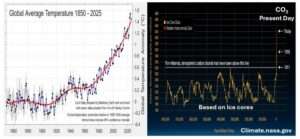
It is not the case that all of the Sun’s heat is trapped by Earth’s atmosphere. Earth’s surface contains both light and dark areas, and albedo is a measure of how much light or radiation a surface reflects instead of absorbing. For example, a bright white shirt reflects much of the sunlight that falls on it, helping you stay cooler; this represents a high albedo. In contrast, a pitch-black shirt absorbs more sunlight, causing you to feel warmer and sweat more; this represents a low albedo.
Similarly, Earth has its own “white shirts”, the polar ice caps, mountain snow, and glaciers. These bright surfaces reflect a significant amount of incoming sunlight back into space and help keep the planet cooler. Earth also has “black shirts”, like the dark oceans, forests, and land surfaces, which absorb more solar energy and become warmer. As snow and ice melt, reflective surfaces shrink and darker surfaces are exposed. Earth then absorbs more solar energy, creating important warming feedback.
The problem becomes more serious when global warming and declining albedo reinforce each other in a vicious cycle. Imagine wearing a white shirt when someone spills dark coffee on it. The stained area absorbs more sunlight than the clean white fabric, making you feel warmer. A similar process occurs in the poles, Arctic and Antarctica and over glacial peaks of the mountains. As global warming raises temperatures, bright ice and snow melt, exposing the darker ocean and rocks beneath. Instead of reflecting much of the incoming sunlight, dark areas absorb more solar energy. This additional heat contributes to further melting, which exposes even more areas and creates still more warming.
Scientists call this process a positive feedback loop, not because it is beneficial, but because it amplifies the initial change. It can be compared to a snowball rolling downhill: once it begins moving, it gathers momentum and grows larger.
You may wonder why carbon dioxide is singled out when there are many other greenhouse gases. One way to understand this is to imagine greenhouse gases as different kinds of blankets. Carbon dioxide is a blanket that is becoming thicker and thicker by the continuous addition through transportation, electricity generation, industry, cement production, and deforestation. Methane is a thicker blanket, but it is relatively short-lived in the atmosphere. Fluorinated gases, released from equipment such as refrigerators, air conditioners, vehicle cooling systems, and cold-storage facilities, are often extremely powerful, but they are emitted in much smaller quantities. Water vapor is a blanket that becomes thicker as the air warms, amplifying the initial warming.
Therefore, carbon dioxide is the most important human-caused driver of long-term warming not because it is the most powerful greenhouse gas but because humans emit such large quantities of it that remain in the climate system for a very long time.
A small group of sceptics and deniers continues to call global warming a hoax and dismiss climate scientists as “alarmists.” However, the overwhelming scientific consensus is that human activities, especially the burning of fossil fuels, are the main cause of current global warming. This conclusion is supported by extensive evidence that includes temperature records, rising sea levels, Arctic ice loss, glacier retreats in mountains, and increasing carbon dioxide concentrations.
As a scientist, I judge the strength of evidence by the breadth and quality of the research behind it. A recent IPCC report reviewed and synthesized findings from approximately 9,000 relevant scientific publications providing evidence for global warming, whereas the Heartland Institute, USA, published an 80-page book in 2023 arguing that Earth is not facing a climate crisis. The contrast is striking; the ratio is approximately 100:1 that is, every 100 credible scientific publications to 1 page in the book! But the devil lies in the details. The Heartland Institute has historically received funding from major oil and gas companies, including ExxonMobil and Shell, though the present status of funding is not disclosed. Readers must decide whether to place greater trust in the evidence-based consensus of climate scientists or in claims promoted by organisations with links to companies with fossil-fuel interests. It is relevant to recall businessman Trumpian famous slogan in his second term of US presidency: “Drill, baby, drill.”


Nicely written article covering all factors defining global climate and natural hazards and disaster
It’s now an established fact that the earth is becoming hotter. Global average temperatures have risen by about 1.1°C to 1.3°C since the late 19th century, and the most worrying aspect is it’s rate of warming, which is speeding up.
The concept and causes of global warming & climate change, and their effects on mother earth are very well explained by Dr. RK Chadha. The simple examples given by him greatly help even a layman to understand these things better
Super explanation on natural hazards and disasters, and associated consequences. The authors further awareness and concerns on these are very much appreciable. Thanks to bringing such a knowledgeable and easily understandable article to the notice of general readers and public.
Clearly one of the best articles in the series. Lucidly written in layman’s language using minimal technical jargon, Dr Chadha has communicated the essence of the matter unambiguously to the general public. I wish such articles reach more and more people. Keep writing and generating awareness about such societal issues !!!
The global warming and its impact is visible and evidence in many extreme rainfall events reported during last two decades. Simple it can be understood with short duration High intensity rainfall due to global warming. It is not Mithi but evidence particularly in northern latitudes where Earth warming is greater than 2-3 degrees centigrade. Even in Hyderabad rainfall pattern during last three decades explain the phenomenon. Dr. Chadda lucidly explained these cause and effect phenomenon in layman terms.
Good article on environment
Nicely written article on a very complex subject,
involving several inter-related phenomena. We may need more long-term authentic datasets to understand and establish the cause and effect relationships.
A comprehensive article on both global warming n climate change. The main culprit being carbon dioxide. The major problem is how to contain CO2 from emission or dilute it in the atmosphere consequently reducing the effect of it.The author left it to the reader, s to decide. Yes the global warming can definitely be controlled if no political intervention is there. After all it is the main concept of every scientist who, in whatever field he is working, struggles for human well being. Dr. RK Chadha, s agony can be easily understood.
The article on Global warming and climate change is an excellent and eye opener in the present situations. You have eloborated the scientific evidence for global warming and climate change to discuss in the community and feel their responsibility.
I congratulate the author for his outlook with regards to atmosphere.
Excellent Article on Global warming. I came to Hyderabad in 1974 temperature never more than 30-32 centigrade. Now days temperature goes more than 41 degree. Clear indicating the changes.