



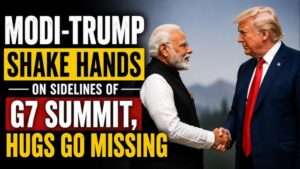
The much-discussed 20-second handshake between Prime Minister Narendra Modi and US President Donald Trump has, unsurprisingly, sent Bharrat’s television studios into a frenzy.
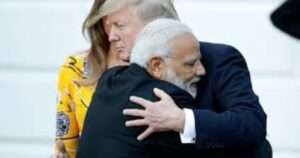
Prime-time anchors have been meticulously analysing why the trademark bear hug was missing and whether the chemistry between the two leaders has suddenly evaporated. Perhaps they are asking the wrong question.
The real story is not the missing hug, but the undeniable trust deficit that Donald Trump himself helped create over the past 16 months. Diplomacy is not a Bollywood script where every frame requires dramatic affection. Nations are governed by strategic interests, mutual respect and consistency.
Unfortunately, consistency has never been Trump’s strongest attribute.
Both Narendra Modi and Donald Trump are powerful personalities with formidable political mandates. But that is where the similarities largely end. While Trump frequently allowed his impulses and ego to override diplomatic conventions, Modi chose the path of restraint and statesmanship.
Trump repeatedly resorted to public threats over tariffs and made provocative remarks that could easily have triggered a public war of words. Yet New Delhi refused to participate in such theatrics. Barring the predictable reactions from sections of the Opposition, Bharat largely maintained its composure.
The turning point, however, came after Operation Sindoor, Bharat’s three-day military response following the Pakistan-sponsored terror attack that claimed innocent lives in Pahalgam.
Bharat demonstrated that the era of endless dossiers and polite protests had ended. Terror infrastructure and strategic assets across the border were targeted decisively, sending an unmistakable message that Bharat’s patience was no longer infinite.
That operation altered geopolitical calculations.
 What exactly unsettled Washington remains open to interpretation. Strategic analysts have debated whether sections within the US establishment were uncomfortable witnessing an increasingly assertive Bharat acting independently without waiting for anyone’s approval.
For decades, many global powers had become accustomed to a cautious Bharat. What they encountered instead was a self-confident Bharat willing to defend its interests unapologetically.
Even more telling was Prime Minister Modi’s decision to decline what would ordinarily have been a routine transit halt invitation from Trump after attending an international summit.
The message was subtle but unmistakable.
Bharat was no longer interested in diplomatic optics for their own sake.
What is equally evident today is that the United States itself has been compelled to re-engage with Bharat, particularly amid rapidly evolving geopolitical realities and the emerging equations involving Bharat, Russia and China.
The world is no longer unipolar.
Trump’s own foreign policy adventures exposed this changing reality. His handling of Iran was perhaps the biggest example. The same leader who projected himself as an uncompromising warrior suddenly appeared more eager to end the conflict than the adversary he had chosen to confront.
Military superiority no longer automatically translates into unquestioned obedience.
Meanwhile, Bharat has quietly transformed itself over the past decade.
The country has emerged as one of the fastest-growing major economies in the world. Massive investments in infrastructure, logistics, defence manufacturing and strategic capabilities have significantly strengthened Bharat’s position globally.
Operation Sindoor merely showcased the outcome of years of preparation.
One cannot help but wonder whether this newfound confidence in Bharat has caused discomfort in certain international quarters.
After all, Bharat that is economically strong, militarily prepared and diplomatically independent is far more difficult to influence than an Bharat perpetually seeking validation from foreign capitals.
Trump compounded matters further by publicly embracing Pakistan’s leadership, including Prime Minister Shehbaz Sharif and Army Chief Asim Munir.
The optics were baffling.
At a time when Pakistan continues to battle allegations regarding its long-standing links with terror ecosystems, Washington’s outreach inevitably raised eyebrows.
Was it strategic necessity, transactional politics or merely another example of Trump’s unpredictable diplomacy? The answer remains open for debate.
Adding to the unease were media reports and commentaries over the past several months that raised questions about alleged efforts by sections of the American establishment and what is often described as the ‘deep state’ to influence Bharat’s domestic political landscape.
While such reports remain matters of debate and interpretation, they undoubtedly contributed to the erosion of trust between New Delhi and Washington.
Against this backdrop, expecting Prime Minister Modi to display the same exuberant camaraderie that defined previous meetings is unrealistic.
Relationships between nations cannot survive on hugs alone. Respect matters. Consistency matters. Trust matters. The era of choreographed bear hugs may have passed, but that does not signal the collapse of Bharat-US ties.
Far from it.
Bharat and the United States remain indispensable partners in trade, defence, technology, and Bharat-Pacific security. Neither side can afford prolonged estrangement. But one thing has fundamentally changed. Bharat no longer approaches Washington from a position of deference. It engages as an equal. Certainly, not allow Washington to be treated as a ‘buffer’ to counter Beijing.
That perhaps is the biggest story behind the 20-second handshake. The real test now lies ahead. Can both leaders move beyond recent bitterness and rebuild strategic trust? Can they replace public posturing with substantive engagement? If their bilateral meeting culminates in meaningful outcomes rather than another carefully choreographed photo opportunity, it may signal that both capitals are finally prepared to turn the page.
Until then, television studios may continue measuring the length of a handshake. The world, however, has moved far beyond counting hugs. And so has Bharat.


