



As Bharat prepares to celebrate its 80th Independence Day, there is little reason for citizens to celebrate the performance of one of the institutions that embodies our democracy. The Monsoon Session of Parliament has ended, and what should have been a forum for debate, scrutiny and legislation was too often reduced to shouting, sloganeering, protests and repeated adjournments.
This is not democracy at its best. It is democracy being deliberately denied its working hours.
The figures are damning. The Lok Sabha recorded a productivity of just 19 per cent, among its lowest in more than two decades, while the Rajya Sabha managed only 39 per cent. Parliament did pass 12 Bills, but the legislative output cannot camouflage the extraordinary amount of time lost to disruption.
By one widely cited estimate, 7,023 minutes of parliamentary time were lost during the session. At the conventional estimate of ₹2.5 lakh per minute as the cost of running Parliament, that translates into roughly ₹175.6 crore of taxpayers’ money. The ₹2.5 lakh figure is itself an old, widely cited estimate, so the ₹175.6-crore figure should be treated as an indicative—not audited—cost.
But even that number understates the real loss.
What was squandered was not merely money. It was Question Hour, Zero Hour, legislative scrutiny, private members’ concerns, constituency issues and opportunities to question ministers. Every minute lost in Parliament is a minute stolen from the citizen who elected an MP expecting him or her to speak—not shout.
And here lies the uncomfortable question: who will hold these MPs accountable?
The Congress-led Opposition may argue that the BJP-led NDA too disrupted Parliament during the UPA years, including during the Manmohan Singh government. There is some truth in that history. Parliamentary disruption has been practised by ruling parties and Opposition parties alike over the decades. PRS Legislative Research itself has noted that disruption has become a recurring political tactic, with parties often condemning it when in power and embracing it when in Opposition.
But that is not a defence. It is an indictment.
If BJP MPs disrupted Parliament yesterday, they deserved criticism then. If Congress and its allies disrupt Parliament today, they deserve criticism now. Democracy cannot operate on the kindergarten principle of “you did it first”.
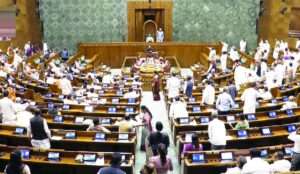
Opposition parties have every democratic right to protest, disagree, demand discussions and challenge the government. That is their constitutional and political responsibility. But there is a fundamental difference between opposing legislation and preventing legislation from being discussed; between raising a voice and drowning out every other voice; between holding the government accountable and making Parliament itself unaccountable to the people.
The irony is breathtaking. Parties that loudly proclaim that democracy is in danger are themselves helping turn Parliament into a theatre of disruption.
The government, too, cannot escape scrutiny. If Bills are passed amid din or with inadequate debate, the Treasury benches must ask whether legislation is receiving the deliberation it deserves. Parliamentary majorities are not a licence for legislative haste. The government must facilitate debate even when the Opposition is difficult, provocative or unreasonable.
But ultimately, the most powerful weapon belongs neither to the Speaker nor the government nor the Opposition.
It belongs to the electorate.
MPs do not own their seats. They borrow them from voters for five years. Their salaries, allowances, privileges, travel and parliamentary facilities are funded by the same citizens whose elected representatives sometimes refuse to let Parliament function.
Therefore, voters must begin asking a brutally simple question at election time: Did my MP work, debate, question and represent me—or merely protest and disrupt?
If an MP’s principal parliamentary achievement is shouting slogans before television cameras, the voter has every right to remember it.
India’s 80th Independence Day should remind every parliamentarian that freedom was not won so that elected representatives could waste the people’s time. Parliament is not a political stage. It is the people’s institution.
The message from the electorate should therefore be unmistakable: Oppose fiercely, debate honestly, protest responsibly—but do not sabotage Parliament.
And when the next election arrives, voters should have the courage to punish those who chose disruption over duty.
That would be democracy delivering its most powerful verdict.


