M Jaishree
Truth is the highest manifestation of the Divine in the visible world. The Vedic seers did not regard truth merely as accurate speech or the narration of facts. They perceived Satya as the eternal principle that sustains creation, preserves harmony, and binds together the physical, moral, and spiritual dimensions of existence. Dharma draws its strength from truth, just as the earth rests securely within the cosmic order. Every movement of nature, from the rising of the sun to the rhythm of the seasons, reflects this unwavering fidelity to truth. Falsehood, injustice, immorality, and cruelty emerge wherever this sacred order is violated, disturbing both individual peace and collective well-being.
The Vedic vision presents truth as the invisible force upon which the universe is balanced. Human civilization flourishes because most people, despite their weaknesses, instinctively value honesty and fairness. Families remain united through trust, friendships endure because of sincerity, and societies function because people generally believe one another’s words. Countless agreements, partnerships, and commercial transactions are concluded solely on mutual trust without elaborate guarantees. Such confidence is the quiet triumph of truth. Whenever deception replaces integrity, fear enters human relationships, economic life weakens, and social harmony begins to crumble.
The sages understood that truth is not merely an ethical principle but also an intellectual discipline. They encouraged seekers to cultivate reason, observation, reflection, and self-examination. Their prayers reveal a remarkable scientific temperament, for they sought knowledge by removing ignorance rather than accepting appearances. In the famous invocation to Pushan, the nourisher and illuminator, the seeker prays that the dazzling golden covering hiding the face of Truth be removed. This golden armour symbolizes the attractive veil of illusion, prejudice, pride, and superficial perception. Genuine wisdom begins only when this glittering curtain is lifted, allowing the mind to perceive reality without distortion. Enlightenment is therefore not the acquisition of new facts but the unveiling of what has always existed.
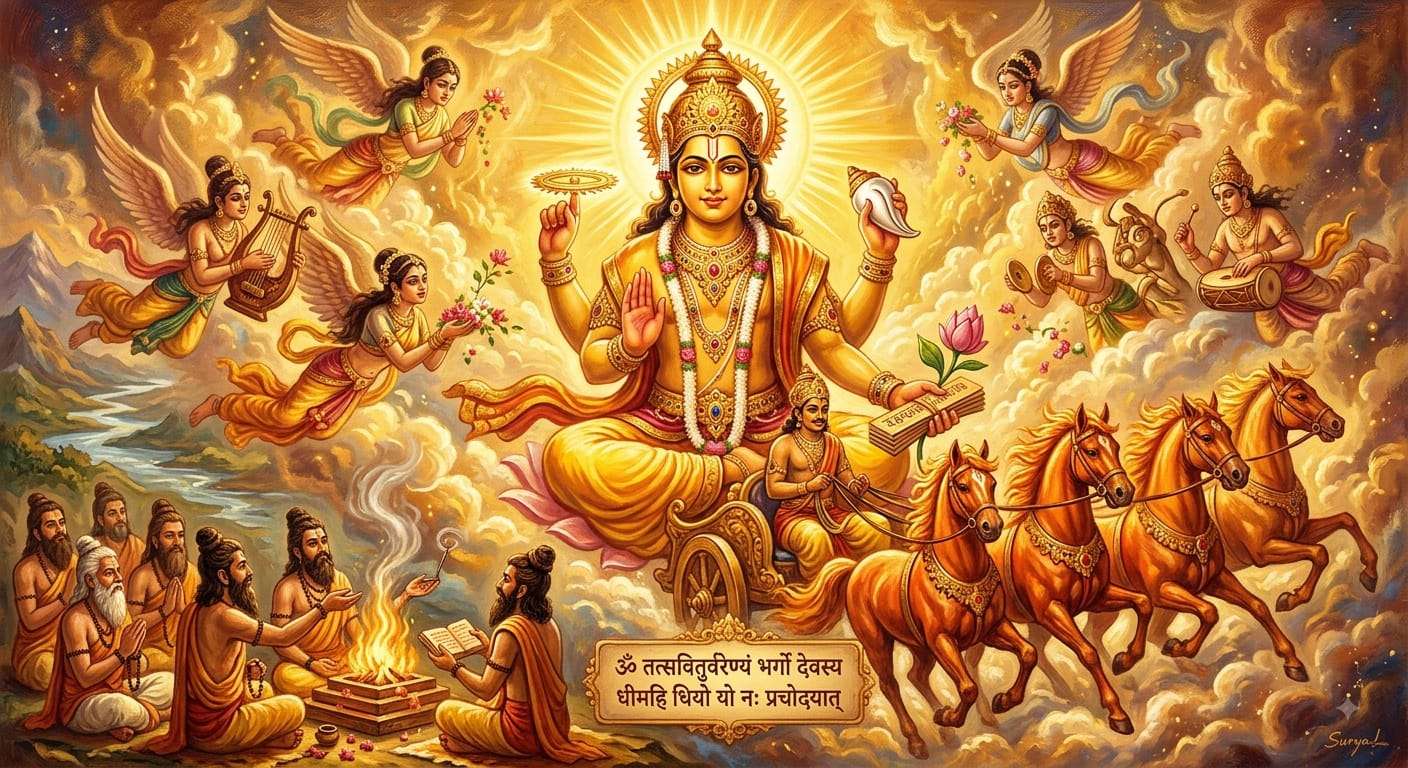
The Vedic prayer to the Sun expresses humanity’s deepest aspiration for inner illumination. The Sun is revered not merely as a celestial body but as the visible embodiment of divine intelligence, sustaining life with unfailing regularity. The seeker addresses the radiant deity as the source of strength, the son of Prajapati, the guardian of cosmic order, and requests that the overwhelming brilliance be softened so that the eternal reality behind it may be directly experienced. The declaration, “I am a part of You,” reflects the profound realization that individual consciousness is inseparable from the universal consciousness. This is not a statement of pride but of spiritual unity, dissolving the illusion of separation between the individual and the cosmos.
The Mahabharata reinforces the incomparable greatness of truth through the words of Shakuntala addressed to King Dushyanta. She declares that one well surpasses a hundred ponds, one noble deed surpasses a hundred wells, one virtuous son surpasses a hundred noble deeds, but a single truthful word surpasses even a hundred virtuous sons. This ascending comparison reveals that truth is the highest wealth a human being can possess. Material achievements, charitable acts, and even worthy descendants derive their lasting value only when rooted in honesty. A truthful word has the power to restore justice, heal wounded hearts, preserve trust, and protect generations from conflict.
The concluding Vedic prayer to Agni further deepens this philosophy. Agni is invoked as the omniscient guide who knows every path of righteousness. The seeker prays to be led along the noble path, to receive the rightful fruits of virtuous actions, and to be freed from sinful tendencies and malicious thoughts. The repeated salutations express humility before the eternal laws governing both nature and human conduct. Fire becomes the symbol of inner purification, consuming ignorance while illuminating the path toward wisdom and moral courage.
From a psychological perspective, truth liberates the human mind from anxiety and inner conflict. Falsehood demands continuous concealment and creates fear of exposure, whereas truth brings clarity, confidence, and emotional stability. A truthful individual experiences harmony between thought, speech, and action, leading to resilience even in adversity. Socially, truth forms the invisible architecture of civilization. Justice, education, governance, commerce, and family life cannot survive without trust. Every institution ultimately depends more upon moral credibility than upon external authority.
The Vedic sages therefore regarded truth as both a spiritual realization and a practical necessity. It elevates the intellect through inquiry, refines character through discipline, and strengthens society through mutual confidence. Their prayers do not seek miracles or material abundance alone; they seek purified perception, enlightened understanding, noble conduct, and compassionate living. The journey from darkness to light is essentially the journey from illusion to truth. In realizing this eternal principle, humanity discovers that the light illuminating the universe also shines within the human heart, transforming knowledge into wisdom, duty into devotion, and existence into a sacred participation in the cosmic order.